Nonparametric Equation of State Realizes a Generalized Quark-Hadron Crossover ✛ ✦
Context
Neutron stars are unique laboratories for studying matter at extreme densities unattainable in Earth-based experiments. Back in the 1930s, Fritz Zwicky predicted their existence, and Jocelyn Bell Burnell discovered pulsars in 1967, which became the main probes of their internal structure. Today, gravitational-wave detectors (LIGO/Virgo) and the NICER X-ray telescope provide complementary data, enabling reconstruction of the equation of state (EOS)—the relationship between pressure and energy density. Stellar evolution leads to the formation of compact remnants, and understanding the phase transition from hadrons to quarks in their interiors is a key challenge at the intersection of nuclear physics and QCD.
Methods
We construct a Bayesian ensemble of EOS by representing the squared speed of sound through an auxiliary field φ and imposing a prior distribution using Gaussian processes (GP). The EOS consists of three continuous segments: the low-density nuclear crust (χEFT), a high-density segment of perturbative QCD (anchored at $μ_B$ = 2.6 GeV, where asymptotic freedom, discovered by Frank Wilczek, applies), and an intermediate action-optimized bridge. The key idea is a least-action principle for $c_s^2$ trajectories, where the action penalizes deviations from thermodynamically consistent evolution. Exact adherence to pQCD bounds is achieved through iterative projection via the GP covariance. The gravitational field of a neutron star is described by the metric of curved spacetime and the Tolman–Oppenheimer–Volkoff equations.
Results
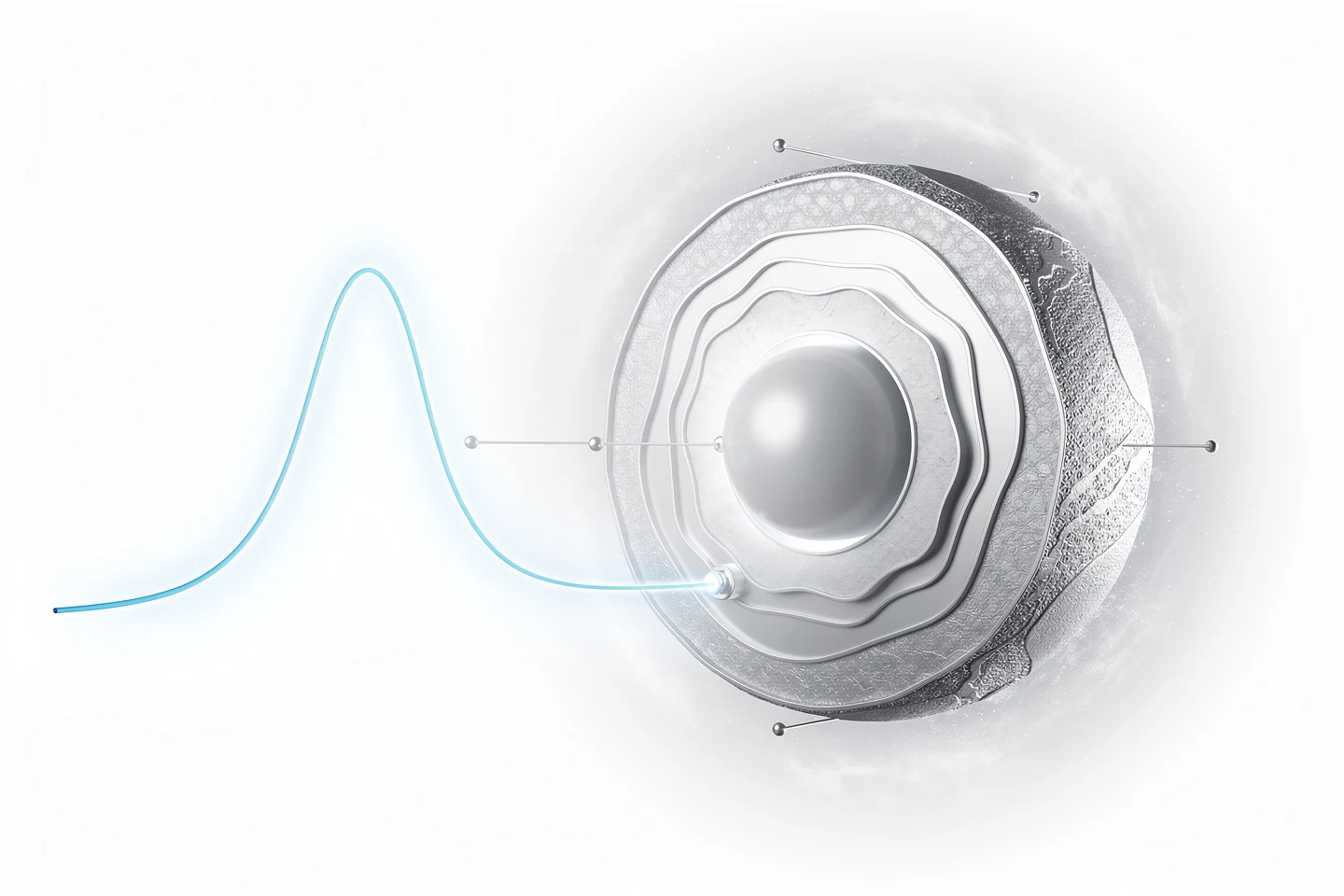
Posterior analysis incorporating NICER data for several millisecond pulsars (PSR J0030+0451, J0740+6620, J0437−4715, and J0614−3329) and the GW170817 merger revealed a nonmonotonic $c_s^2$ profile. The peak reaches 0.68 (+0.14, -0.13) — well above the conformal limit of 1/3, followed by significant softening, with $c_s^2$ returning to ~1/3 at a density of about 30 $n_{sat}$. The trace anomaly Δ ≡ 1/3 − p/ε becomes positive inside the neutron star and approaches the pQCD limit from above. To quantify the transition, an accumulated softening index ς is introduced; its posterior distribution shows that the softening substantially exceeds the maximum achievable in purely hadronic models (≤ 1.01×10⁻³). The maximum mass $M_{TOV}$ = 2.11 (+0.12, -0.09) M☉ is weakly correlated with the height of the $c_s^2$ peak.
Implications
The discovered “peak–softening” structure is not imposed by the model but dictated by thermodynamics: supporting massive neutron stars requires an early stiffening of the EOS, but this also quickly accumulates energy density; to avoid exceeding the pQCD limit, a subsequent softening is necessary. Thus, the nonparametric statistical EOS naturally realizes the thermodynamic profile of a generalized quark-hadron crossover—a smooth transition analogous to the one known at finite temperature. Quark matter above nuclear densities turns out to be soft and nonperturbative, contrasting with hypothetical quark stars that require a stiff EOS.
Future development
Future observations with next-generation gravitational-wave detectors (Einstein Telescope, Cosmic Explorer) and X-ray missions (STROBE-X) will pinpoint the crossover location and probe the behavior of matter at finite temperature. Numerical simulations of neutron star mergers incorporating the quark-hadron transition and the formation of quark-gluon plasma may reveal unique multimessenger signatures—from the gravitational-wave signal to kilonova afterglows.
Impact
The results directly impact the physics of dense matter, the astrophysics of compact objects, and quantum chromodynamics, providing a consistent picture from the nuclear crust to the asymptotic freedom regime.
Next steps
Priority steps: incorporating strange quark mass and color superconductivity effects into the pQCD bounds, and applying the method to new NICER data and LIGO–Virgo–KAGRA merger catalogs.
Key open problems
The study connects fundamental problems: the equation of state of cold dense matter, the nature of deconfinement in QCD, and the origin of the maximum mass of neutron stars, offering a unified framework for their joint analysis.
The knowledge machine's view
This section is addressed to the author of the paper and their colleagues. Neighbouring works were found by meaning-based search across our archive, not by word overlap. We do not review: we show the field around the work.
What the work does
The study constructs a Bayesian ensemble of neutron star equations of state, where the squared speed of sound is parameterized by Gaussian processes and bounded from below by nuclear theory and from above by perturbative QCD. Analysis of NICER and GW170817 data reveals a non-monotonic speed-of-sound profile with a peak around 0.68 and subsequent softening, interpreted as evidence for a smooth crossover from hadronic to quark matter.
Where its strength is
The method recovers the equation of state without rigid assumptions about the phase transition, and the introduced accumulated softening index provides a quantitative measure of deviation from purely hadronic behavior.
Where it could go next
- It might be interesting to compare the obtained speed-of-sound profile with predictions from models where a first-order phase transition is replaced by a crossover, and see how variations in transition parameters affect observable masses and radii.based on: A Star with a Double Heart arXiv:2605.05816
- Nearby lies work on the role of mass in generating magnetic fields in neutron stars; one could check how a non-monotonic equation of state with a speed-of-sound peak affects the conditions for magnetar formation and their observable manifestations.based on: Neutron Star's Sleeping Volcano: How Mass, Not Spin, Gives Birth to Magnetic Monsters arXiv:2607.17556v1
- The archive also contains a study linking the neutron skin thickness of atomic nuclei to the equation of state; it would be useful to check how well your Bayesian ensemble agrees with constraints from laboratory measurements and how this affects the crossover conclusion.based on: How the Thickness of a Neutron Skin Reveals the Heart of Dead Stars arXiv:2604.26876
Worth trying
- Perform a joint analysis by adding constraints on the neutron skin thickness from PREX/CREX experiments to the NICER and GW170817 data, to narrow the allowed region of the equation of state at intermediate densities.
- Use the accumulated softening index to compare with predictions from specific microscopic models (e.g., quark-meson coupling) and assess which ones pass Bayesian selection.
- Calculate the maximum mass distribution for the obtained EOS ensemble and compare with the population of massive pulsars, including recent findings with masses around 2.3 M☉, to test the robustness of the crossover conclusion.
Why this may matter
If the smooth crossover is indeed realized in neutron star interiors, it changes our understanding of the QCD phase diagram at finite density and may explain why no sharp signatures of a phase transition are observed, also impacting the interpretation of future gravitational wave observations from neutron star mergers.
Nearby works in our archive
- Neutrino Pairing Dance in a Dense Gassimilarity 0.68
- A Star with a Double Heartsimilarity 0.67
- Neutron Star's Sleeping Volcano: How Mass, Not Spin, Gives Birth to Magnetic Monsterssimilarity 0.67
- How the Thickness of a Neutron Skin Reveals the Heart of Dead Starssimilarity 0.66
- How Quarks Help Neutron Stars Avoid Collapsingsimilarity 0.65
- Recipe for the Invisible: What Neutron Stars Are Made Ofsimilarity 0.65
The closest work in the archive sits at 0.68 by meaning — the usual level for our corpus.
Original abstract
as written by the authors arXiv:2605.08584v2
We propose a non-parametric approach to construct the statistical equation of state (EOS) continuously from the nuclear crust to the asymptotic-freedom regime. The combined requirement of supporting two-solar-mass neutron stars (NSs) with relatively small radii at low masses and of reaching the asymptotically soft pQCD boundary forces a squared-sound-speed ($$c_s^2$$) peak followed by extended softening, with $$c_s^2$$ returning toward $$1/3$$ near $$\sim\!30\,n_{\rm sat}$$. Correspondingly, the trace anomaly $$\Delta \equiv 1/3 - p/\epsilon$$ becomes positive beyond NS densities and approaches the pQCD limit from above. By quantifying the degree of this softening in the posterior, we find evidence for a hadron-quark transition in the cores of the most massive neutron stars. More importantly, this shows that the thermodynamic structure of a complete crust-to-pQCD statistical EOS naturally realizes a generalized quark-hadron crossover. The quark EOS above NS densities is therefore soft and non-perturbative, in contrast to the stiff quark EOS underlying the quark-star picture.
Although the speed of sound in a neutron star can exceed 1/3 the speed of light, it does not violate causality, and information from the core reaches the surface in fractions of a millisecond.
In Robert Forward’s novel “Dragon’s Egg,” intelligent life is described on the surface of a neutron star, based on nuclear interactions, echoing the idea of exotic states of matter in such objects.
Key numbers
- c_s^2 peak: 0.68 +0.14 -0.13
- Maximum mass M_TOV: 2.11 +0.12 -0.09 M☉
- Crossover density: ~30 n_sat
- pQCD boundary energy: \mu_B = 2.6 \text{ GeV}
- Maximum softening index for hadronic models: ≈ 1.01×10⁻³