Webb Telescope Discovered a Cosmic Dust Mill express
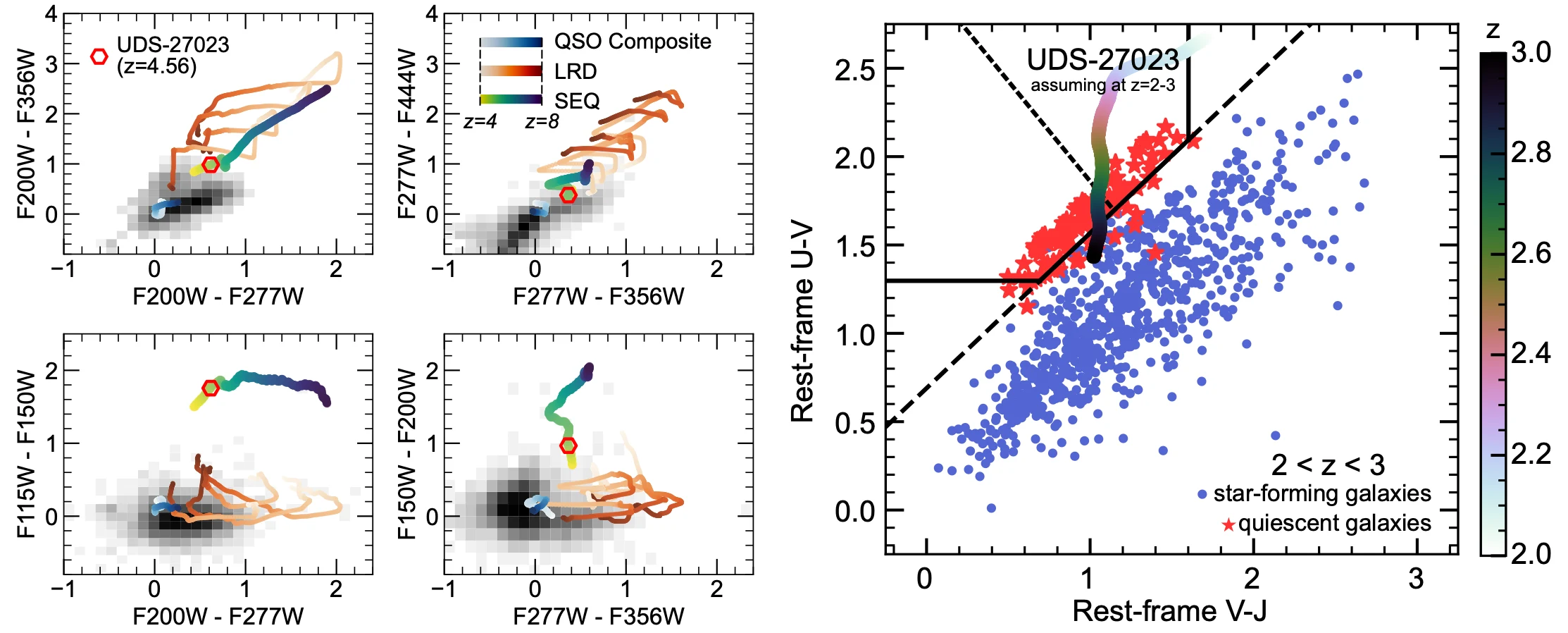
Using the James Webb telescope, astronomers peered into an ancient quasar — the dazzling heart of a galaxy where a giant black hole sucks in matter. It turns out it doesn't just destroy, but also creates: its powerful outflows and shock waves act like a true cosmic mill. They grind cosmic dust particles into the finest powder, just like ordinary sand, but pulverized to microscopic sizes.
And here's an unexpected twist: the telescope didn't spot the characteristic spectral feature that gives away carbon dust — which is almost everywhere. It seems this mill is selective: it only processes silicates, ignoring carbon.
Original abstract
as written by the authors arXiv:2606.02685
The rapid accumulation of massive dust reservoirs in the early Universe remains a major challenge in astrophysics. While core-collapse supernovae can inject large dust grains ($$a \gtrsim 0.1\,\mu{\rm m}$$) on short timescales, explaining the total dust budgets in the early Universe likely requires efficient grain growth in the interstellar medium (ISM). Such growth depends critically on an abundant population of small grains, which maximize the surface area available for accretion and may be generated by rapid dust-processing or dust-formation channels. Here, we report the discovery of a QSO UDS-27023 at $$z=4.556\pm0.003$$, identified using JWST/NIRSpec spectroscopy. By quantitatively comparing the spectra to QSO composite templates, we find that UDS-27023 displays an exceptionally steep far-UV extinction curve ($$A_{1500}/A_V \approx 8$$) but notably lacks the 2175 Angstrom bump, indicating a dominance of small silicate dust grains. We interpret this phenomenology as evidence for active small-grain production and processing in the QSO environment. Mechanical shattering of pre-existing large grains by QSO-driven shocks and outflows provides one natural pathway, while in-situ condensation of silicate grains inside dense QSO-driven winds may offer an additional route. Such a population of steep-extinction QSOs (SEQs) may therefore reveal a short-lived phase in which luminous AGN generate, process, and redistribute small grains, potentially facilitating rapid ISM grain growth and enriching the circumgalactic medium.
The light from this quasar traveled 12.5 billion years to reach the telescope. We see it as it was just 1.3 billion years after the Big Bang.