Quantum Geometry Lurks in the Current Jump express
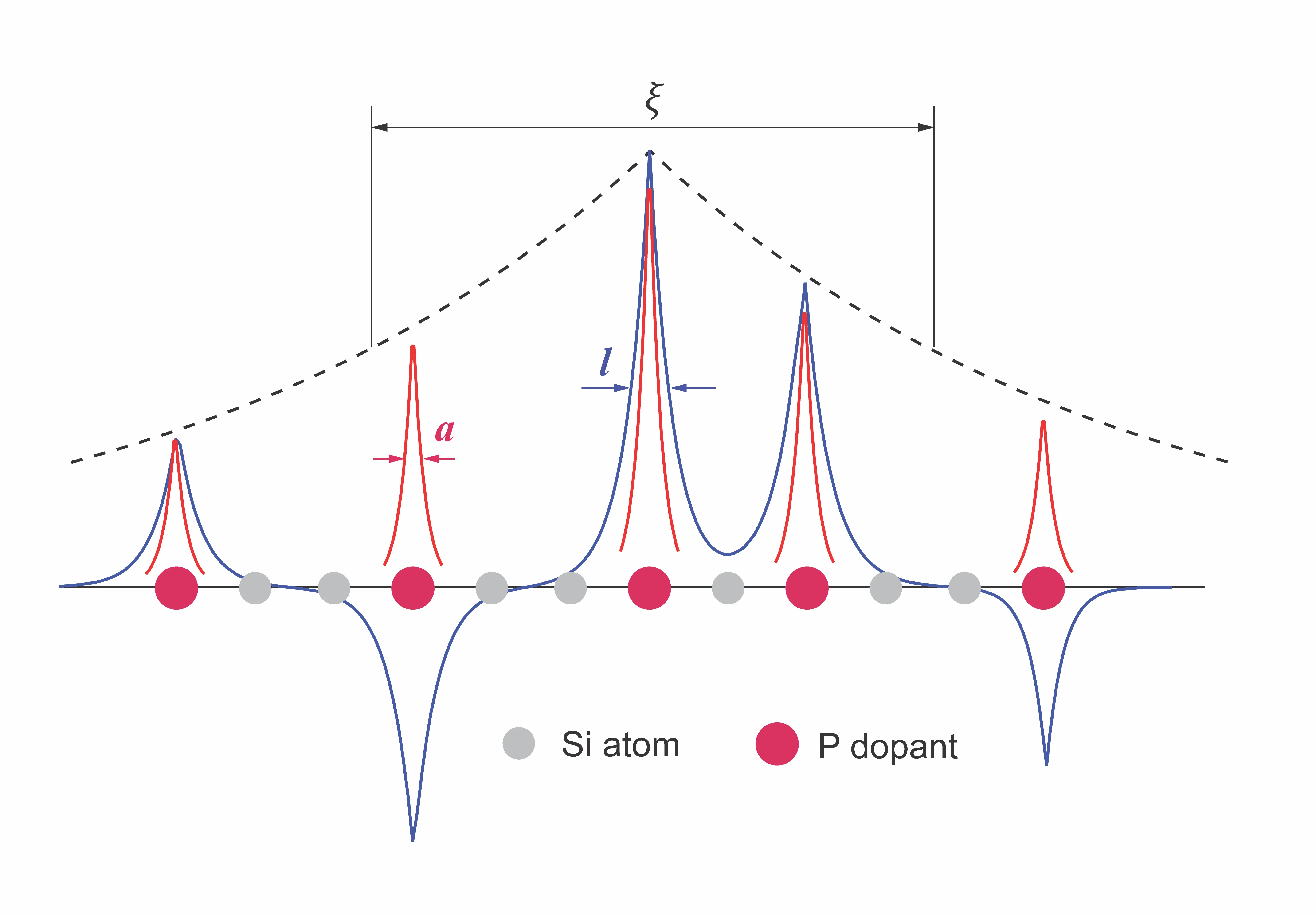
Toss a handful of phosphorus into silicon, and at a certain impurity concentration the material suddenly starts conducting electricity. This is a metal-insulator phase transition, and it happens abruptly. But what exactly changes in the electron wave functions when an insulator becomes a metal? The answer can be extracted from how the material absorbs light.
The authors took the optical conductivity, how strongly an alternating electric field shakes charges, and computed its first negative moment. This quantity, like a sensitive dynamometer, measures quantum geometry: how 'spread out' the local electron wave functions are. The result is a length ℓ — the characteristic size of the region where an electron still remains itself. Away from the transition, when donor phosphorus atoms sit alone, ℓ is almost exactly the Bohr radius. That's about 2 nanometers, like a lone hydrogen atom.
As the impurity concentration approaches the critical value, the length ℓ grows. But instead of increasing smoothly, like the correlation length (the typical distance over which fluctuations decay), it makes a leap: right at the transition point it goes to infinity. This means electron states suddenly delocalize across the entire sample. Such a jump is a consequence of the fact that in the three-dimensional case, the main contribution to the sum comes from ultraviolet (that is, very fast) processes, not slow critical fluctuations. Quantum geometry turns out to be 'nearsighted' to the slow dances of charges near the transition.
This result not only provides a new experimental probe for quantum geometry in disordered systems but also sheds light on the century-old Herzfeld criterion: when the polarizability of atoms (the ability of the electron cloud to deform) reaches a critical value, the material must become a metal. The quantum-geometric correction to the Clausius-Mossotti equation, which describes the dielectric response, makes it more accurate, as if an old recipe finally got its missing spice. It turns out that the 'swelling' of donor polarizability, driven by quantum geometry, leads to the divergence of the dielectric constant, and with it, the birth of a metal.
The Bohr radius is about 0.05 nanometers for hydrogen, but in silicon, due to the large dielectric constant, it swells to several nanometers, so the donor electron is so easy to detach.
In Peter Watts's novel 'Blindsight,' alien creatures use quantum-geometric effects for information processing — here we see how the same principles govern the transformation of an insulator into a metal.