Simple

Black Hole Descendants: The Secret of Rapid Spin

Original: "Smoking-gun evidence for hierarchical black-hole mergers"
arXiv:2607.01121v1 · 2026-07-01 · CC BY · ⏱ 2 min · High Energy Cosmology Galaxies General Relativity
Fast-spinning black holes are the 'children' of past cosmic mergers.
Abstract

Stellar-mass black holes are born when stars collapse, but some later become heavier and spin faster. Scientists analyzed 259 mergers and discovered that the mass of fast-spinning holes exactly matches the merger products of slow ones, like a Lego brick. This means heavy holes are assembled from lighter ones, not just by gathering gas. Could a gravitational ‘assembly line’ of monsters be operating at the centers of galaxies?

Links in the knowledge graph 1

Black holes black holes are places in space with gravity so strong that even light cannot escape. They are born when a massive star explodes as a supernova. But after birth, some holes remain solitary, while others live in dense clusters and can collide, merging into a single more massive one. The big question: how to tell which hole grew on its own and which is the result of a cosmic 'encounter'? The answer came from studying their spin and mass.

When two black holes collide, nearly 5% of the total mass is converted into gravitational waves—ripples in spacetime. This shimmer is caught by detectors on Earth, as if listening to a cosmic orchestra.

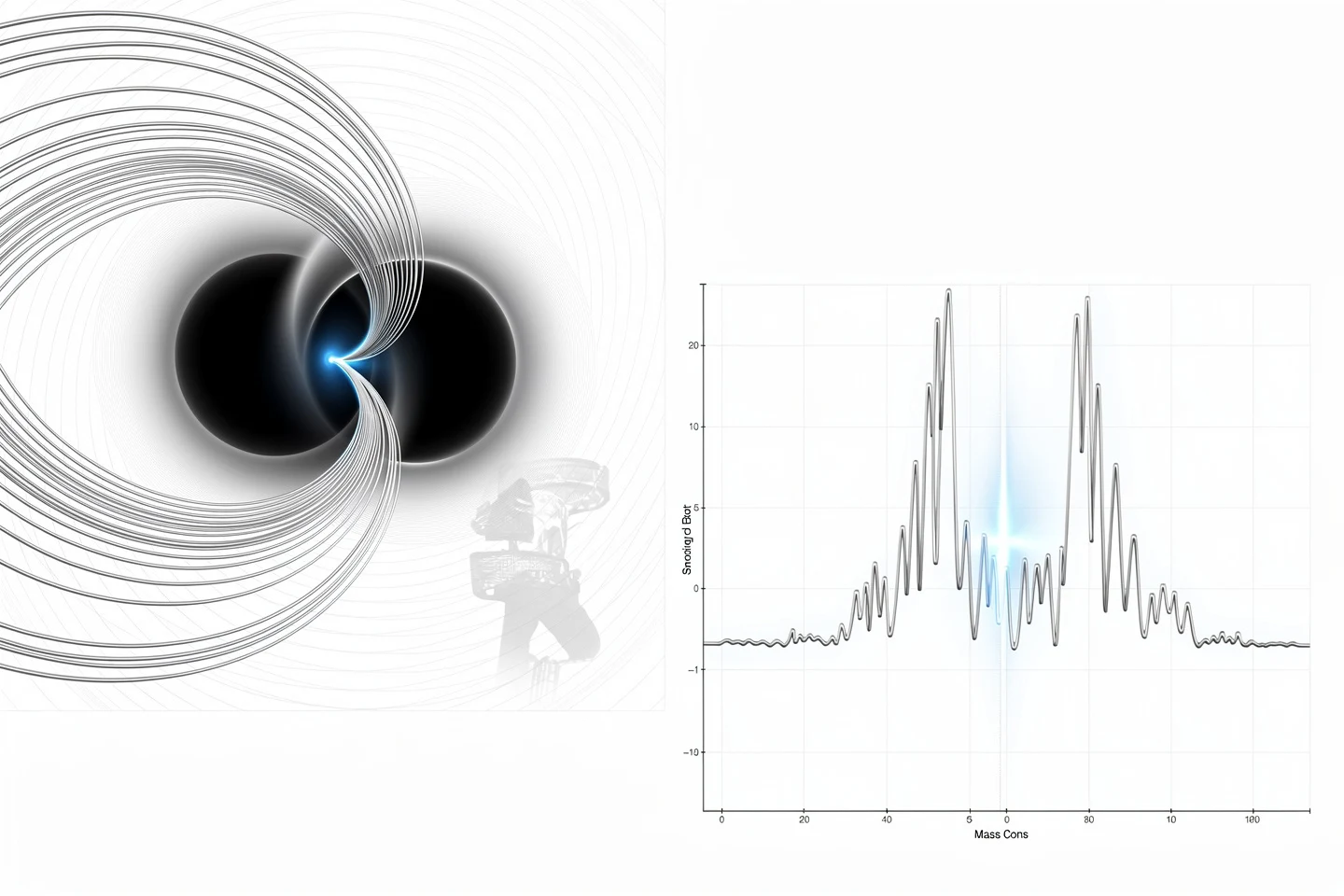
Scientists, among them followers of the ideas of Vera Rubin and Rainer Weiss, used recordings of 259 merger events. They split the black holes into two groups: 'quiet' (slow spin) and 'fast'. And here they found something astonishing. If you take the masses of two quiet holes, add them up, and subtract the 5% energy carried away by gravitational waves, the resulting mass—surprise—lands exactly on the peak of the fast holes' distribution. Moreover, all the bumps and dips of these distributions match perfectly. It's like having a broken plate and finding a shard that fits another piece perfectly—no doubt, they're parts of a whole.

This work also helped refine the rate of a crucial nuclear reaction: the formation of carbon in stars—the very one predicted long ago by Fred Hoyle. Thus, black holes unexpectedly linked astrophysics to the origin of chemical elements in the Universe.

The discovery means that massive fast black holes are the second or even third generation, grown in dense galactic centers. And to explain their properties, there's no longer a need to invoke mysterious dark matter. Now astronomers can confidently build black hole family trees—just like a genealogy chart, only rendered in black.

🎯 The degree of match between distributions reached 95%—it's like finding someone in a crowd with your fingerprint, only in the world of black holes such a match proves kinship.

m_{\text{final}} \approx 0.95(m_1 + m_2)
The mass of the black hole after merger is almost equal to the sum of the masses of the two original holes, minus 5% energy carried away by gravitational waves.
Scientists
Alan GuthAndrei LindeGeorges LemaîtreJames PeeblesAdam RiessBrian Schmidt
Tags
black hole gravitational waves supernova carbon dark matter galaxy big bang
Laws
Friedmann equationsHubble's lawHawking radiationgravitational lensingBekenstein-Hawking entropyEinstein field equations
Original: arXiv:2607.01121v1 · CC BY · bridge42worlds