The Smoking Gun of Hierarchy: Black Holes Betray Their Ancestors ✛ ✎
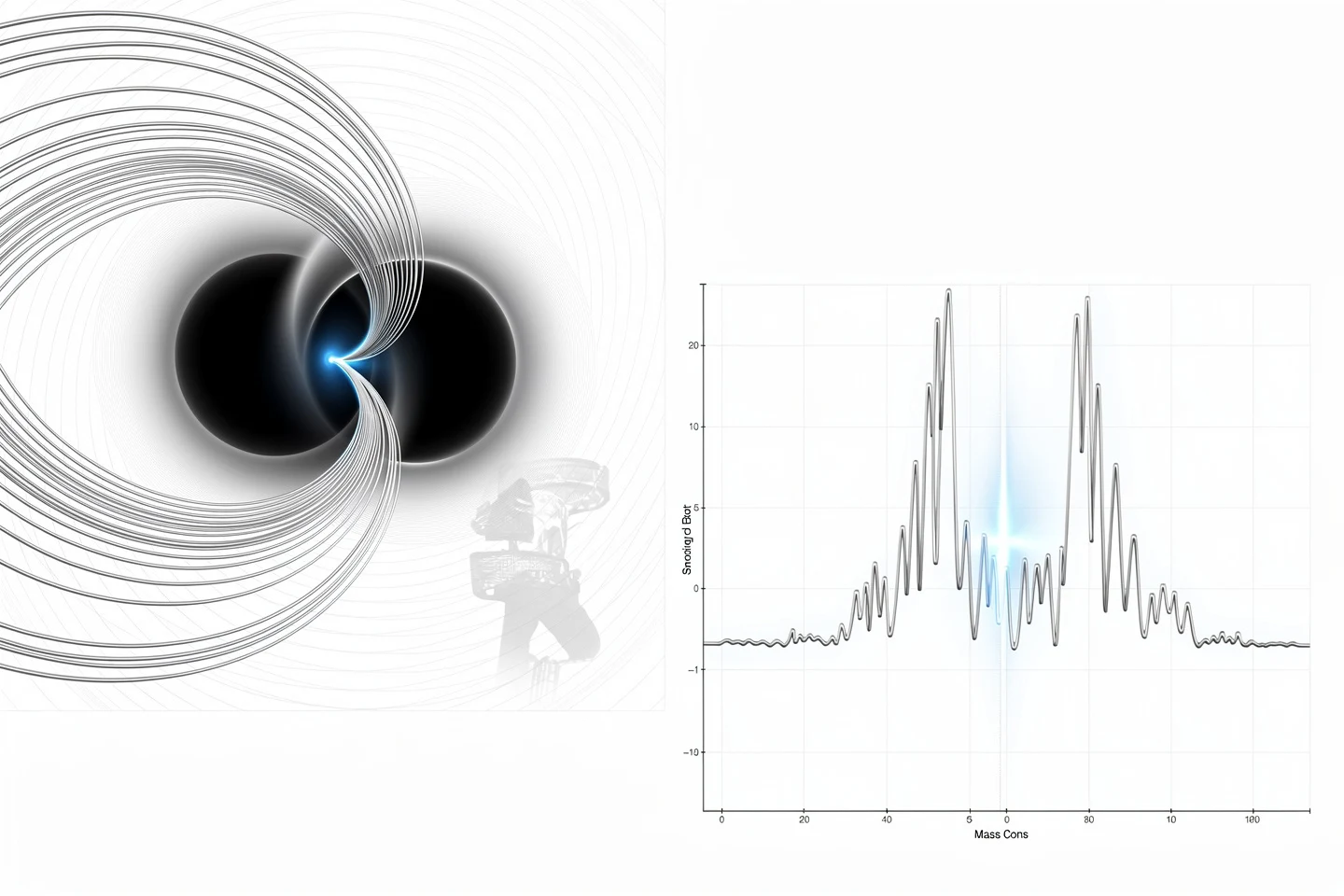
A detective story unfolded in the GWTC-5 catalog. Hundreds of signals from merging black holes, captured by the detectors of Rainer Weiss and his colleagues, held the secret to the origin of the most massive and rapidly spinning stellar-scale objects. For a long time, astrophysicists argued: do such giants build up mass by gobbling gas in binary systems, or are they born in dense galactic clusters through successive mergers, like a snowball? The answer came from an unexpected place — the analysis of the mass imprints left by these scenarios.
Imagine: an investigator finds two sets of footprints in the sand. One set was left by a group of passersby walking with a lazy gait — these are the ‘slow’, low-spin black holes formed from isolated stars. The second pattern is more complex: its authors moved quickly and carried extra weight — these are the ‘fast’, high-spin giants. The detective suspects that the second group are none other than the first, who have joined hands. He tests this: he superimposes the footprint maps and sees a perfect match of the profiles. That’s exactly what the authors of the study did, using a flexible Bayesian model with two subpopulations. For each, they constructed distributions of masses, spins, and merger rates, and then asked the question: if the low-spin objects are indeed the progenitors, what should the mass of their offspring look like after merging? Applying the simple rule $m_{\text{final}} \approx 0.95(m_1+m_2)$, they calculated the expected distribution of remnant masses — and found that it mirrors the actual spectrum of the high-spin subpopulation with mirror-like precision in the range from 20 to 80 solar masses.
This discovery is more than just proof of hierarchy. The low-spin subpopulation, acting as a pure ‘stellar’ ruler, allowed the detection of a mass cutoff at ~54 solar masses — a telltale sign of a pair-instability supernova. Nuclear astrophysicists have been searching for decades for the rate of the reaction 12C(α,γ)16O, which determines how much carbon and oxygen remains in the Universe after the lives of massive stars. The fine-tuning of this reaction, once predicted by Fred Hoyle, is now directly measured by gravitational waves: $S_{300\,\text{keV}} = 151^{+30}_{-26}$ keV·b. Moreover, the analysis completely swept away the hypothetical primordial black holes, born in the furnace of the Big Bang and considered as dark matter candidates since the time of Vera Rubin. All observed mergers are explained by stellar evolution.
The next generation of detectors — the Einstein Telescope, the space-based LISA observatory — will turn this detective work into a full-fledged generational census. We will see not only the ‘children’ from the first merger, but also the ‘grandchildren’, and possibly great-great-grandchildren, whose masses will exceed a hundred solar masses, marking the seeds of intermediate-mass black holes. At the same time, refining the position of the mass cutoff will narrow down the S-factor to laboratory precision, uniting gravitational-wave astronomy and thermonuclear reaction physics into a single research framework. Thus, the cosmos itself tells us the story of its structure — we just need to properly hear it out.
The Bhattacharyya coefficient, commonly used in signal processing to compare contours, reached 0.95 here — an unexpected coincidence not seen in astrophysics since the discovery of pulsars.