Simple

Dusty Cradle of Stars: What James Webb Saw

Original: "MICONIC: The spatial relationship between star formation and the AGN in Centaurus A revealed by JWST/MIRI"
arXiv:2607.04942v1 · 2026-07-06 · CC BY · ⏱ 1 min · Galaxies Stellar
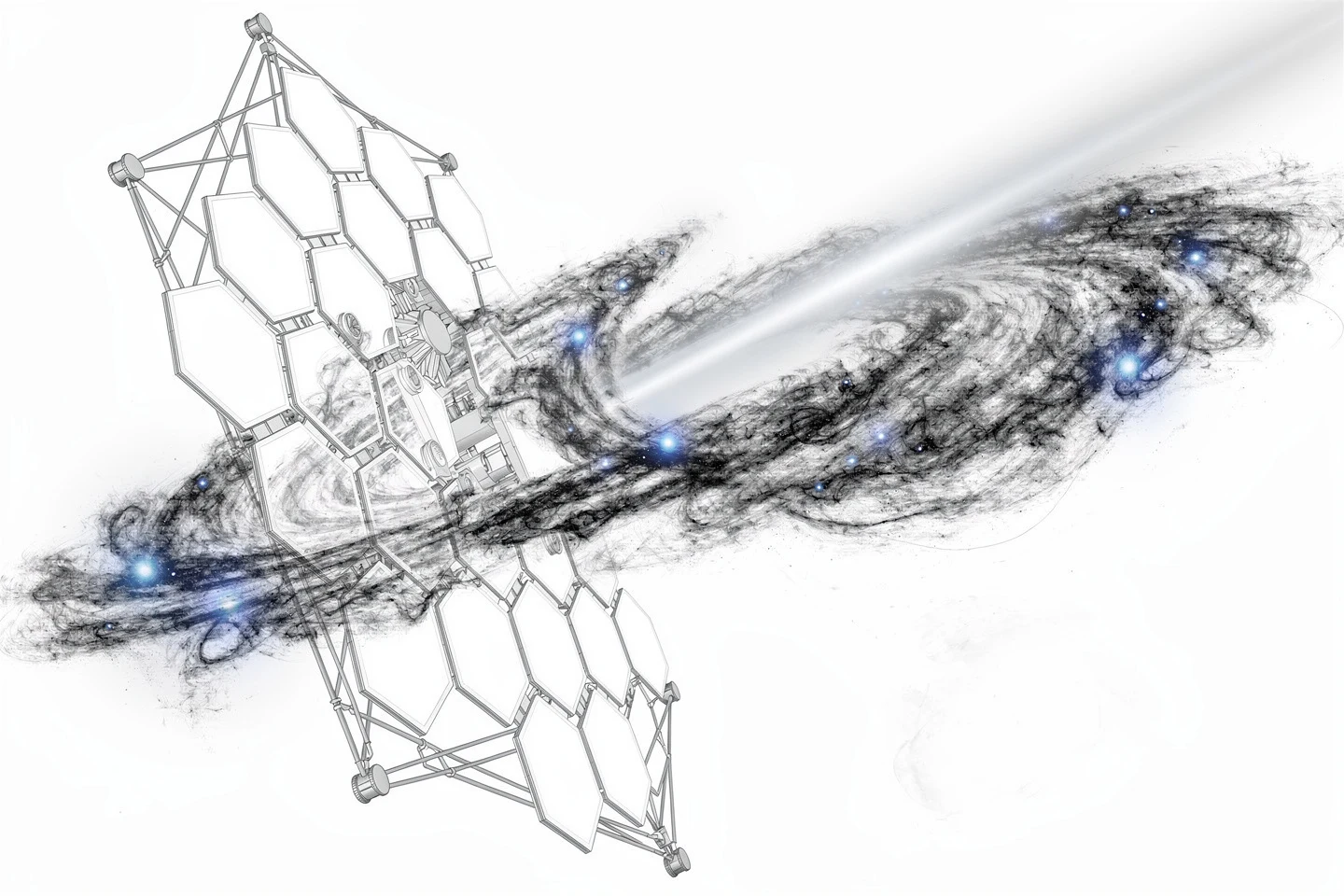
The James Webb Space Telescope has spotted nearly a thousand newborn stars in the dusty disk of the Centaurus A galaxy.
Abstract

Using the James Webb Space Telescope, scientists peeked into the center of galaxy Centaurus A. There, in a warped disk of dust, they discovered hundreds of young stars, like in a cosmic nursery. These stars were born from gas brought by a collision of galaxies, not from the central black hole's activity. Could it be that black holes don't always hinder star birth?

Links in the knowledge graph 1

Edwin Hubble once classified galaxies into types and believed that elliptical ones don't give birth to stars. But Centaurus A, with its huge black hole at the center and a dense dusty disk, breaks that rule. Using James Webb, astronomers peered into the heart of this veil for the first time. It's like using a thermal camera to spot a person radiating heat through thick fog: dust scatters regular light, but infrared rays pass through almost unimpeded.

Centaurus A's jet is so enormous that if our eyes could see radio waves, it would cover an area in the sky the size of the full Moon.

Inside the disk, the camera detected 928 reddish sources — young stars still wrapped in warm dust. They cluster along the warped disk, but have no connection to the black hole's jet; meaning their birth is fueled by gas brought in by an ancient galaxy merger. The dust here is rich in carbon and hydrogen compounds, which glow in infrared. As Vera Rubin showed, galaxies are immersed in clouds of invisible dark matter, and it's in these cold halos that gas accumulates for future stars. The exact chemical makeup of this cradle still needs to be studied using spectroscopy — a method that breaks light into colors.

Over time, the most massive of these stars will explode as supernovae, enriching the interstellar medium with heavy elements from which planets and even life could form.

🎯 Centaurus A is the closest radio galaxy to us, and its radio jet extends for hundreds of thousands of light-years, covering an area in the sky the size of the full Moon.

\alpha = \frac{d \log(\lambda F_\lambda)}{d \log \lambda}
Infrared spectral slope indicator: the larger α, the more the flux increases with wavelength, typical of warm dust emission around a young star.
M_J \propto \frac{T^{3/2}}{\rho^{1/2}}
Jeans mass: the threshold mass of a gas cloud at which gravity overcomes thermal pressure and collapse begins. A cold, dense cloud compresses more easily, giving birth to a star.
Scientists
Christian DopplerD. B. McLaughlinDidier QuelozMichel MayorR. A. RossiterStephen Hawking
Tags
galaxy JWST black hole carbon hydrogen dark matter spectroscopy supernova
Laws
Doppler effectHawking radiationgravitational lensingBekenstein-Hawking entropyCoulomb's lawEinstein field equations
Original: arXiv:2607.04942v1 · CC BY · bridge42worlds