Stellar Nurseries in the Jet's Shadow: JWST Explores Centaurus A ✛ ✎
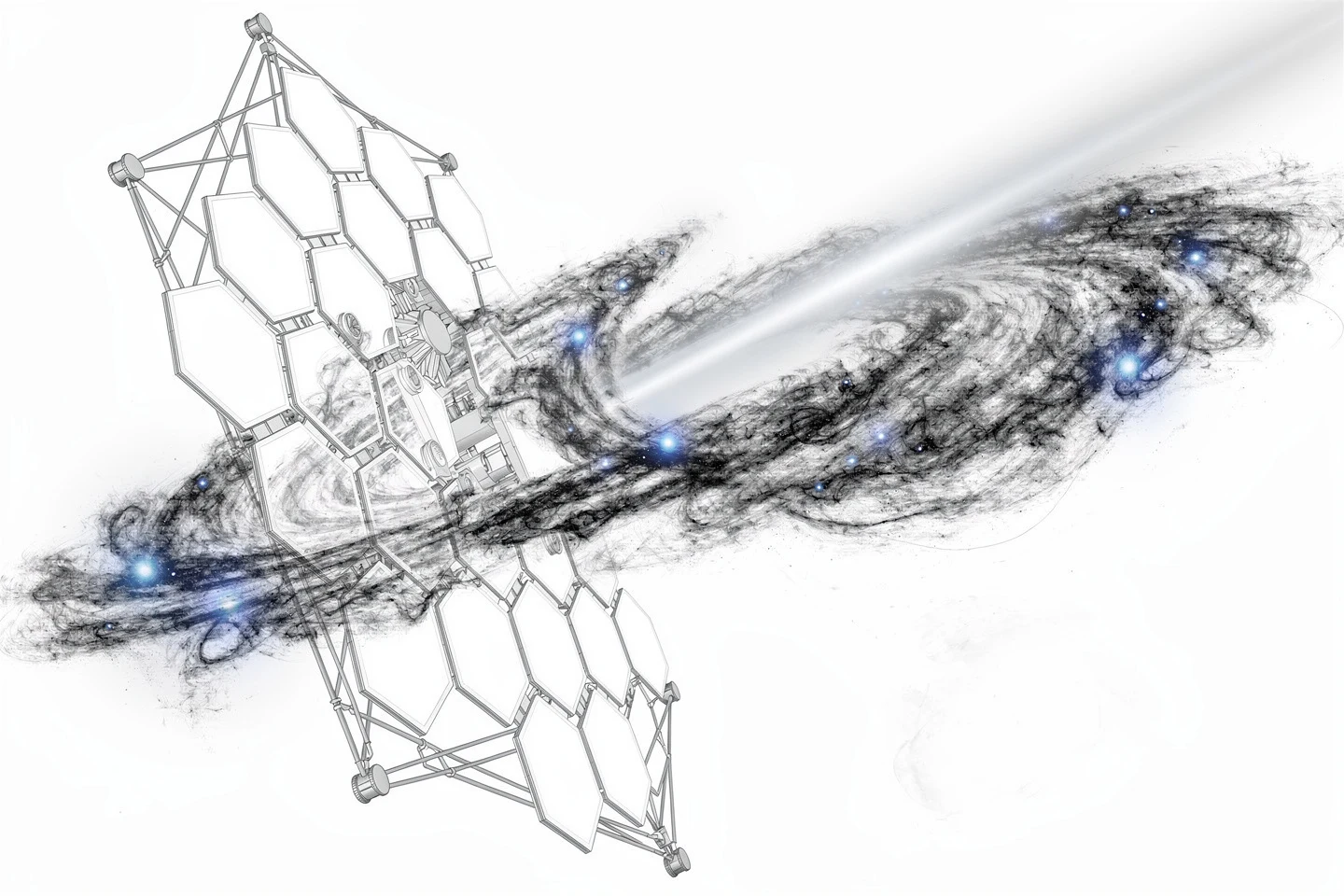
The cosmic spectacle unfolds on the stage of Galaxy галактики Centaurus A. In the lead role: a supermassive black hole with a powerful jet that pierces space for hundreds of thousands of light-years. But look away from the dazzling core and peer behind the scenes — at the warped dusty disk — and a quiet, diligent work reveals itself: the birth of new stars. Right there, in dense regions hidden from prying eyes, the JWST telescope glimpsed 928 young stars that haven't yet shed their dusty swaddling clothes.
To peek behind the curtain, it took a unique tool — the MIRI camera on JWST, capable of piercing dusty veils in the thermal infrared. Much like a stage spotlight picks actors out of the darkness, three filters — F560W, F770W, and F1130W — plucked 58 thousand sources from the murk, and nearly a thousand of them showed a telltale red blush: an excess of radiation at wavelengths 5–11 microns. This blush is a sure sign of dusty cocoons heated to hundreds of degrees by young stars. In color-color diagrams, these objects lined up in a distinct sequence, like notes on a musical staff, sharply contrasting with the ordinary stellar population. Their spectral slope \(\alpha = \frac{d \log(\lambda F_\lambda)}{d \log\lambda}\) averaged 3.55 — as if a candle flame became dozens of times brighter if you just squinted with an infrared eye.
The picture turned out strikingly clear: all 928 'ruddy' sources huddled exactly in the warped disk, like spectators in the orchestra pit, echoing its filamentary structure. The scatter perpendicular to the disk plane is just 0.38 kiloparsecs, half that of normal stars. Meanwhile, no connection with the powerful radio jet was found — this completely upends previous ideas. While in Centaurus A's outer halo the jet does serve as a trigger for star formation by compressing gas clouds, near the nucleus the main director is the disk's own gravitational instability, fueled by gas brought in by a galactic merger two billion years ago. The active core, in essence, is merely a disinterested bystander to this hidden process.
This discovery isn't just a census of newborns. It changes the fundamental picture of how galaxies live. We've grown used to thinking that supermassive black holes, with their radiation and jets, blow gas away, quenching star formation. Centaurus A shows that even with an active nucleus, stellar nurseries can secretly thrive in dusty hideouts. This dichotomy — public suppression and underground production — may be universal for many galaxies at certain evolutionary stages. Massive stars born in the disk will, in a few million years, explode as supernova, scattering freshly synthesized heavy elements — carbon, hydrogen, oxygen — into the interstellar medium, laying the groundwork for new generations. Moreover, perhaps inside such disks lie the keys to the nature of dark matter — that invisible substance hinted at by Vera Rubin.
What's next? JWST has only just begun its hunt for such hidden populations. Spectroscopy with MIRI/MRS will measure the chemical composition and velocities of the gas in the cocoons, confirming their youthful nature with spectral-line precision. Future telescopes like Nancy Grace Roman will add near-infrared coverage to estimate stellar masses, while the ALMA radio interferometer will map cold molecular hydrogen — the fuel of this quiet star formation. Eventually, we'll be able to not only count stellar embryos but also construct a full evolutionary epic: from the infall of intergalactic gas to the flashes of сверхновых. And then perhaps we'll understand why спектроскопия of distant galaxies sometimes reveals chemical anomalies, as if hinting that somewhere out there, in the dusty wings, invisible life is also bustling. Even Edwin Hubble considered elliptical galaxies to be quiet stellar graveyards, but Centaurus A has challenged that classification — and keeps surprising us.
Centaurus A is the closest radio galaxy to us: a mere 3.8 megaparsecs away. If the human eye could see radio waves, its giant jets would outshine the full Moon in the sky.