Stellar Nurseries in the Shadow of an Active Nucleus: JWST Peers into Centaurus A ✛ ✎
Context
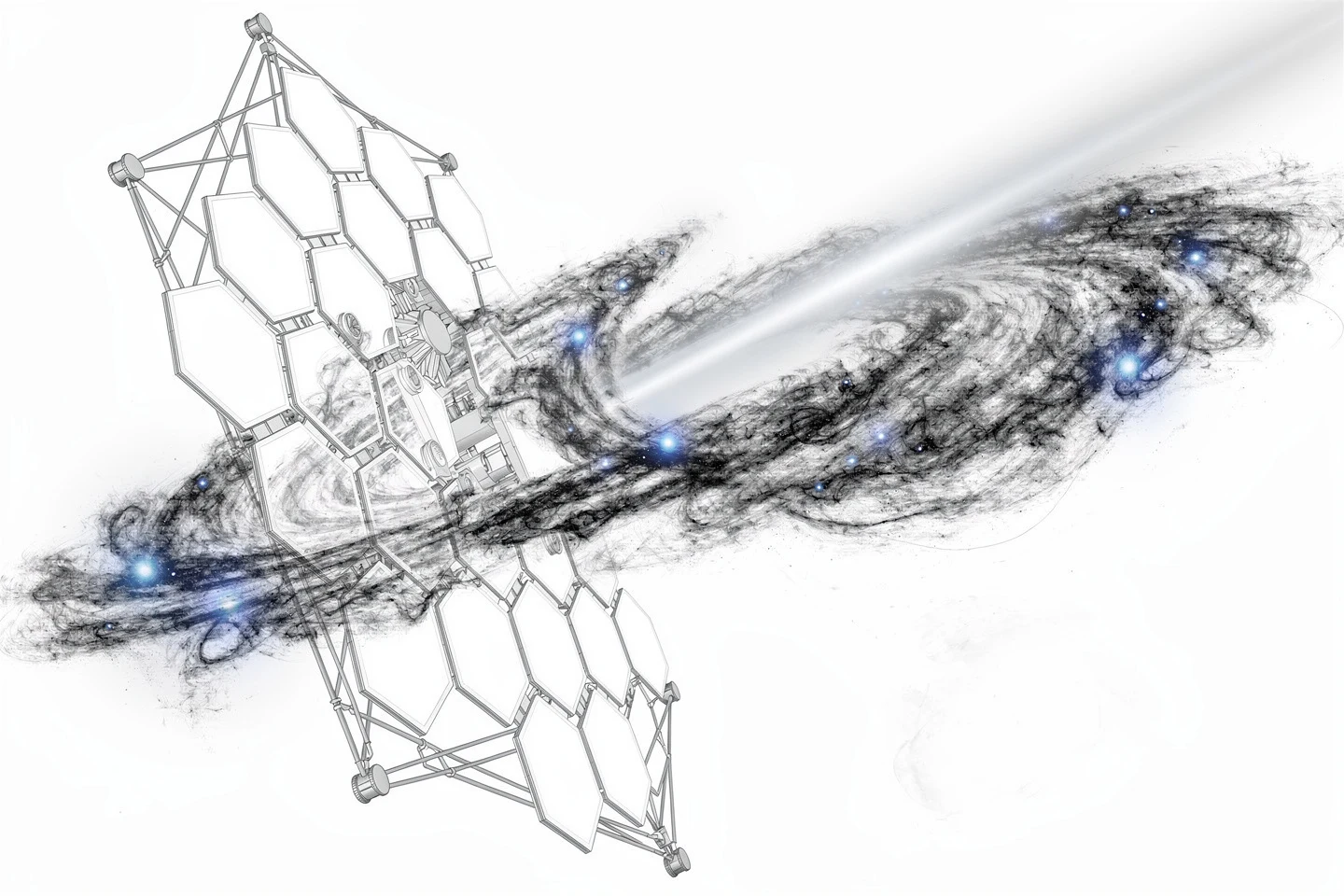
Centaurus A, located 3.8 Mpc away, is a unique laboratory for studying the interplay between an active nucleus and the interstellar medium. This giant elliptical galaxy harbors an active nucleus powered by a supermassive black hole, and a vast dusty disk formed by a merger with a gas-rich disk galaxy about 2 billion years ago. As early as Edwin Hubble showed, elliptical galaxies are usually gas-poor and don't form stars, but Cen A defies this classification. Understanding what drives star formation in such systems—large-scale gas inflows from mergers or local compression of the medium by jets from the active nucleus—remains a key challenge in extragalactic astrophysics.
Methods
Observations were made with the MIRI camera aboard the James Webb Space Telescope in the F560W, F770W, and F1130W filters, covering wavelengths from 5.6 to 11.3 μm. A mosaic totaling ~6.9 square arcminutes covered the central region of about 4×2 kpc. Source detection and photometry used the starbugii package, optimized for complex diffuse background. To isolate stars with dust shells, strict color criteria were applied: sources were considered “red” if F560W–F770W > 1.4 mag and F560W–F1130W > 1.8 mag.
Results
The final catalog contains 58,445 sources, of which 2,558 have photometric errors less than 0.1 mag in all three filters. Among these high-quality objects, 928 (36%) show strong infrared excess and form a distinct sequence on color diagrams. Their spectral energy distributions rise steeply toward longer wavelengths: the median slope α = 3.55 between 5.6 and 11.3 μm, typical of warm dust emission at hundreds of kelvins. Spatially, these sources clearly outline the warped dusty disk, concentrating in its filamentary structures: the dispersion perpendicular to the disk is only 0.38 kpc versus 0.63 kpc for ordinary stars. The images show loop-like dust shells, brightest in the F1130W filter, which captures emission from polycyclic aromatic hydrocarbons containing carbon and hydrogen. Unlike the outer halo of Cen A, where young stars are associated with the radio jet, no correlation with the jet is seen in the central disk.
Implications
The results indicate that star formation in the central region of Cen A is fueled by gas brought in during the merger, and only weakly depends on feedback from the active nucleus. This contrasts with the outer regions, where the jet does trigger star birth. Thus, different triggering mechanisms can coexist in a single system, depending on local conditions. Moreover, the detection of a population of embedded young objects confirms that even in the presence of a powerful active nucleus, dusty disks can retain the ability to form stars, which is important for understanding the evolution of galaxies surrounded by dark halos of cold dark matter, as pointed out by Vera Rubin. Massive stars in the disk will eventually explode as supernovae, enriching the interstellar medium with heavy elements.
Future development
Further progress will come with spectroscopy, including using the MIRI/MRS mode on JWST, which will probe the physical conditions in gas and dust. Future near-infrared observations, for example with the Nancy Grace Roman Space Telescope, are expected to help estimate masses and ages of these objects, while millimeter interferometry (ALMA) will map the cold molecular gas fueling star formation. These data will build a complete picture of stellar life cycles in extreme active nucleus environments and may explain why spectroscopy reveals unexpected chemical anomalies in some galaxies.
Impact
The results will impact several fields: galaxy evolution, active nucleus physics, interstellar medium chemistry, and feedback theory. They are also important for interpreting observations of distant galaxies, where similar processes may be hidden by insufficient resolution.
Next steps
Immediate next steps include obtaining high-resolution spectra for a sample of “red” sources to confirm their nature and measure accretion rates. In parallel, numerical simulations of jet-disk interaction from parsec to kiloparsec scales are needed.
Key open problems
This work directly addresses the problem of regulating star formation in active galaxies: to what extent can an active nucleus suppress or stimulate star formation on galactic scales? The data confirm that on scales of several kiloparsecs, the main driver is gravitational instability of the gas, not jet energetics.
The knowledge machine's view
This section is addressed to the author of the paper and their colleagues. Neighbouring works were found by meaning-based search across our archive, not by word overlap. We do not review: we show the field around the work.
What the work does
The study uses JWST/MIRI observations in three filters to probe the central region of Centaurus A, identifying 928 sources with infrared excess associated with the dust disk. The authors show that star formation in the central disk is linked to gas brought in by the merger, not to nuclear activity, unlike in the outer regions where the jet triggers star birth.
Where its strength is
A convincing separation of star formation mechanisms within a single galaxy based on spatial distribution and color criteria, backed by high-quality JWST data.
Where it could go next
- It might be interesting to compare the identified star-forming regions with maps obtained via computer vision techniques for the Fireworks galaxy, to see how well automated algorithms pick out similar structures in the complex environment of an active nucleus.based on: Contour Map of Stellar Nurseries: Computer Vision Finds Clusters in the Fireworks Galaxy arXiv:2607.26330v1
- Related work discusses how massive black holes can clear gas from galaxy centers; it may be worth considering how feedback from Cen A's active nucleus could have shaped the gas distribution in the past and how that aligns with the observed picture.based on: Two massive black holes swept clean the center of a galaxy arXiv:2603.10104
Worth trying
- Apply machine learning methods to identify dusty envelopes and young stellar objects, similar to those used in the work on the Fireworks galaxy.
- Check for evidence of past gas clearing in the central region using kinematic and dust distribution data.
- Cross-match the source catalog with observations at other wavelengths (e.g., ALMA) to confirm the nature of embedded objects.
Why this may matter
Disentangling the contributions of mergers and nuclear activity to star formation is important for understanding galaxy evolution, especially in the context of feedback from supermassive black holes.
Nearby works in our archive
- Two massive black holes swept clean the center of a galaxysimilarity 0.64
- A Cradle Carved by Lightsimilarity 0.64
- Bubbles in Cosmic Foam: A New Look at the Breathing of Starssimilarity 0.62
- Tiny Black Holes Build Giantssimilarity 0.62
- Where Dwarfs Ignite Starssimilarity 0.61
- Black Hole Wind Clears the Galactic Centersimilarity 0.60
- Contour Map of Stellar Nurseries: Computer Vision Finds Clusters in the Fireworks Galaxysimilarity 0.60
The closest work in the archive sits at 0.64 by meaning — the usual level for our corpus.
Centaurus A is the nearest radio galaxy to us (only 3.8 megaparsecs), and its jet extends for hundreds of kiloparsecs, making it one of the most spectacular extragalactic radio sources in the sky. By the way, if our eyes were sensitive to radio waves, Centaurus A would span an area in the sky comparable to the full Moon!
Key numbers
- distance: 3.8 Mpc
- red_sources_count: 928
- percentage_IR_excess: 36%
- disc_extent: 4 × 2 kpc
- median_spectral_slope: 3.55