The Hidden Geometry of an Electron-Hole Sandwich express
Take two thin sheets of a semiconductor. One is saturated with free electrons, like a packed café where every table is taken. The other, by contrast, is full of empty spots—'holes' eager to be filled. When these sheets are brought close together, a spark of attraction jumps between them: electrons and holes begin to feel each other across the thin gap. They form pairs — excitons (bound states of an electron and a hole)—and these pairs, like dancers moving in a shared rhythm, merge into a single quantum state called an exciton condensate.
For a long time, it was thought that if each layer on its own lacks any special 'twist' (trivial quantum geometry), then the condensate would be simple too. The authors of the new work showed the opposite. It turns out that the very act of pairing electrons and holes gives birth to a hidden geometry — the so-called Berry phase (the phase accumulated by the wavefunction when moving around in momentum space). This geometry is invisible in the individual layers, but it shows up when the condensate is subjected to an alternating electric field.
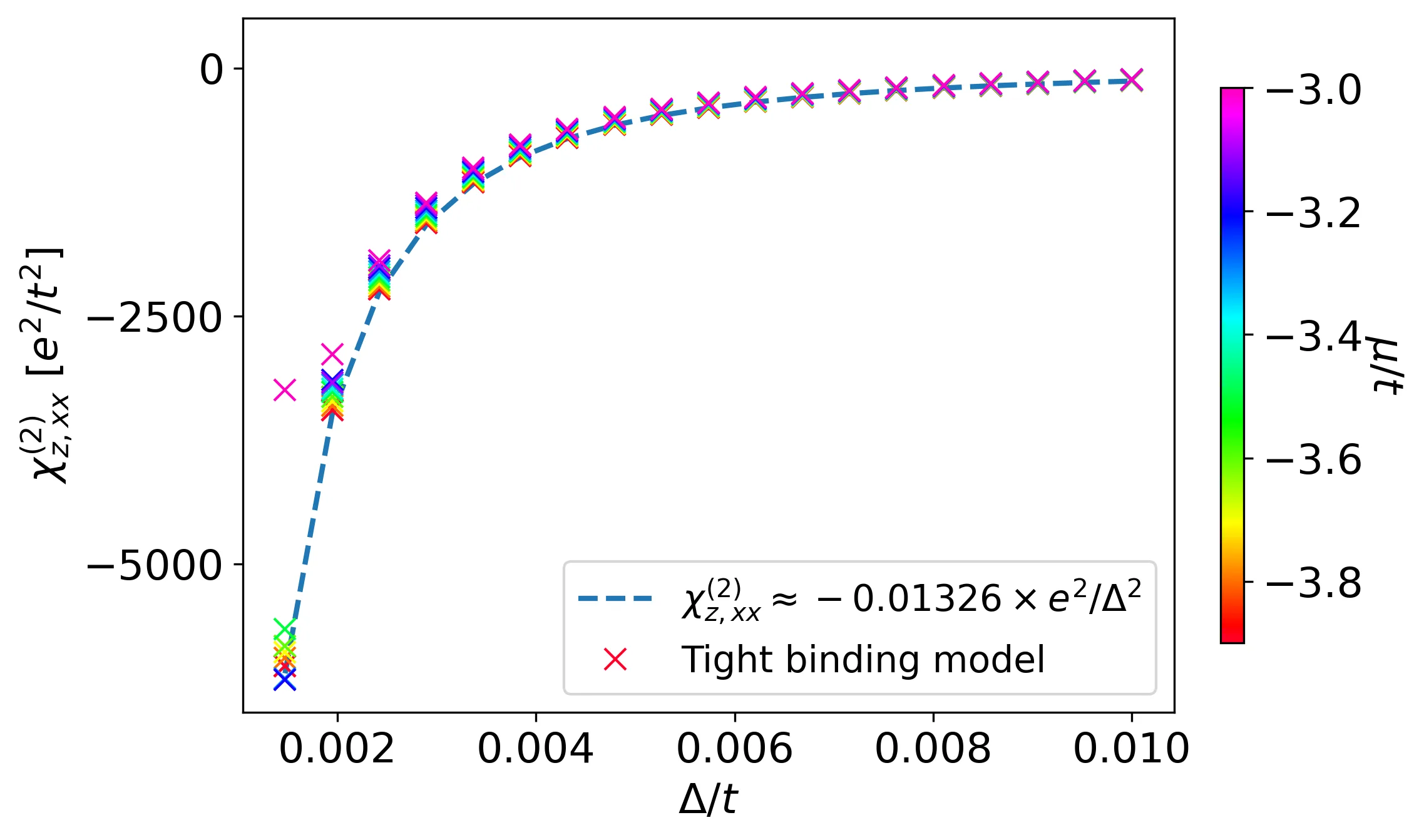
The effect resembles an unexpected mechanical response: you pull the two-layer sandwich horizontally, and it suddenly starts shifting up and down. That is exactly the kind of surprise, polarization in the perpendicular direction, that the calculations revealed. Moreover, the strength of this shift turned out to be inversely proportional to the square of the condensate order parameter: the weaker the condensate, the stronger the effect. It's like a lever where a tiny force at one end produces a powerful push at the other.
This hidden Berry phase effect, born from electron-hole correlations, turns the two-dimensional condensate into a playground for rich nonlinear physics. Here, high harmonics, parametric amplification, and other phenomena, previously sought in complex crystals, can emerge. And now, in a simple sandwich of two doped layers.
The exciton condensate was predicted back in the 1960s, but for a long time it was only sought at ultra-low temperatures. In the 2000s, it was achieved in double quantum wells at temperatures above 1 K, and later even at room temperature in thin films.
In Greg Egan's novel 'The City of Permutations,' quantum condensates are used to create computational environments where information is processed through collective states of particles.