Cloud-9: A Clean Dark Matter Detector express
The five-hundred-meter FAST radio telescope picked up a signal at the 21-centimeter wavelength — the telltale glow of cold hydrogen. The signal came from a cloud named Cloud-9. It hangs in space near the galaxy M94, but it contains not a single star. This is not just a cosmic dust cloud of gas: it is a relic hydrogen blob, preserved from the time when the universe had just cooled after its fiery youth.
Clouds like Cloud-9 are called RELHICs—"reionization-limited hydrogen clouds." Stars never ignited in them, leaving the gas almost pristine. Ordinary galaxies are noisy places: stars explode, black holes spew matter. Here, it's quiet. Only dark matter holds the hydrogen together in a cloud shape through its gravity. So Cloud-9 is the perfect place to "weigh" dark matter and understand how it behaves.
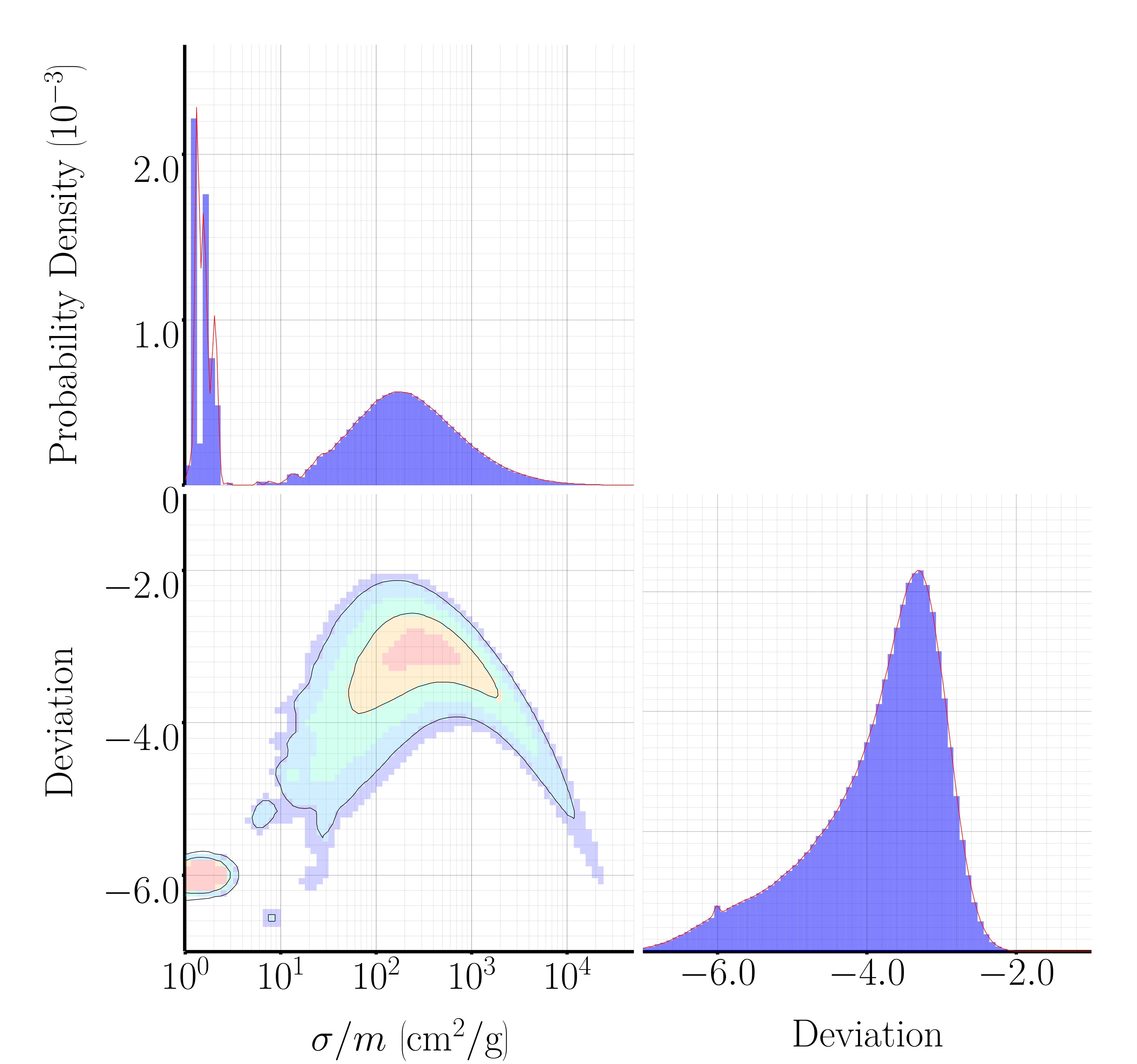
Scientists fitted Cloud-9 against the two main dark matter models. In the standard cold dark matter (CDM) model, particles rarely collide, and the density of the halo, the invisible scaffold of dark matter, rises sharply toward the center, creating a "cusp." In the second model, self-interacting dark matter (SIDM), particles sometimes collide and "smooth out" the center, making it flatter. It turns out that the hydrogen density profile in Cloud-9 can be explained by both models, but with some strain. For the standard model, the required halo deviates from the usual mass-concentration relation by 7 sigma — a lot. For the self-interacting model, the deviation is only about 3 sigma — much closer to expectations. In other words, if dark matter can interact with itself, Cloud-9 is easier to explain.
This conclusion was backed by computer simulations. In the Concerto simulations, where dark matter "feels" collision speeds, analogs of Cloud-9 were found. They confirmed that RELHICs are not just cosmic curiosities but real laboratories for testing dark matter properties. Astronomers now have a new tool to peer into the dark sector of the universe, without the distracting glare of stars.
Original abstract
as written by the authors arXiv:2608.04362v1
Recently, the Five-hundred-meter Aperture Spherical Telescope discovered a gas-rich hydrogen cloud near M94 in the $$21\,{\rm cm}$$ band. Lacking an optical counterpart, this object, dubbed Cloud-9, has been identified as a compelling Reionization Limited \textsc{Hi} Cloud (RELHIC). RELHICs provide exceptionally clean laboratories for probing dark matter, free from the baryonic complexities associated with star formation and feedback. We show that the observed hydrogen column density profile of Cloud-9 is consistent with a gas cloud embedded in either a cuspy halo predicted by the standard cold dark matter (CDM) model or a cored halo produced by self-interacting dark matter (SIDM). In both cases, the halo must have an unusually diffuse central density. The best-fitting CDM halo lies around $$7\sigma$$ below the cosmological concentration--mass relation, whereas SIDM core-forming halos reduce the tension to only around $$3\sigma$$. We further identify Cloud-9 analogs in the Concerto suite of cosmological zoom-in simulations with velocity-dependent SIDM, demonstrating that RELHICs provide a promising new probe of dark matter self-interactions.
Cloud-9 is so tenuous that its density is billions of times lower than the air we breathe. Yet, because of its enormous size, its mass rivals that of a small galaxy.