A Chip-Sized Spectrometer Captures Invisible Light express
The orchestra plays, but the conductor hears only a general hum. Each instrument plays its own part, but you can't tell where the flute is and where the double bass is. You need a spectrum analyzer — a device that breaks down sound by frequency. In astronomy, the same problem exists: cold interstellar dust and gas emit at millimeter and submillimeter wavelengths, and to understand their composition and motion, you need to split that light into a spectrum.
The new instrument, SWISS, is such an analyzer, but for light. It looks like a tiny maze carved into a stack of silicon wafers. Light enters an antenna that splits it into two polarizations (two directions of wave oscillation), then passes through a series of tiny resonant cavities. Each cavity is tuned to its own frequency, like a guitar string to its note. When light matches the cavity's frequency, it lingers and is transferred to a sensitive detector, so spectroscopy becomes precise and compact.
The key trick is in the stacking. Usually, such filters are arranged in a single plane, making the device as wide as a pancake. Here, the filters are turned perpendicular, and the output signal is bent in a smooth curve, so engineers packed the maximum number of channels into a minimal volume. The whole structure is assembled from silicon wafers, etched with deep reactive ion etching (like burning a pattern with a laser, but at the atomic level) and coated with metal. A prototype is already being tested, including an antenna transition without mechanical contact — light jumps from the antenna into the waveguide through a metamaterial, as if over an invisible bridge.
Such a spectrometer can be mounted on a space telescope or in a network of ground-based antennas. It will help see how stars are born in dense clouds of cosmic dust, and how galaxies move on the outskirts of the expanding universe. The cosmic orchestra will finally play by the notes.
Original abstract
as written by the authors arXiv:2608.05129v1
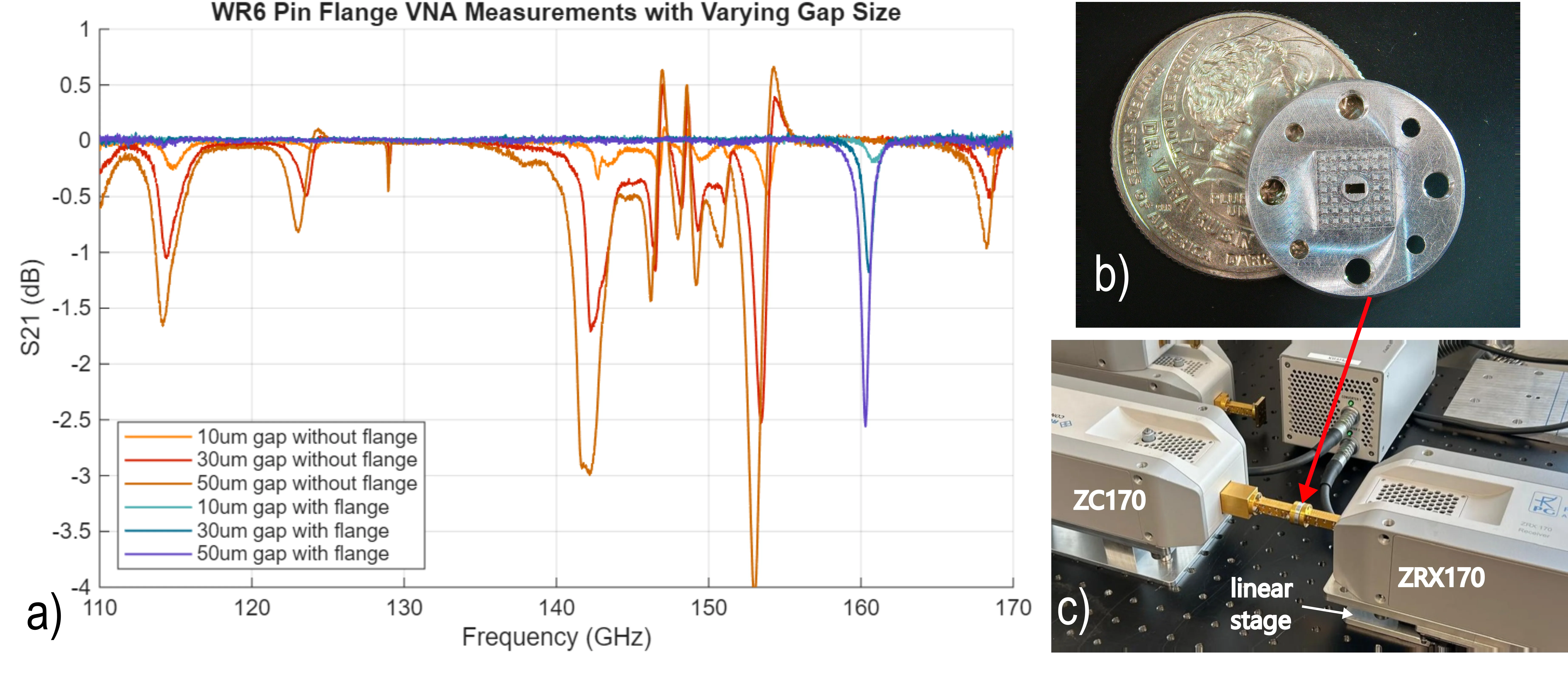
We present the design and development of a novel, compact integrated on-chip spectrometer operating at millimeter (mm) and submillimeter (sub-mm) wavelengths. The Superconducting Waveguide Integrated Submillimeter Spectrometer (SWISS) promises significant improvements in spectral resolution, optical efficiency, and frequency coverage over current mm-wave spectrometers by using a free-space rectangular waveguide architecture. Light is coupled in through the antenna front end, which separates the two polarizations and passes them to the waveguide spectrometer through a contactless metamaterial transition. Each waveguide spectrometer consists of a feedline coupled to a series of filters based on single-pole cavity resonators with varying resonant frequencies. To maximize packing density, the filter banks are oriented out of the focal plane, and an E-plane bend in the output from the cavity filters enables a planar and scalable construction. The output of each filter is coupled to a kinetic inductance detector (KID) to enable high multiplexing factors. The spectrometer is fabricated using stacks of silicon wafers etched with a deep reactive-ion etch (DRIE) and metallized. In these proceedings, we discuss current development on a SWISS prototype including measurements on a prototype antenna front end contactless transition and fabrication a prototype waveguide spectrometer.
The millimeter waves that SWISS captures are blocked by water vapor in the atmosphere, so such telescopes are built high in the mountains — for example, in the Atacama Desert at an altitude of 5000 meters.