Two-Stage Dehydration of Mirabilite: From Nucleation to the Phase Boundary ✛
Context
This work sits somewhat apart: the nearest neighbors study freezing chaos in cubic ice, order from chaos upon heating, salt near a graphene sheet, and similar phase transitions. But here the object is different: not freezing, but drying of a crystalline hydrate, with a simultaneous look at macro- and microscales. Previously, dehydration kinetics were described by solid-state transformation models without accounting for the water vapor that is itself released. The authors bring vapor back into the equation, but more importantly, they show for the first time that behind the averaged macroscopic curve lie two distinct regimes visible only at the microscopic level.
Methods
Mirabilite crystals were grown from a supersaturated Na₂SO₄ solution and dried under controlled humidity (20–60%) at room temperature. Mass loss was recorded on an analytical balance with an accuracy of 0.001 g. The internal structure of crystals during dehydration was observed using time-resolved X-ray microtomography. The surface and depth of growing anhydrous zones were mapped with confocal Raman microscopy, and the morphology of the final product was examined with a scanning electron microscope. Kinetic data were fitted to integral models of diffusion, phase boundary, and reaction order, corrected for the partial pressure of water vapor.
Results
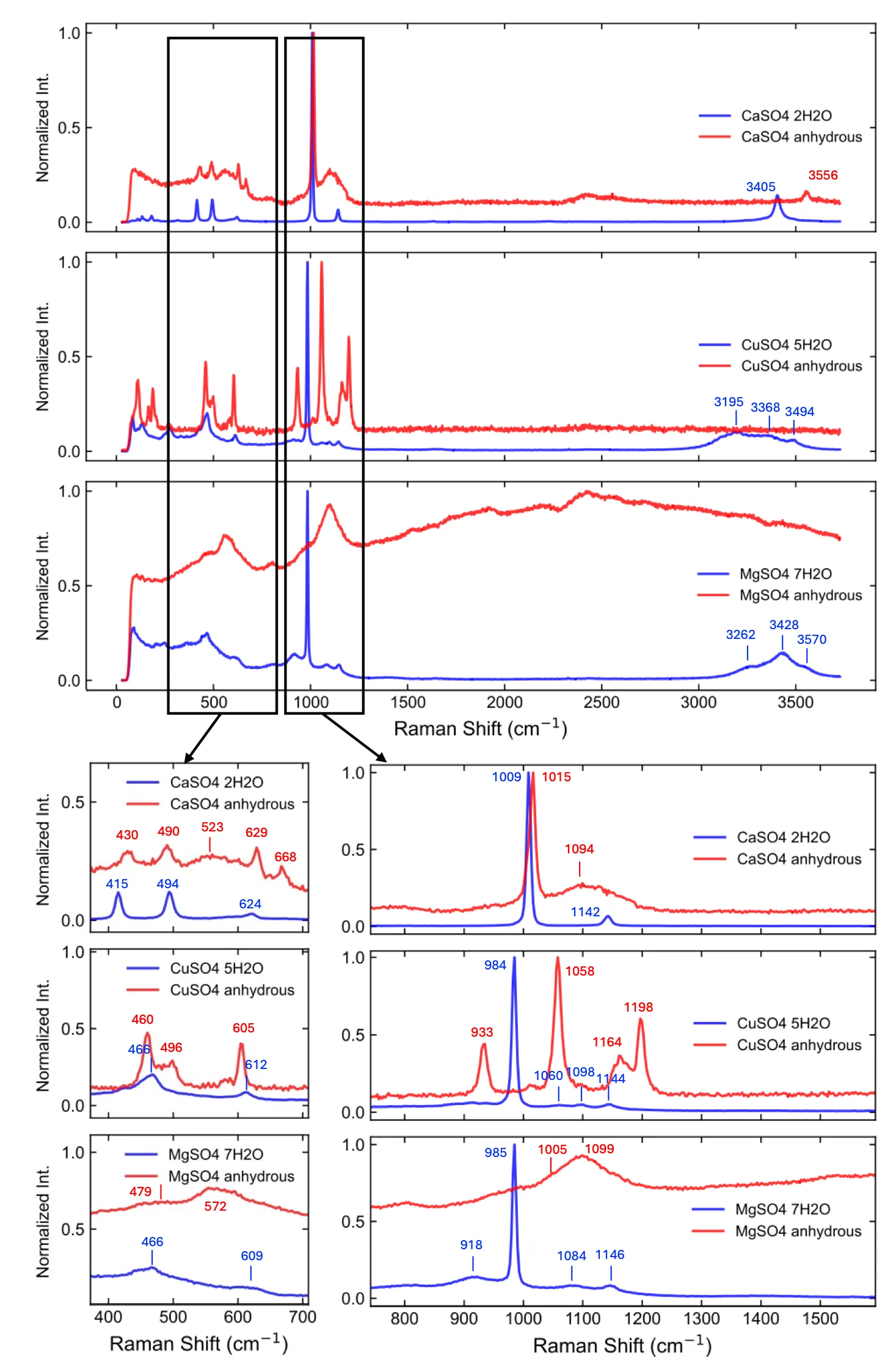
Macroscopic mass loss is described by the contracting volume model: the rate is limited by the reaction at the hydrate/anhydride boundary, specifically the formation of water vacancies. Microscopy shows that dehydration begins with the appearance of round thenardite patches on the surface, which grow in the crystal plane following an exponential law (nucleation regime). Then growth moves inward, and the rate begins to follow the phase boundary model. The transition between regimes depends on proximity to other patches: isolated patches grow in the plane longer. After complete dehydration, the crystal shrinks by about 35% and acquires a layered structure with dual porosity: macropores between layers and micropores within them. Air humidity controls the size of thenardite nanocrystals: at 5% RH they are small and elongated, at 60% RH they are larger and more isotropic. Comparison with CaSO₄·2H₂O, CuSO₄·5H₂O, and MgSO₄·7H₂O showed that if the crystal system changes during dehydration (e.g., from monoclinic to orthorhombic), round patches form on the surface; if the system is preserved (MgSO₄), linear cracks appear.
Implications
This work differs from its neighbors by linking the microscopic morphology of the product to the dehydration mechanism: the type of cracks can predict which process limits the reaction. This is not just another observation of a phase transition, but a tool for rapid screening of new crystalline hydrates without lengthy kinetic experiments. Furthermore, the authors show that macroscopic models are incomplete: they average out and hide the initial nucleation stage, which may be critical for the reversibility of cycles.
Future development
The topic could develop toward a quantitative link between lattice symmetry, crack morphology, and activation energy. If such a link is confirmed for other hydrate families (carbonates, oxides), it would become possible to predict dehydration pathways of new materials for thermal storage without labor-intensive experiments. A separate question: how does the product's microstructure affect the rate of reverse hydration and degradation upon repeated cycling?
Impact
The results will be useful in developing thermochemical heat storage systems based on salt hydrates, as well as in pharmaceuticals, where dehydration affects the stability and bioavailability of drug crystals.
Next steps
The next step is to study the kinetics of thenardite rehydration as a function of porosity and nanocrystal size, to find optimal cycling conditions. It is also worth testing the 'symmetry–morphology–mechanism' correlation on a broader set of hydrates.
Key open problems
In solid-state chemistry, the question remains open how microstructural changes during dehydration relate to reaction reversibility. This work shows that product morphology can serve as an indicator of the mechanism, but it does not solve the problem of quantitatively predicting reverse kinetics. This connects it to the fundamental problem of nucleation and growth in solid phases.
The knowledge machine's view
This section is addressed to the author of the paper and their colleagues. Neighbouring works were found by meaning-based search across our archive, not by word overlap. We do not review: we show the field around the work.
What the work does
The authors studied the two-stage dehydration of mirabilite to thenardite, combining macroscopic kinetics (mass loss) with microscopic techniques (microtomography, Raman microscopy, SEM). They found that the process begins with two-dimensional nucleation of anhydrous domains on the surface, then transitions to a regime limited by the advancement of the phase boundary. The influence of humidity on nanocrystal size and the link between crystal lattice symmetry and crack morphology are also demonstrated.
Where its strength is
The strength of the work lies in its simultaneous view of the macro- and microscales, which revealed two dehydration regimes and connected product morphology to reaction mechanism. This provides a tool for predicting the behavior of other crystalline hydrates without lengthy experiments.
Where it could go next
- It might be interesting to compare the observed nucleation and growth patterns with ordering processes in other systems, for example, how cubic ice builds symmetry from chaos. Perhaps common principles of nucleation and growth could also describe dehydration.based on: Freezing Chaos: How Cubic Ice Builds Symmetry arXiv:2607.03465
- Nearby lies work on how heat gives birth to a crystal from chaos. Analogies with thermally activated ordering might help deepen understanding of thenardite nucleation kinetics on mirabilite surfaces.based on: Order from Chaos: How Heat Gives Birth to a Crystal arXiv:2603.07121
- In our archive there is an analysis of pressure effects on ice memory. It might be worth examining how mechanical stresses during dehydration (35% shrinkage) affect morphology and kinetics, similar to how compression affects ice properties.based on: Ice Remembers How It Was Squeezed arXiv:2606.01401
Worth trying
- Test whether the initial stage of dehydration follows an Avrami nucleation model adapted for two-dimensional surface growth.
- Use in situ X-ray diffraction to track crystal structure evolution at the nanoscale in real time.
- Correlate thenardite nanocrystal size with water vapor partial pressure using models that account for supersaturation.
Why this may matter
Understanding dehydration mechanisms of crystalline hydrates is important for developing thermal energy storage materials, where cyclic stability and kinetics are crucial. Linking morphology to mechanism could accelerate screening of new materials.
Nearby works in our archive
- Freezing Chaos: How Cubic Ice Builds Symmetrysimilarity 0.53
- Water in a Vise: Two Views of Meltingsimilarity 0.52
- Why Water Gets Heavier at 4 Degreessimilarity 0.51
- Planetary pressure cooker: how gas and rock give birth to oceanssimilarity 0.51
- Ice Remembers How It Was Squeezedsimilarity 0.49
- A Two-Particle Recipe for the Right Lithiumsimilarity 0.49
- Order from Chaos: How Heat Gives Birth to a Crystalsimilarity 0.48
The archive is sparse around this work: the closest review is only 0.53, against a usual 0.64. It looks like few have drilled nearby.
Mirabilite's energy density (2.4 GJ/m³) is higher than that of lithium-ion batteries (0.72–1.8 GJ/m³), so it is considered a cheap material for seasonal heat storage.
Key numbers
- volume shrinkage upon dehydration: 31.5–36%
- theoretical shrinkage from lattice parameters: 52%
- equilibrium relative humidity of mirabilite/thenardite at 20°C: 76.4%
- energy density of mirabilite: 2.4 GJ/m³
- number of analyzed nucleation patches: 47 (14 from birth)