A cube of potassium tantalate behaves like an ordinary dielectric: it doesn't store an electric field. But grow this material as a thin film on a substrate of another crystal, and everything changes.
A thin film of ruthenium oxide Sr₃Ru₂O₇ grown on a foreign crystalline substrate behaves like a tightly stretched rubber sheet: the substrate either compresses it or stretches it.
On the surface of a thin film of bismuth iron oxide, you can see neat stripes, like furrows in a plowed field. What lies beneath them has remained a mystery until now.
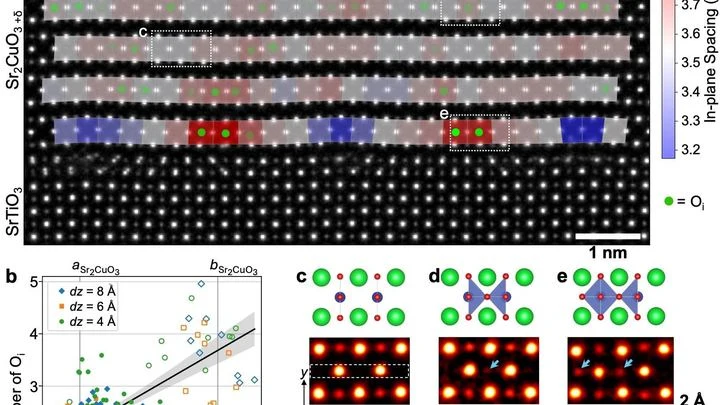
A superconductor is a material that conducts electricity without loss, like water flowing through a perfectly smooth pipe. In copper-based superconductors, tiny oxygen additions act like a volume knob: a bit more and the material starts superconducting; a bit less and it stops. But the oxygen atoms themselves are so small that seeing them directly was impossible.