Yan Zhang

5 articles · 30 co-authors · latest: 2026-07-30
0 citations · h-index 0 · 4 papersData: Semantic Scholar

We have retold 5 papers by this author. most often about: superconductivity, superfluidity, thermal conductivity. 30 co-authors across our retellings.

Links in the knowledge graph
Superconductivity2026-01-081 minarXiv:2601.04712express
A Superconductor with Two Gaps
At a temperature of 4.3 degrees above absolute zero, a crystal of palladium telluride stops resisting electric current. Electrons pair up and move without loss, like a crowd holding hands. But this superconductor seems to have not one but two different ways of pairing.
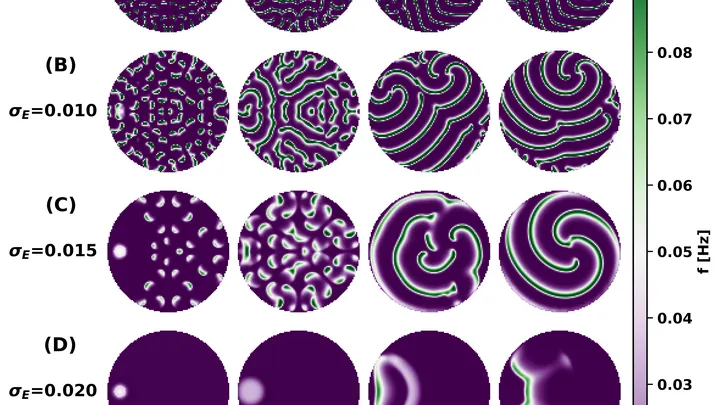
How Chlorine Conducts a Seizure
A neuron that has just calmed down is like a pianist lifting their hands from the keys. But inside, silent work continues: tiny pumps push chloride ions outward, returning the instrument to a state of readiness. If the pumps fall behind, chloride builds up, and then an inhibitory signal meant to quiet the cell suddenly starts exciting it.
Superconductivity2026-07-122 minarXiv:2607.10668express
Squeezed, pressed, and peeked into the soul of a superconductor
Imagine trying to overhear a whisper between two people in a noisy hall. That's roughly the challenge physicists face when they want to understand how electrons pair up inside a superconductor. And if the "hall" is also squeezed by a giant press to pressures of hundreds of thousands of atmospheres, the task seems impossible. The authors of the new study found an ingenious solution.
Machine Learning2026-07-262 minarXiv:2607.23518express
Chameleon protein: one chain for many targets
A protein in a cell is not a rigid part but rather a soft glove that can grasp different objects. Until now, protein designers worked like sculptors, crafting a key for a single lock: one target, one shape. But life is more complex: sometimes a protein needs to recognize two different viruses at once or change its contours depending on its neighbors.
Quantum Physics2026-07-302 minarXiv:2607.28231express
Light Fringes Betray a Photon’s Spin
On the wall: light and dark fringes. That’s what light looks like when it cancels itself out. Way back in the 17th century, Christiaan Huygens suggested that light is a wave.