How to Watch the Electron Dance in Living Cells express
Inside every living cell, chemical transformations are constantly taking place. Some of them create unstable particles whose electrons behave like paired magnets. Their interaction resembles a dance: each movement of the pair responds to external magnetic fields, as if to a changing rhythm.
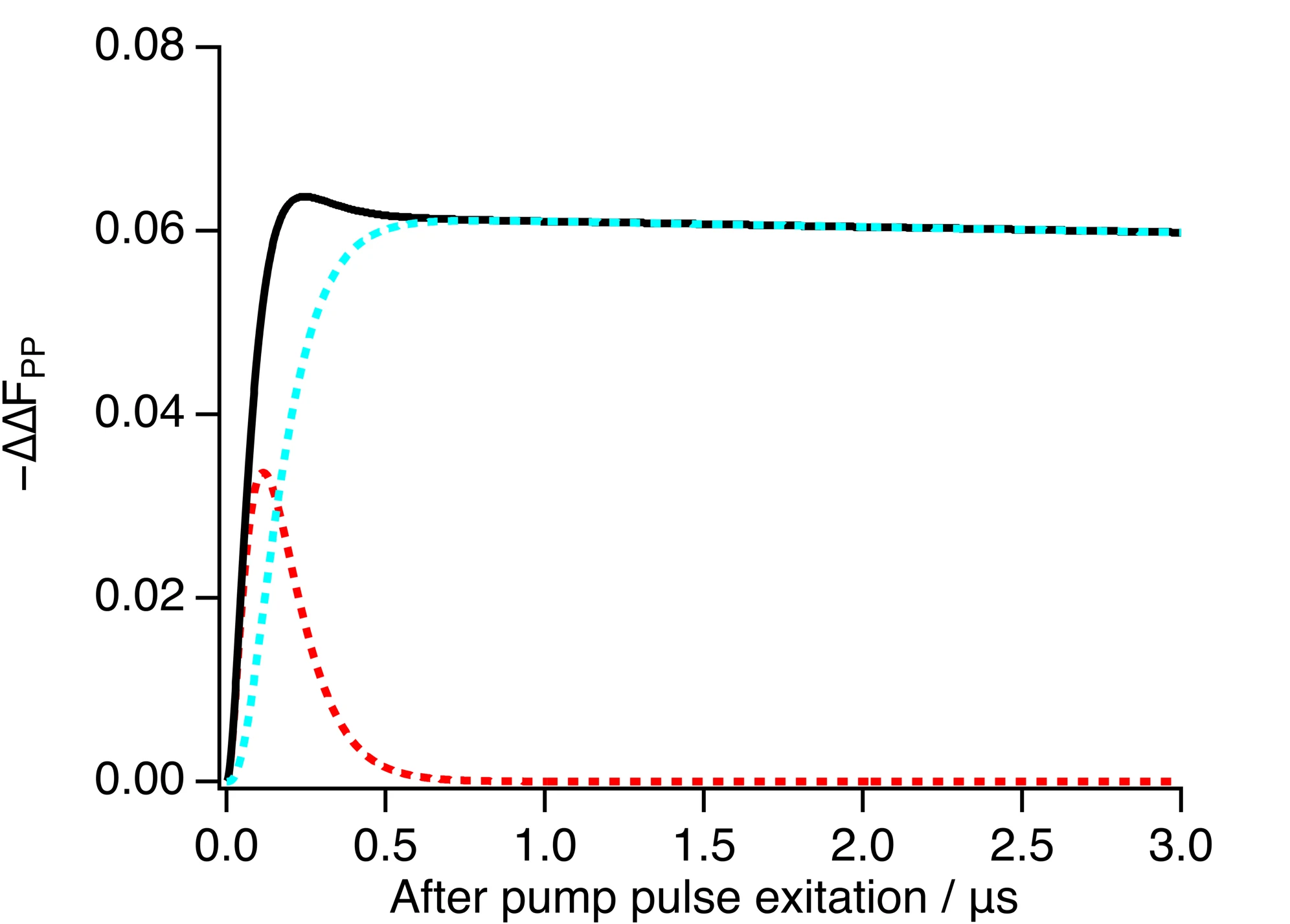
The invisibility of this dance prevented us from seeing it directly. Now scientists illuminate the cell with a pair of ultrashort laser flashes. The first sparks the dancers into motion; the second, arriving precisely an instant later, makes the reaction products glow. By analyzing the change in brightness of this glow, they reconstruct each 'step,' revealing a picture of the chemistry of magnetic interactions.
The method was tested on cells containing a magnetism-sensitive molecule. The same principle explains the navigation of migratory birds: their visual cells capture the electron dance, translating Earth's magnetic field into tangible images. In the future: portable sensors and therapies controlled by weak magnetic pulses.
Original abstract
as written by the authors arXiv:2510.05600
The importance of spin-correlated radical pairs in biology is increasingly recognized, with roles in biological effects of weak magnetic fields and emerging quantum spin-based biomedical applications. Fluorescence microscopy offers sufficient sensitivity to study magnetic field effects on radical pair reactions in living cells, but conventional techniques cannot directly resolve their dynamics because most biologically relevant radical pairs are non-emissive. To overcome this challenge, we introduce two novel microscopy techniques: single color pump-probe (PP) and pump-field-probe (PFP) fluorescence. Here, we describe their working principles, provide their mathematical formulation, and validate both techniques through theoretical analysis and experiments on well-established flavin-based magnetic field sensitive reactions. These approaches offer a sensitive and broadly applicable platform for quantifying and visualizing the quantum spin dynamics of radical pair chemical reactions in biological systems.
Migratory birds use this same mechanism: their eyes capture the electron dance, turning Earth's magnetic field into visual cues.