Rejection sampling is a simple Monte Carlo method for generating samples from a target probability distribution when direct sampling is difficult. It works by sampling from a simpler proposal distribution that covers the target distribution, then accepting or rejecting each sample based on a random test. The accepted samples follow the target distribution exactly. It is a foundational algorithm in computational physics and statistics, often used as a building block for more sophisticated methods like Markov chain Monte Carlo.
History
The method was described by John von Neumann in 1951 in a paper on various techniques for random number generation, though similar ideas appeared earlier in the statistical literature.
How it works
Given a target distribution p(x) and a proposal distribution q(x) such that p(x) ≤ M·q(x) for some constant M, you draw a candidate x from q(x) and a uniform random number u in [0,1]. Accept x if u < p(x)/(M·q(x)), otherwise reject and try again. The accepted samples are distributed according to p(x). The efficiency depends on the ratio of the areas under p and M·q; if M is too large, many samples are rejected, wasting computation. The method works best when q is a good approximation to p.
In practice
Used in particle physics to generate random events according to complex differential cross-sections, and in Bayesian statistics to sample from posterior distributions when the normalizing constant is unknown.
Fun fact
Rejection sampling is also known as the 'accept-reject method' and is a key ingredient in the famous Metropolis-Hastings algorithm, which generalizes it to handle high-dimensional problems.
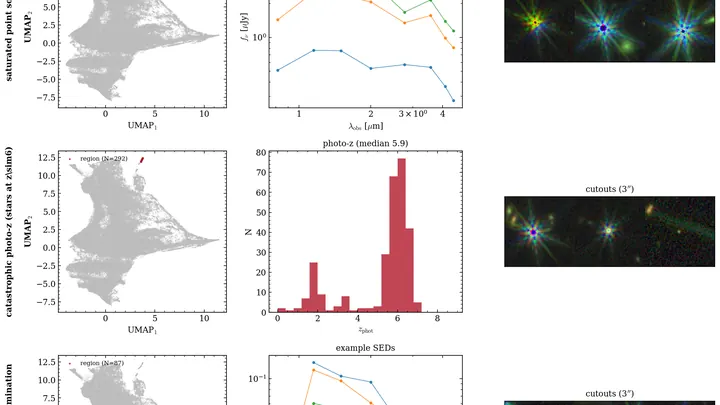
Two hundred forty-two thousand three hundred twenty-seven galaxies — like grains of sand on a beach. But astronomers turned this chaos into a map: the UMAP algorithm (a machine learning method) took from each galaxy eleven parameters — seven colors from optical to mid-infrared (that's photometry), magnitude…
Imagine a fleet of many ships, resembling a galaxy — a vast stellar system where every element follows the overall dynamics. From time to time, one ship breaks down, exploding like a supernova — a catastrophic event that can disrupt the integrity of the entire formation. If the damaged unit isn't replaced in time, the fleet loses combat capability.
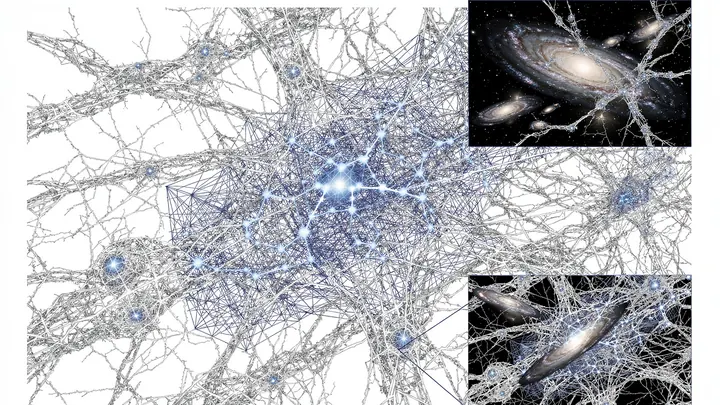
Dark matter — the invisible foundation of cosmic architecture — makes up 85% of all mass, yet eludes direct observation. In the 1920s, Edwin Hubble discovered the expansion of the universe and the realm of galaxies; by the 1930s, Fritz Zwicky suspected hidden mass in their clusters.
Light from distant galaxies travels to us for billions of years, but along the way it gets bent and twisted by the invisible web of dark matter. This effect, predicted by Albert Einstein within general relativity, is called gravitational lensing.
The search for extraterrestrial intelligence is like panning for gold in an endless river. For decades, SETI has been listening to the hum of the Galaxy, but the ether is silent. It’s not about antenna sensitivity — it’s that we don’t know where to dip our pan.
Pairs of black holes dance in three different styles before merging. The first is a neat waltz: the objects swirl in the same direction, like partners facing the same way. Such pairs are born from binary stars and often have unequal masses. The second is chaotic disco: spins are scattered, masses nearly equal.
A tomograph is like a photographer who walks around an object and takes pictures from different sides. Usually, it snaps at regular intervals and uses the same amount of light for each shot. But if you need to shoot quickly and not waste extra film, you have to choose: which angles matter more and where to direct more light.
When matter is compressed to pressures of millions of atmospheres and heated to thousands of degrees, it is neither solid nor gas. This warm dense state is like the interiors of giant planets or the moment of a meteorite impact. You can't look inside directly, but you can shine X-rays and see how they scatter off electrons.
Inside the Sun, invisible nuclear transformations occur every second. One of them is the birth of boron-8: a beryllium-7 nucleus captures a passing proton and momentarily becomes a new element. This step kicks off a chain that ends with the emission of a neutrino — a particle capable of passing straight through Earth.
The galaxy NGC 1560 is a modest island of stars and gas ten million light-years away. Its rotation curve, first measured in 1991, became an icon for those seeking an alternative to dark matter. The plot of rotation speed versus radius shows bends that seem to exactly mirror the bends in the distribution of ordinary matter.