Cosmic Rays in Bubbles: Why Heavy Nuclei Unexpectedly Rise with Energy ✛ ✎ ✦
The ATIC balloon rose over Antarctica and caught particles older than Earth itself. Among them are atomic nuclei from sulfur to chromium, and the higher their energy, the larger their fraction compared to iron. The standard 'leaky box' model predicted the opposite: heavy nuclei should dissolve like salt in water. But the data stubbornly rose.
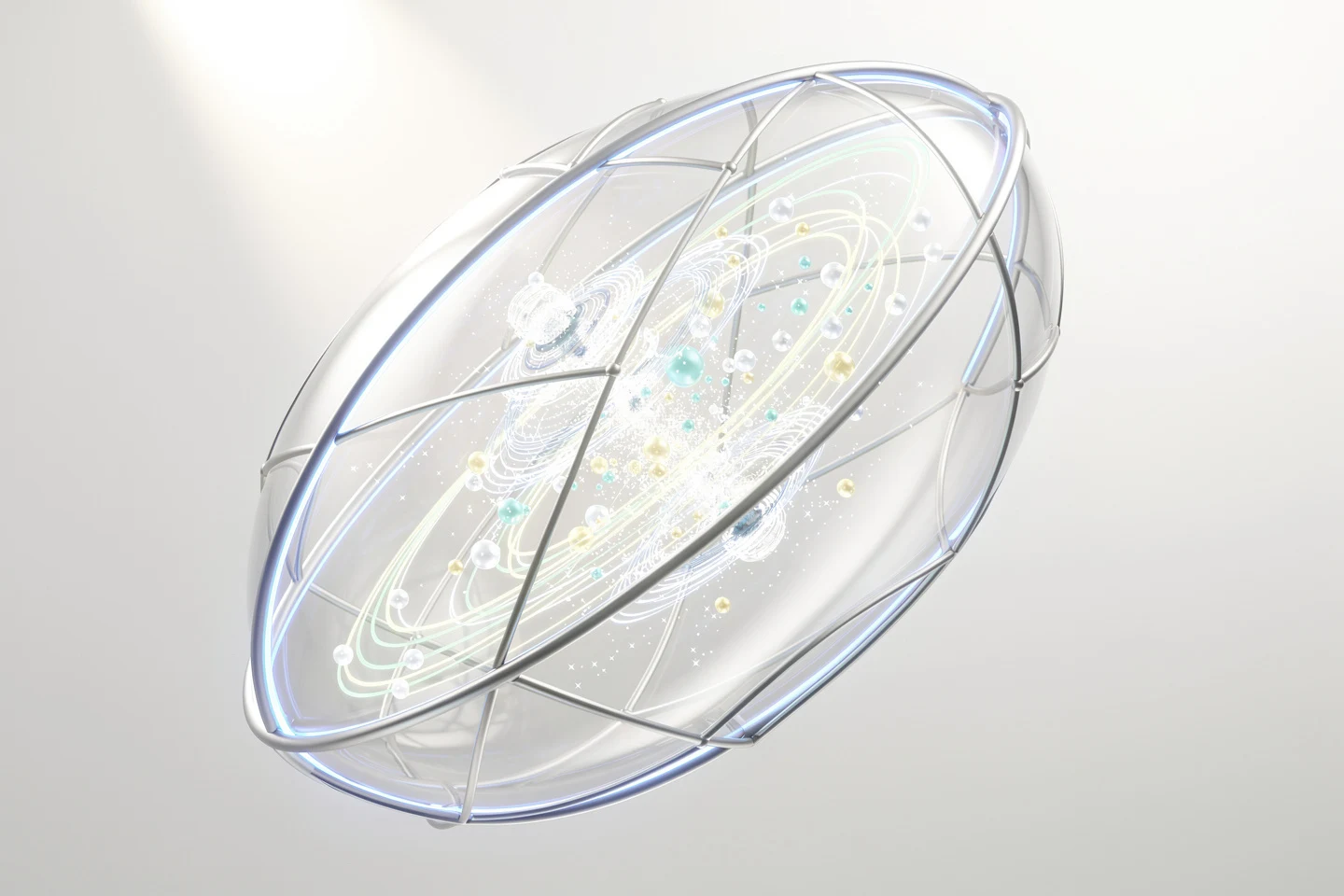
The authors returned to a forgotten 1977 idea: the galaxy is not a 'leaky box' but a closed room with bubbles. Inside each bubble are sources, like lamps in soap bubbles. The Sun sits in one of them, and we see not only the light of our own lamp but also the reflections of others, seeping through the walls. A model with a 20% volume flux fraction reproduced the rise: first the ratio falls, as expected, and then it rises: this is the light from other bubbles coming into play.
The model predicts a universal hardening of primary nuclei spectra at 200–300 GeV/nucleon, and this agrees with observations. But there is a price: the sources must be soft, with spectral indices of 2.55 for protons and 2.45 for oxygen. It is as if the lamps in the bubbles were dim, but there are many of them.
The estimated diffusion coefficient in the local bubble came out 2–3 orders of magnitude lower than commonly accepted — particles seem to stick in syrup rather than freely escape. Perhaps the bubble walls reflect them back, like mirrors.
For now, this is pure knowledge: no practical applications are in sight. But the model offers a new tool for interpreting future data from AMS-02 and CALET. If it is correct, we literally live inside a 'cauldron' where cosmic rays are brewed.
The local bubble, which hosts the Sun, is a real region of tenuous hot gas about 100 parsecs across, created by supernova explosions. If the CG+B model is correct, we literally live inside a 'cauldron' where cosmic rays are brewed.