Monsoon under the Magnifying Glass: How Regional Models Reshape Rain Forecasts over West Africa ✛
Context
The West African monsoon dictates life for hundreds of millions of people: nearly all annual rainfall falls within a few months, and food security in the region hinges on how much rain arrives. Global climate models (GCMs) capture this process only coarsely because of their large grid spacing and warm sea surface temperature biases in the tropical Atlantic. Regional climate models (RCMs) with higher resolution promise to refine the picture, but their ability to improve large-scale ocean–atmosphere links has remained contentious. This work sits somewhat apart: nearby in the archive are studies using machine learning for climate data analysis, El Niño prediction, and statistical signal–noise separation, but direct neighbors on monsoon teleconnections are scarce. That makes this study a rare anchor point for evaluating regional downscaling in Africa.
Methods
The authors took 8 historical global model simulations from CMIP5 and 11 regional runs from CORDEX-Africa for the peak monsoon season (July–August–September) from 1979 to 2004. All fields of precipitation, sea surface temperature, and atmospheric dynamics were interpolated onto a common coarse grid of 2.8 degrees to allow comparison across models of different resolutions. To isolate the joint variability of West African rainfall and sea surface temperature in three key regions (tropical Pacific, Mediterranean Sea, equatorial Atlantic), they applied maximum covariance analysis (MCA) using the S4CAST model. Additionally, they assessed the added value of regional models using a formula that compares squared errors of global and regional simulations relative to observations.
Results
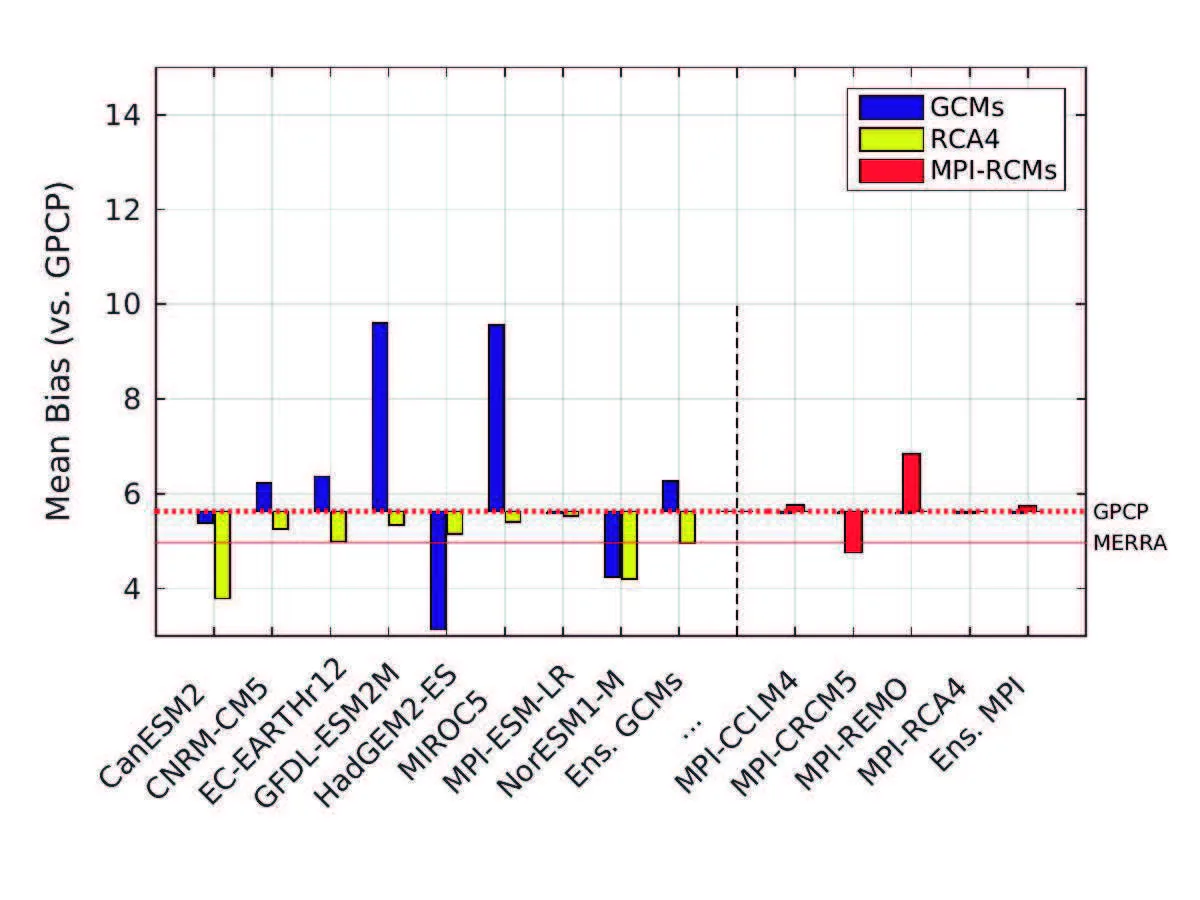
Global models systematically shift the intertropical convergence zone southward: too much rain falls over the Gulf of Guinea and too little over Senegal and Gambia. Regional models partially correct this bias but introduce a new one: a strong drying over the Congo. The largest improvement from regionalization occurs for the most inaccurate global models. For the El Niño–monsoon link, regionalization offers no benefit: regional models lose the signal of subsiding air over the Sahel that global models reproduce, however imperfectly. In contrast, regional models transmit the influence of a warm Mediterranean Sea on Sahel rainfall markedly better: they more accurately capture the southwest moisture transport and agree with observations over the central and eastern Sahel. For the equatorial Atlantic regime, no robust conclusions are possible because during the chosen period this signal always appears together with the opposite phase of El Niño, and they cannot be separated.
Implications
This study is the first to systematically show that regional downscaling is not universally beneficial for monsoon teleconnections: it improves one ocean influence channel while disrupting another. This sets it apart from neighboring studies, which either focus on statistical methods for signal extraction or on predicting El Niño itself, but do not test how regional models transmit large-scale atmospheric bridges. The result underscores that the value of a regional model depends on which process one aims to study and on how the domain boundaries and external forcings are specified.
Future development
The topic could evolve toward experiments with isolated oceanic forcings: for example, running a regional model with only Atlantic warming prescribed, without the El Niño contamination. Also promising is the use of spectral nudging of the large-scale circulation within the regional domain to preserve the El Niño signal. Using longer observational records and model simulations would help test how robust the found differences are.
Impact
The results directly affect model selection for climate services in West Africa: for forecasts of El Niño–related droughts, global models are preferable, while for assessing the Mediterranean's influence on the rainy season, regional models are better. This also matters for agricultural and water resource adaptation projects in the Sahel.
Next steps
Conduct sensitivity experiments with regional models where only the equatorial Atlantic regime is prescribed as a boundary condition, without El Niño. Investigate how spectral nudging affects the transmission of the El Niño signal within the regional domain.
Key open problems
For West African climatology, an open question remains why regional models transmit different teleconnections differently. This ties into a fundamental problem: how to reconcile the large-scale circulation prescribed at the boundaries with the internal dynamics of a regional model. The study shows that simply increasing resolution does not automatically solve this problem.
The knowledge machine's view
This section is addressed to the author of the paper and their colleagues. Neighbouring works were found by meaning-based search across our archive, not by word overlap. We do not review: we show the field around the work.
What the work does
The authors compared 8 global CMIP5 models with 11 regional CORDEX-Africa simulations for the peak season of the West African monsoon (1979–2004), interpolating all fields onto a common 2.8° grid. Using maximum covariance analysis (MCA, S4CAST model), they isolated the joint variability of precipitation over West Africa and sea surface temperature in three key regions (tropical Pacific, Mediterranean Sea, equatorial Atlantic). They assessed the added value of regionalization by comparing squared errors relative to observations. They found that regionalization improves the connection with a warm Mediterranean Sea but degrades the response to El Niño; for the Atlantic regime, no conclusions can be drawn due to signal mixing.
Where its strength is
This work is the first to systematically show that regional downscaling is not universally beneficial for monsoon teleconnections: it improves one oceanic influence channel and disrupts another. This provides a concrete empirical guideline for choosing RCMs when studying monsoon–ocean linkages.
Where it could go next
- One could explore how machine learning methods for climate data analysis, similar to those used in 2502.15356, might help separate the mixed El Niño and Atlantic signals that the current study could not disentangle.based on: Network catches the monsoon beyond the horizon arXiv:2502.15356
- Related work 2401.14804 treats the ocean as a dictator of Sahel precipitation; perhaps their approach to identifying the dominant oceanic driver could be used to assess which of the three signals most strongly controls monsoon variability in regional models.based on: The Ocean Dictates the Rains of the Sahel arXiv:2401.14804
- It would be interesting to compare the findings on heterogeneous added value of downscaling with results from 1803.08909, which discusses the instability of the El Niño–Indian monsoon relationship: possibly the same applies to West Africa, and this should be tested over longer time series or different periods.based on: El Niño and the Indian Monsoon: A Connection Under Pressure arXiv:1803.08909
Worth trying
- Apply nonlinear signal separation methods (as in 2502.15356) to precipitation and temperature fields to disentangle the El Niño influence from the Atlantic regime in historical data.
- Test whether the advantage of regional models for the Mediterranean connection persists when moving to higher grid resolutions (e.g., 0.44° vs. 0.22°).
- Evaluate the added value of RCMs not only by mean squared errors but also by their reproduction of extreme Sahel precipitation, using metrics sensitive to distribution tails.
Why this may matter
If regional models systematically distort one teleconnection channel, this could lead to incorrect drought forecasts in the Sahel. Understanding which channels are strengthened and which are weakened by downscaling is critical for climate services in a vulnerable region.
Nearby works in our archive
- Network catches the monsoon beyond the horizonsimilarity 0.55
- The Overzealous Translator: Why Models Overestimate the El Niño–Hurricane Linksimilarity 0.55
- El Niño and the Indian Monsoon: A Connection Under Pressuresimilarity 0.54
- A Ceiling of Randomnesssimilarity 0.54
- An Orchestra Without a Conductor: How the Ocean and Atmosphere Strike a Dealsimilarity 0.54
- A Translator That Learned the Language of the Oceansimilarity 0.53
- The Ocean Dictates the Rains of the Sahelsimilarity 0.52
The archive is sparse around this work: the closest review is only 0.55, against a usual 0.64. It looks like few have drilled nearby.
The regional model SMHI-RCA4, when driven by different global models, consistently produces a spurious drought over the Congo. This defect also appears in other regional models, pointing to a common problem with convection parameterization in that part of Africa.
Key numbers
- analysis period: 26 seasons (July–August–September 1979–2004)
- number of global models: 8 from CMIP5
- number of regional simulations: 11 from CORDEX-Africa
- explained covariance fraction for El Niño in observations: 41%
- explained covariance fraction for the Mediterranean in observations: 40%