Quantum Filter: How Entanglement Pierces a Murky Medium ✛
Context
Light scattering in complex media, from biological tissues to turbulent atmospheres, has long limited optical imaging. Classical methods, such as wavefront shaping or computational correction, attempt to reverse scattering to recover the image. These approaches rely on linear optics and ignore the quantum nature of light. Alongside this work on the archive are studies in quantum optics: entangled photons in multimode fibers, two-photon speckles, and quantum communication through 62 kilometers of air. All of them explore how nonclassical light behaves in scattering media, but until now no one has used entanglement to selectively transmit images while keeping the classical channel blocked.
Methods
The experiment is built on spontaneous parametric down-conversion: an ultraviolet laser with a wavelength of 405 nm illuminates a nonlinear beta-barium borate crystal, which generates pairs of entangled photons at 810 nm. The object is encoded in the spatial correlations of these pairs: the image is reconstructed from photon coincidences recorded by a camera with nanosecond time resolution. The complex medium consists of a spatial light modulator and a layer of parafilm. To find the right phase mask, the researchers numerically optimized the correlation image using the measured scattering matrix and an entangled state as a guide. In the classical regime, the same object was illuminated by a superluminescent diode, and the image was captured by a regular camera.
Results
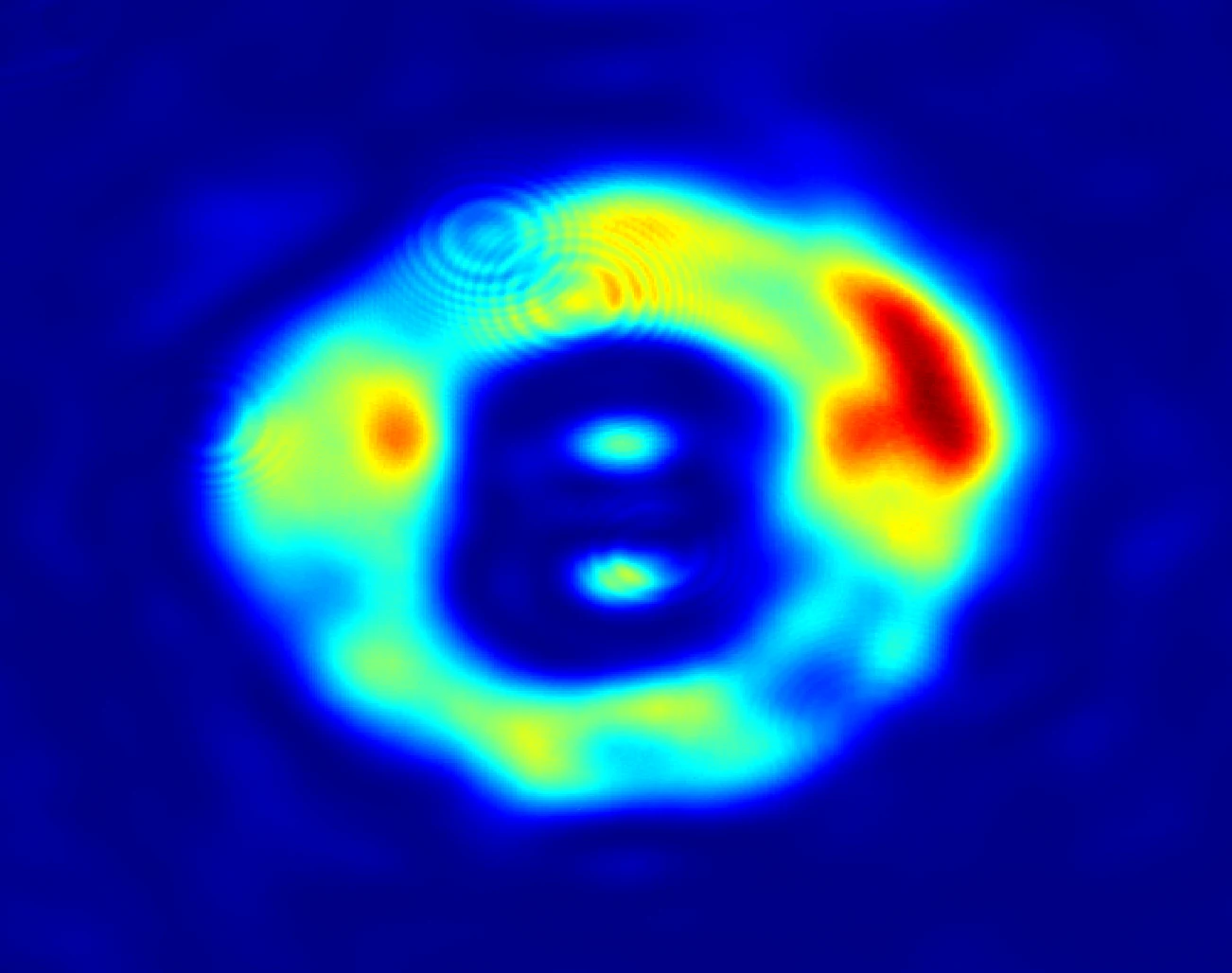
After optimization, the medium became transparent to the correlation image of entangled photons, but the classical image remained completely blurred. In numerical simulations with 50 different nonclassical solutions, the average transmission fidelity for the entangled state was 0.92, while for the classical state it was only 0.25. The key result: an image encoded in the correlations of a separable (non-entangled) two-photon state was also not transmitted. This proves that the filtering is sensitive specifically to entanglement, not just to the presence of correlations. Experiments with different media, including a random phase mask, a 1 cm thick layer of polydimethylsiloxane, and a numerically simulated thick medium, confirmed the method's universality.
Implications
This work introduces a conceptual shift: a complex medium can not only be compensated for, but also used as an active programmable component of quantum technologies. Unlike neighboring works, which either study the propagation of entangled photons in scattering media or use quantum entanglement to improve classical imaging, here the medium itself becomes a quantum-classical filter. This is the first experimental demonstration of selective image transmission based on the physical difference between entangled and classical states, rather than on computational processing.
Future development
The method could be extended to dynamic media, such as biological tissues, if the optimization and correlation registration are sped up. Theoretically, it has been shown that for arbitrary entangled states and arbitrarily complex media, nonclassical solutions always exist, implementable through multi-plane wavefront shaping. This opens the way to quantum imaging in real-world conditions where the medium changes over time.
Impact
On secure communication: a channel transparent only to entangled photons provides hardware-level protection against signal substitution. On biomedical imaging: it potentially allows seeing through scattering tissues without inverting the scattering.
Next steps
Speed up the optimization with faster cameras and algorithms to work with dynamic media. Explore multi-plane wavefront shaping to implement more general nonclassical transformations.
Key open problems
In quantum optics, an open question remains: how to scale the control of entangled states in media with a large number of modes. This work shows that entanglement provides access to solutions unavailable to classical light, but practical implementation for thick media and rapid changes is not yet solved.
The knowledge machine's view
This section is addressed to the author of the paper and their colleagues. Neighbouring works were found by meaning-based search across our archive, not by word overlap. We do not review: we show the field around the work.
What the work does
The study demonstrates that a scattering medium can be programmed with a spatial light modulator to transmit images encoded in the correlations of entangled photons while remaining opaque to classical light. Experiments with pairs of entangled photons from spontaneous parametric down-conversion confirmed that the filtering is sensitive specifically to entanglement, not to correlations in general. The average transmission fidelity for the entangled state was 0.92, compared to 0.25 for the classical case.
Where its strength is
The strength of the work lies in a conceptual shift: the medium is used not as an obstacle to be compensated for, but as an active programmable filter that distinguishes quantum from classical channels. This opens new possibilities for quantum communication and imaging.
Where it could go next
- It might be interesting to see how the method works in biological tissues, where scattering is multiple and disordered. Nearby in the archive there is an analysis of quantum photon annihilation in tissues, which uses time-resolved detection to extract the useful signal.based on: The Quantum Waltz of Annihilation: What Photons Reveal About Tissues arXiv:2607.12182
- A possible development is the use of entangled photons for imaging objects hidden behind scattering media, as in the work on target detection through fog. That work proposed a protocol with entangled photons to improve contrast, which resonates with the idea of a quantum filter.based on: Entangled Photons Find Their Target Through Fog arXiv:2602.08947
- Another avenue is to apply the approach to non-imaging objects, such as transparent cells, as in the work on invisible cells in transmission. Quantum correlations could provide new contrast for phase objects that weakly absorb light.based on: Seeing the Invisible: A Clear View of Transparent Cells arXiv:2603.02446
Worth trying
- Test whether the filtering persists when using continuous variables instead of discrete spatial modes.
- Apply the method to biological samples with controlled thickness and scattering properties.
- Investigate whether the quantum filter can be used to protect against eavesdropping in quantum communication by transmitting the key in a classical channel that remains closed.
Why this may matter
If the quantum filter can be realized under real-world conditions, it could lead to new methods for secure image transmission and quantum imaging in turbid media, where classical approaches fail.
Nearby works in our archive
- X-ray Snapshot of a Crystal Without Guessworksimilarity 0.57
- The Quantum Waltz of Annihilation: What Photons Reveal About Tissuessimilarity 0.57
- Encounter with a Shutter: How a Photon Creates a Fountain of Probabilitiessimilarity 0.56
- Entangled Photons Find Their Target Through Fogsimilarity 0.56
- Seeing the Invisible: A Clear View of Transparent Cellssimilarity 0.55
The archive is sparse around this work: the closest review is only 0.57, against a usual 0.64. It looks like few have drilled nearby.
Acquiring a single correlation image required up to 30 seconds of accumulation, whereas a classical image was recorded in tens of milliseconds. Meanwhile, the entangled photons passed through a layer of parafilm, the ordinary film used to seal laboratory glassware.
Key numbers
- transmission fidelity for entangled image: 0.92
- transmission fidelity for classical image: 0.25
- wavelength of entangled photons: 810 nm
- thickness of PDMS layer: 1 cm
- number of optimization steps: 4000