How a cosmic 'snap' created dark matter ✛ ✎
The Universe is full of invisible dark matter — a substance that doesn't emit light but reveals itself through gravity. The astronomer Vera Rubin proved that galaxies rotate as if they contain far more mass than meets the eye. One of the best candidates for these invisible particles is the axion, an ultralight particle that physicists added to the Standard Model to solve the mystery of strong interactions.
It was commonly thought that axions slowly 'wake up' in the early Universe: their mass increases gradually. But what if the mass switched on suddenly — like a light switch? This is exactly the scenario physicists considered, inspired by the work of Stephen Hawking on quantum effects and possible violation of entropy conservation in the first moments of the world. This could have happened during a cosmological phase transition — that very 'shake-up'.
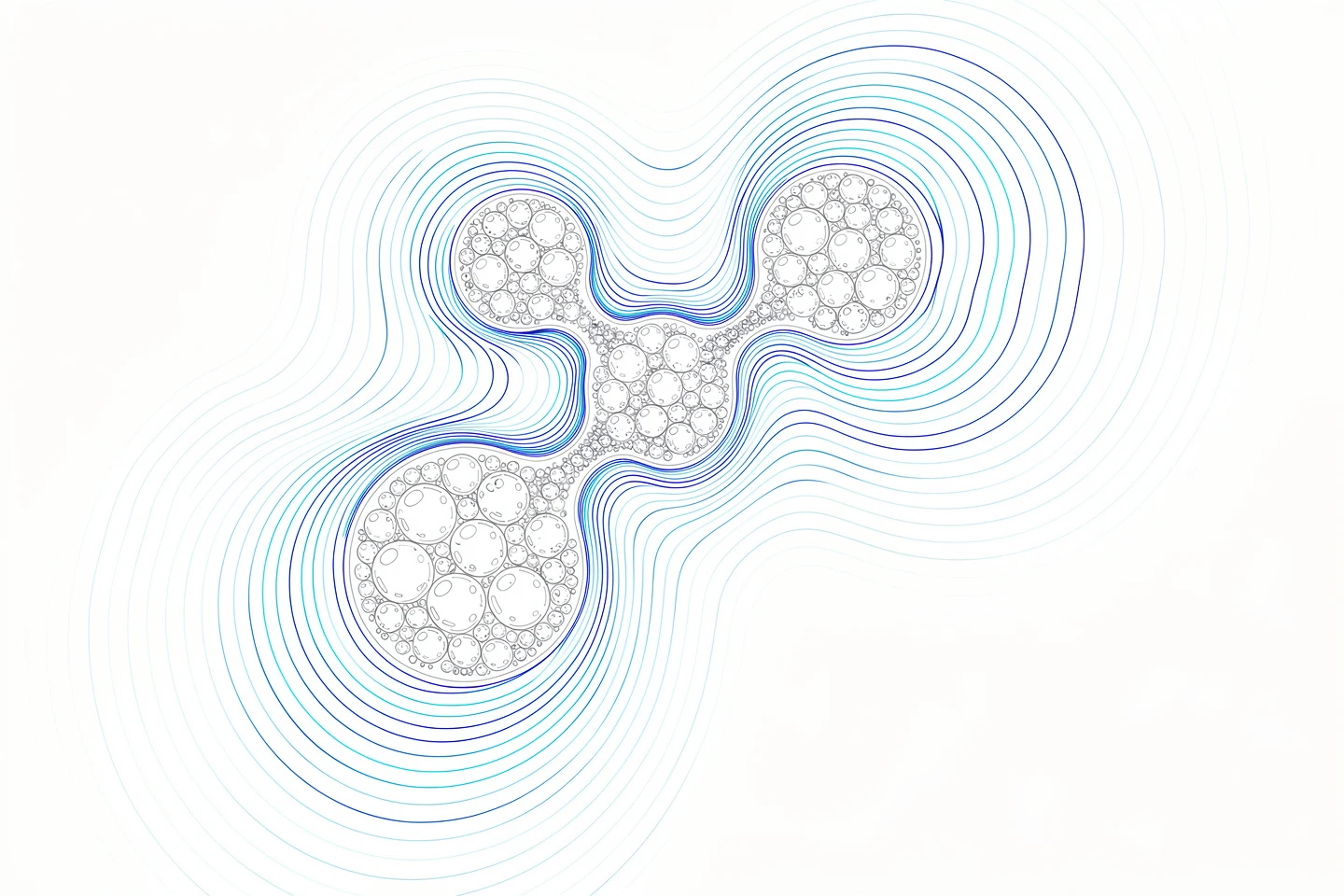
Computer simulations showed: in the expanding Universe, whose dynamics were described a century ago by Georges Lemaître, 'bubbles' with switched-on mass suddenly start to grow. If they merge quickly, axions lag behind in their oscillations and accumulate in excess — like a swing pushed with a delay, causing it to sway more strongly. But if the transition is slow, shock waves form ahead of the bubble walls, which instead dampen the oscillations — and fewer particles are produced. This forces a rethink of the hunt for axions. New data from the JWST telescope and observations of black holes help refine how fast that ancient transition was. And that same process might have left behind ripples — gravitational waves that scientists are trying to detect today. So the cosmic 'snap' opens the way to unraveling the nature of dark matter.
If the cosmic 'snap' had happened a little later, dark matter clumps would have become so dense they could collapse into tiny black holes.