First-order phase transitions change the game for axion dark matter ✛ ✎
Context
The dark matter problem is one of the main mysteries of modern physics. Already Vera Rubin showed that galaxies rotate as if they contain much more mass than can be seen. One of the best candidates is the axion — an ultra-light particle proposed to solve the strong CP problem in the Standard Model. It is usually assumed that axions are produced in the early universe via the misalignment mechanism: the field freezes away from the minimum of the potential, then begins to oscillate, producing cold dark matter. However, what if the axion mass turns on not smoothly, but abruptly — as a result of a cosmological first-order phase transition? It is this scenario, inspired by the ideas of Stephen Hawking about quantum fluctuations in the early universe and the possible violation of entropy conservation in such processes, that the authors considered.
Methods
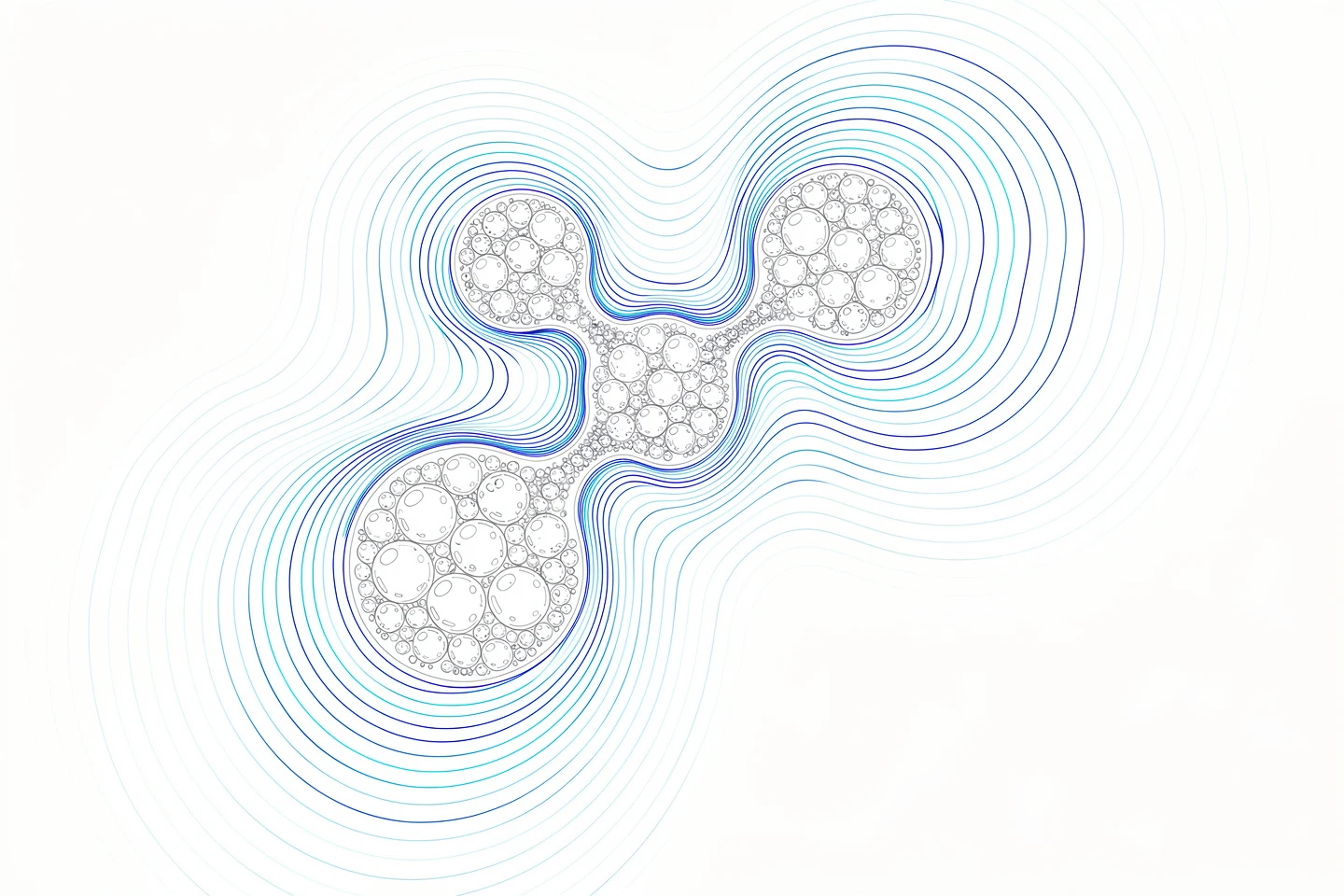
The modeling used a lattice in an expanding universe governed by the Friedmann–Lemaître equations derived by Georges Lemaître. Initially the axion field is homogeneous and frozen, but then true vacuum bubbles begin to nucleate, inside which the axion mass abruptly assumes a finite value. The nucleation rate is given by a phenomenological law, and the bubbles expand with a constant wall velocity. The equation of motion was solved using the leapfrog method, taking into account the nonlinearity of the potential and cosmological expansion. To avoid spurious oscillations at the bubble boundaries, finite differences were used instead of spectral methods. The key parameter is the ratio of the phase transition duration to the axion oscillation period.
Results
Simulation results showed two limiting regimes. In fast transitions, when bubbles collide before the field can start oscillating, the mass turn-on simply delays the onset of oscillations until percolation. This boosts the relic density: the axion "forgets" to get diluted by expansion. The numerical boost factor ξ can reach hundreds. In slow transitions, conversely, shock waves form in front of the bubble walls, reducing the oscillation amplitude inside. This mechanism, dubbed bubble misalignment, was first proposed in 2024 and is now confirmed in a realistic cosmology. The resulting semi-analytical formula describes both regimes with ~10% accuracy and predicts that to explain all of dark matter, the axion decay constant must be lower than usual.
Implications
The finding means that standard predictions for axion cosmology may be significantly corrected if phase transitions occurred in the early universe. This forces a revision of estimates for the axion mass and coupling constant, as well as the interpretation of observational data. In particular, the shift in the start time of oscillations alters the isocurvature spectrum and affects the formation of mini-clusters — clumps of dark matter that might be detectable with the JWST telescope.
Future development
In the future, researchers plan to apply these ideas to the QCD axion, whose mass depends on temperature even before the phase transition. This will complicate the picture but may lead to a richer phenomenology. Moreover, studying the stochastic gravitational-wave background from the same phase transition will provide an independent way to test the model. Work is already underway to embed the scenario into a full theory with Peccei–Quinn gauge symmetry.
Impact
The results will impact areas: early universe cosmology, particle physics beyond the Standard Model, astrophysics of black holes (via superradiance constraints), and observational cosmology using JWST and Lyman-α forest data.
Next steps
Next steps include detailed modeling of axion strings in the presence of a phase transition and calculating the gravitational wave signal in specific ultraviolet completions. Public adaptation of the code is also planned.
Key open problems
The work is directly connected to the unsolved problems of the nature of dark matter and the strong CP problem. The bubble misalignment mechanism also sheds light on a general question: how do non-equilibrium processes in the early universe shape the relic abundance of particles?
The knowledge machine's view
This section is addressed to the author of the paper and their colleagues. Neighbouring works were found by meaning-based search across our archive, not by word overlap. We do not review: we show the field around the work.
What the work does
The authors simulated a first-order cosmological phase transition on a lattice, in which the axion mass switches on abruptly inside expanding bubbles of true vacuum. They considered two limiting regimes: a fast transition, where bubbles percolate before oscillations begin, and a slow one, where shock waves form ahead of the bubble walls, reducing the field amplitude. They obtained a semi-analytic formula for the relic axion density that describes both regimes with an accuracy of ~10%.
Where its strength is
The strength of the work lies in direct numerical simulations of the nonlinear field dynamics against the backdrop of expansion, including bubble nucleation and growth, which revealed a non-monotonic dependence of the density on the transition rate and allowed a unified description.
Where it could go next
- It might be interesting to compare the obtained density dependence on transition parameters with the analytical estimates from the work on why bubbles do not immediately become matter: that work examines wall dynamics and energy transfer, which could refine the applicability limits of your formula.based on: Why Bubbles Don't Immediately Turn into Matter arXiv:2607.19469
- Closely related is the analysis of a scenario with a bubble in a sea of dark energy, which also models bubble expansion in a cosmological context; perhaps their approach to background dynamics or numerical methods could help extend your simulation to the case of nonzero vacuum pressure.based on: Bubble in a Sea of Dark Energy arXiv:2607.18376v1
- It would be interesting to look at the work on dark matter from thermal noise: if you include thermal fluctuations of the field during the transition in your scenario, this could lead to an additional contribution to the density that should be compared with your mechanism.based on: Dark Matter from Thermal Noise arXiv:2608.05538v1
Worth trying
- Check how the enhancement factor ξ changes if one accounts for the finite thickness of bubble walls and their interaction with shock waves.
- Apply the method from the paper on early Universe bubbles to more accurately account for bubble collisions in the fast transition regime.
- Consider the axion density distribution after the transition and assess whether clumps could form that affect galactic dynamics, as in the work on stellar tuning.
Why this may matter
The proposed mechanism could substantially alter predictions for the axion parameters needed to explain all of dark matter and opens a new channel through which phase transitions influence the formation of large-scale structure.
Nearby works in our archive
- Why Bubbles Don't Immediately Turn into Mattersimilarity 0.66
- Magnetic Storm Gives Birth to an Invisible Particlesimilarity 0.66
- The Cosmic Conductor and the Unheard Notesimilarity 0.65
- Bubble in a Sea of Dark Energysimilarity 0.65
- Stellar Tuning: Why Gravity Suddenly Changes Its Charactersimilarity 0.65
- Dark Matter from Thermal Noisesimilarity 0.65
The closest work in the archive sits at 0.66 by meaning — the usual level for our corpus.
If the phase transition had occurred a little later, the axions could have supercooled, and we would be living in a very different universe — with much denser mini-clusters that might have already collapsed into black holes.
Key numbers
- Ω_DM h^2: 0.12
- minimum transition temperature T_p: 0.3 MeV
- typical value of H_⋆/M_ϕ in simulations: 0.05
- maximum boost factor ξ: ~103
- number of sampling points: 105