Cosmic Lightning: How Fast Radio Bursts Illuminate Hidden Baryons ✛
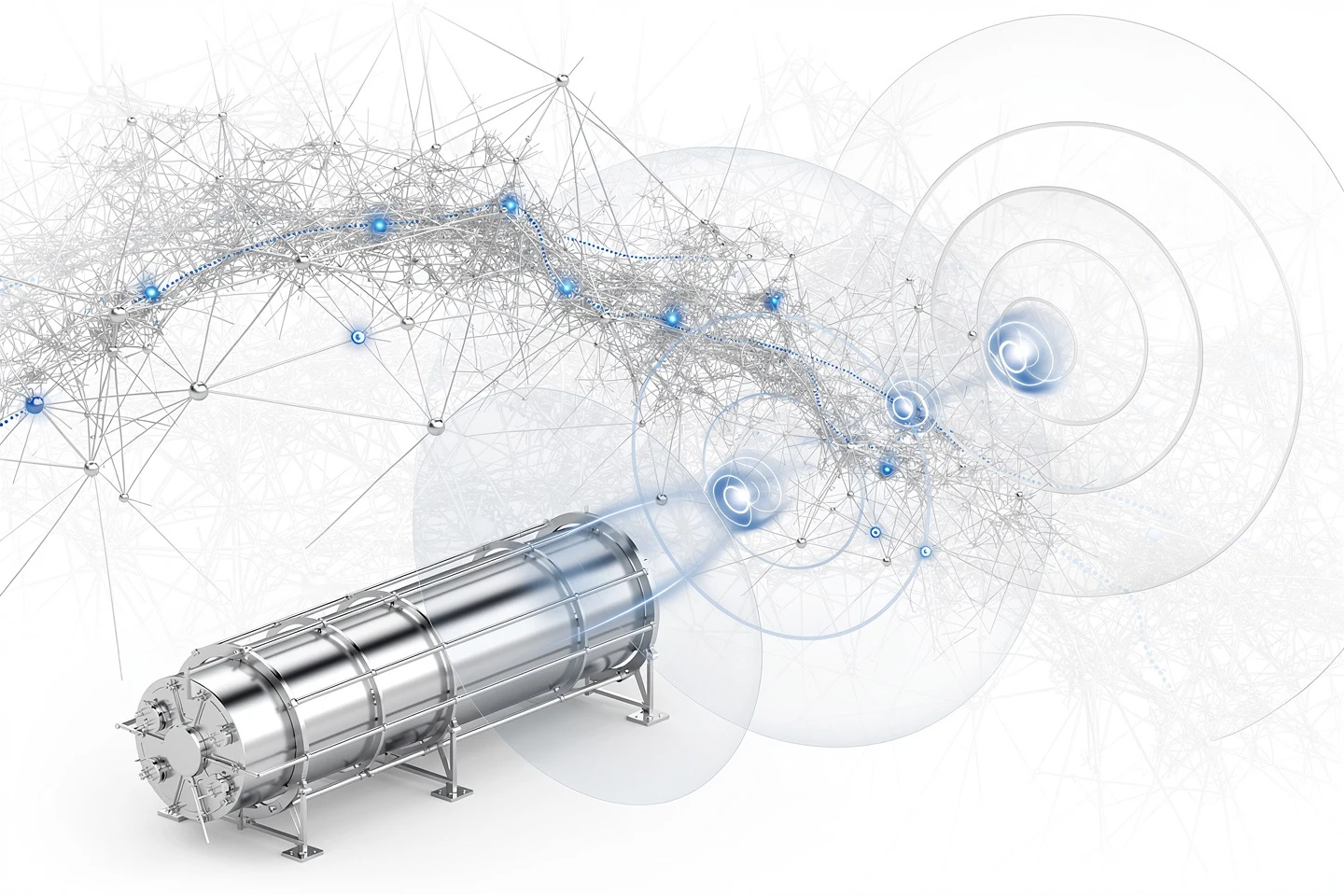
Half a century ago, Fritz Zwicky noticed that the visible matter in galaxy clusters was catastrophically insufficient to explain gravity. Today we know that a significant fraction of ordinary matter, the very baryons, hides in the diffuse plasma between stars and galaxies, in a giant web of hydrogen and helium. The 'hidden baryons' problem remained a challenge for decades because traditional telescopes couldn't detect this barely warm ionized gas. But nature provided an elegant probe — neutron stars, emitting fast radio bursts (FRBs). Each such pulse is like a discharge of cosmic lightning: lasting milliseconds, it travels through a thicket of electrons, and just as the delay of thunder betrays the distance to a storm, its dispersion measure (DM) accumulates information about the electron density along the line of sight.
The CHIME telescope, with its network of antennas spread across Canada, recorded 3455 such 'lightning bolts' scattered across the entire northern hemisphere. Astronomers subtracted the contribution of our Milky Way and for the first time constructed the angular autocorrelation spectrum of residual DMs — essentially, a map of how strongly electron density fluctuates at different angular scales. The metaphor is remarkably precise: just as a meteorologist uses a map of lightning strikes to identify pockets of moist air, we use the pattern of bursts on the sky to infer clumps of baryonic plasma. The statistics proved solid: the signal exceeds random noise at a confidence level above 3σ, meaning we are indeed seeing the cosmic web, not noise.
By comparing the measured spectrum with predictions from the standard model ΛCDM, where matter evolution is computed down to the smallest details, scientists obtained the first constraints. With a fixed fraction of baryons in structures $f_d$ = 0.83, the baryon density $Ω_b$ h² = 0.035, and the Hubble constant H₀ = 74 km/s/Mpc — still with sizable uncertainties, but already in the same range as the classical estimates obtained long ago by Edwin Hubble using nearby galaxies. If, instead, H₀ is fixed, the baryon fraction $f_d$ = 0.56 and $Ω_b$ h² = 0.047. These numbers are tantalizing: they hint that the current tensions in measuring the Universe's expansion rate could be resolved once hundreds of thousands of FRBs come into play. Notice how the numbers resonate with the work of Vera Rubin: her galaxy rotation curves showed the dominance of dark matter, but now we are also beginning to map the ordinary matter, entwined with it in a single cosmic dance.
An avalanche is coming. Instruments like SKA and DSA-2000 will catch thousands of FRBs daily by the end of the decade. The angular power spectrum will cease to be a statistical curiosity and will become a precision probe. Imagine: cross-correlating the DM field with maps of the cosmic microwave background will show how dark energy stretches baryon clumps during the acceleration era. Gravitational lensing by dark matter will add a third axis, and we'll get a holographic snapshot of the large-scale structure. The hidden baryon problem, which plagued Zwicky himself, will finally get a quantitative solution. And then, perhaps, the nature of dark matter will reveal itself in subtle distortions of these 'thunderstorm' maps.
Thus, fast radio bursts are moving from the category of astrophysical curiosities to the status of a fundamental tool, linking the Big Bang era with the modern Universe. Henceforth, each cosmic lightning bolt is not just a flash, but a stroke on the portrait of the invisible.
Fast radio bursts are so energetic that a single millisecond pulse releases as much energy as the Sun does in several days. Moreover, they come from all directions and can serve as 'lighthouses' that illuminate the cosmic web.
The idea of using distant pulses to study hidden matter echoes the concept of 'interstellar radio beacons' from Carl Sagan's novel 'Contact,' where an extraterrestrial signal carries information about the structure of the Universe.