How to Spot Life in a Chunk of Ice ✛
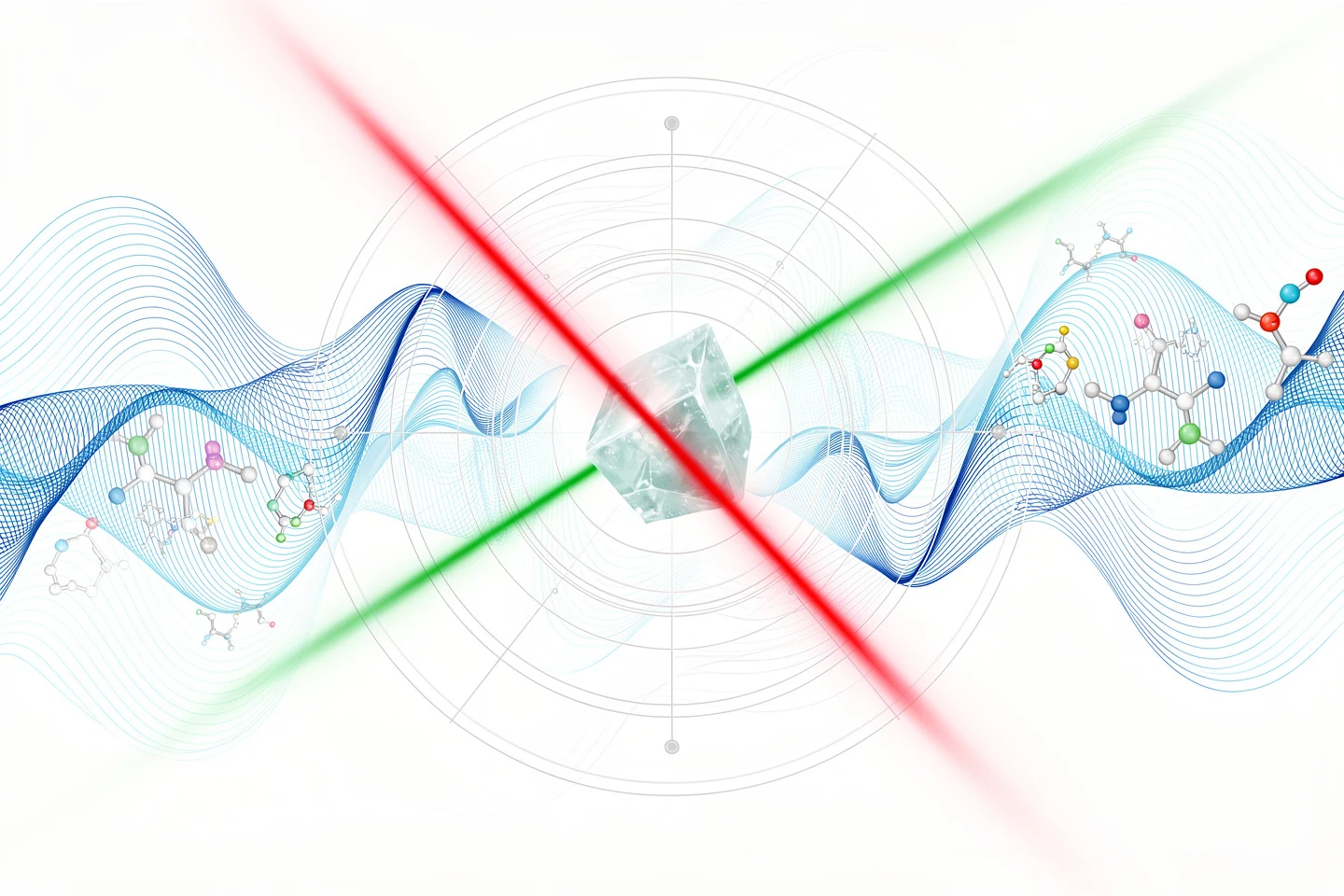
In the cold of space, beneath the icy crust of moons, simple molecules of life could be lurking. In the past, finding them meant melting or drilling the ice. But now there's a gentler method. Imagine a frozen cube of sweet tea. If you heat it gently, the sugar makes the ice expand in a slightly different way. This thermal “fingerprint” can reveal what’s inside. Scientists have done something similar: they use one laser to heat a tiny spot on the ice, and a second to read the microscopic expansion caused by that heat. It’s called O-PTIR.
In the lab, they froze the amino acid glycine — one of the “building blocks” of proteins. It turned out that even a tiny impurity—0.2 parts per million — changes the spectral pattern of the ice. The ice itself, under the influence of organics, starts absorbing light differently. This means we might not need to chase the signal of the organics themselves, just noticing the distortion in ordinary water ice could be enough. Water, which fills these worlds, is made of hydrogen and oxygen. Interestingly, Cecilia Payne-Gaposchkin was the first to prove that hydrogen is the main element of the universe.
This approach paves the way for future spacecraft. A probe could “feel” the ice with a beam from orbit or after landing, without damaging it. Large telescopes like the James Webb can also spot changes in the spectra of distant icy bodies. Perhaps one day humanity will glimpse the ghost of life simply by studying the light reflected from a frozen moon.
The method is so sensitive it could detect glycine even if you dissolved a single aspirin in an Olympic-sized pool.
In the sci-fi book 2010: Odyssey Two, a probe lands on Europa in search of life — O-PTIR technology could make that a reality.