Opto-Photothermal IR Spectroscopy: A Fresh Look at Organics in Ice ✛
Context
The search for signs of life beyond Earth has captivated astrophysicists and planetary scientists for decades. Icy moons like Europa and Enceladus are among the most promising places to find organic molecules—the building blocks of life. But analyzing these compounds right on the surface of celestial bodies hits a snag: how do you detect and precisely identify rare organic flecks inside an ice matrix without destroying their spatial context? Traditional IR spectroscopy is limited by the diffraction limit, and mass spectrometry requires sample destruction. A new technique, opto-photothermal IR spectroscopy (O-PTIR), overcomes these limitations, opening the submicron world of ice grains. This work not only lays groundwork for future space missions but also echoes the legacy of great scientists like Cecilia Payne-Gaposchkin, who showed stars are mostly hydrogen, and Johann Balmer, who deciphered hydrogen’s spectral series.
Methods
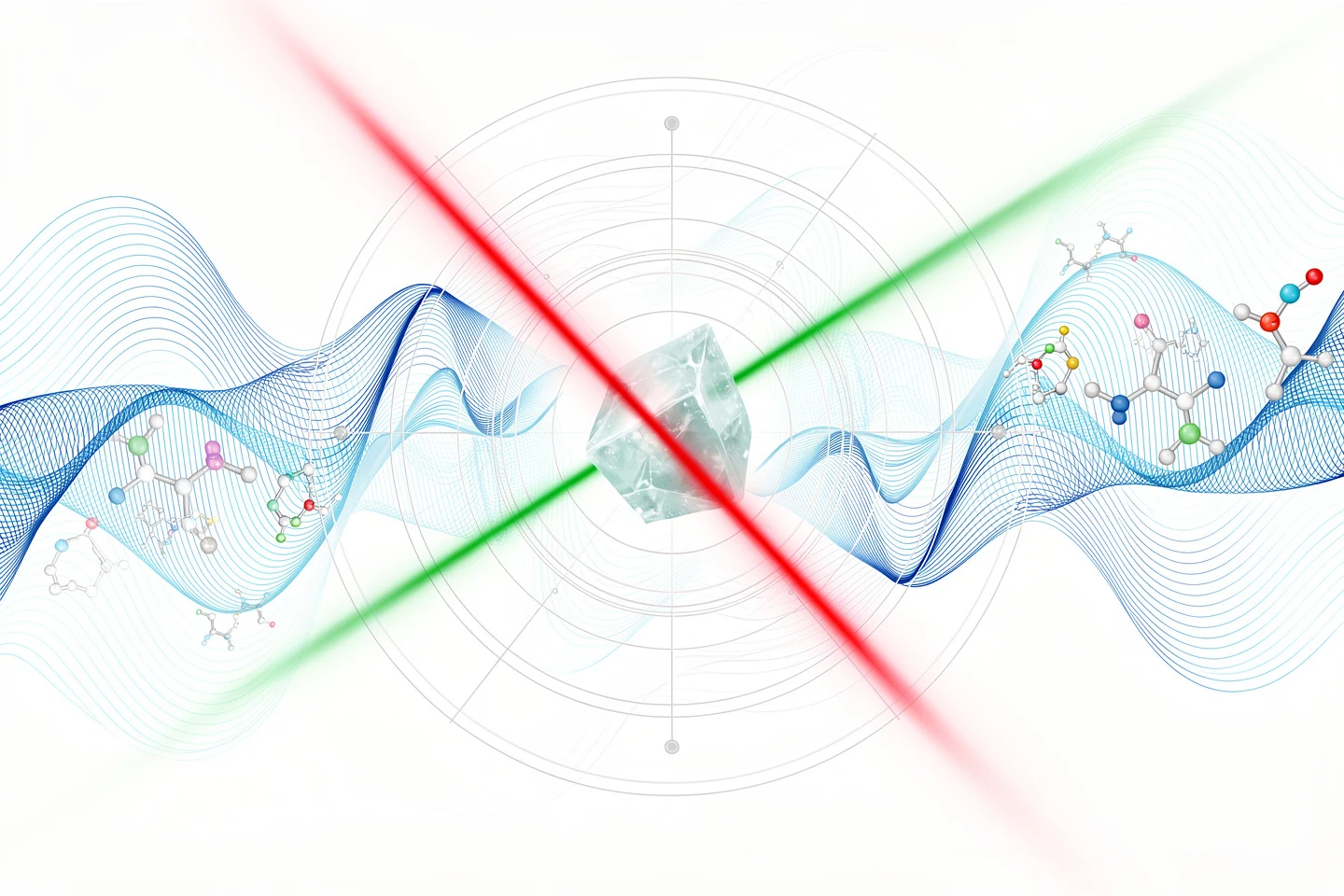
The method is based on photothermal modulation: a pulsed, tunable IR laser (pump) heats absorbing molecules locally, and their thermal expansion is detected by a visible probe laser. This way, spatial resolution is determined by the visible beam spot size, not the IR wavelength, enabling submicron detail. To work with ice, the team designed a three-stage Peltier element keeping the temperature at −15°C, and a purging system to eliminate frost (humidity below 8%). Samples were prepared by serial dilution of L-glycine and lactic acid in deionized water and deuterium oxide D2O. Spectra were collected in the 5.4–10.4 µm range with a pump laser power below 20 mW, ensuring non-destructive analysis—a critical requirement for fragile ice samples.
Results
The experiment showed that O-PTIR can reliably identify organics in water ice. The detection limit for L-glycine was 0.2 µM (0.015 parts per million), and the quantification limit was 3.83 µM. Pure frozen H2O and D2O spectra showed no significant absorption bands, but with organics, a broad band appeared near 1650 cm−1, overlapping the H-O-H bending vibration. Comparison with D2O revealed a shift of the L-glycine band toward its position in the pure crystalline state, indicating a specific interaction between organic molecules and the water environment. In binary mixtures of L-glycine and lactic acid, O-PTIR not only distinguished the components but also estimated their proportions. Comparison with a linear superposition model of the spectra gave a coefficient of determination R² up to 0.95; the exception was a mixture with nearly equal ratio, where band broadening was anomalously small (broadening factor 0.52), possibly indicating cocrystal formation. Spatial mapping revealed heterogeneous organic distribution with ~0.5 µm resolution.
Implications
These results fundamentally change the interpretation of icy body spectra. Shifts and broadening of H2O bands induced by even trace organics mean that standard models linking spectral features solely to ice physical properties (temperature, crystallinity) need revising. For astrobiology, this provides a new observational yardstick: the distortion of water bands itself could serve as a biomarker during remote sensing with future telescopes like JWST. More broadly, the work highlights that even “empty” spectral regions in spectroscopy of celestial bodies may hold encrypted information about molecular-level interactions.
Future development
This technology is at the beginning of miniaturization for spaceflight. Work is underway to reduce mass, power consumption, and size to levels suitable for planetary landers and small-body orbiters. In the future, O-PTIR could be combined with mass spectrometry and Raman spectroscopy into a single analytical suite, preserving sample context before destructive analysis. Scaling the method for ice cores returned from Enceladus or Europa will usher in an era of molecular paleontology beyond Earth.
Impact
The development will impact astrobiology (life detection), planetary science (icy body studies), and materials science (analysis of multicomponent transparent media). Space agencies like NASA and ESA are already eyeing O-PTIR for Flagship-class missions to icy moons.
Next steps
Next steps include testing on more complex organic mixtures simulating meteorite composition, and studying the influence of mineral impurities under vacuum and low temperatures approaching real planetary conditions.
Key open problems
The work directly connects to the problem of interpreting spectroscopic data from icy bodies, where features are mistakenly attributed solely to ice physical properties, and to the fundamental question of life’s origins: how organic molecules concentrate and interact in cryogenic environments, setting the stage for prebiotic chemistry.
The knowledge machine's view
This section is addressed to the author of the paper and their colleagues. Neighbouring works were found by meaning-based search across our archive, not by word overlap. We do not review: we show the field around the work.
What the work does
The paper introduces O-PTIR as a method for non-destructive mapping of organic molecules in ice matrices with submicron resolution. The authors developed a cryogenic cell, measured detection limits for glycine and lactic acid, and investigated spectral changes in ice in the presence of organics.
Where its strength is
The key strength lies in achieving submicron spatial resolution without damaging the sample, which opens up the possibility of studying the distribution of organics in heterogeneous ices while preserving their native context.
Where it could go next
- It might be interesting to see how machine learning methods, similar to those used for rapid analysis of stellar spectra, could speed up the interpretation of O-PTIR data, especially when analyzing complex multicomponent mixtures.based on: Neural Network Reads Stars' Chemical Passport in Seconds arXiv:2604.03082
- A related approach involves using interferometry to suppress the bright background signal; adapting such a technique could help isolate weak organic bands against the strong ice absorption.based on: Tricoupler on a Chip: The Knot That Cancels Starlight arXiv:2607.26168v1
- To extend applicability to other icy environments, one could look at studies of mineral analogs of biosignatures; comparing spectral characteristics across different matrices could aid in interpreting data from planetary surfaces.based on: The Red Edge of Life and Its Mineral Mimics arXiv:2605.10646
Worth trying
- Test whether spectral decomposition methods used in astrophysics can be applied to automatically separate the contributions of ice and multiple organic components in O-PTIR spectra.
- Try a background suppression technique based on interference, similar to nulling interferometry, to improve the signal-to-noise ratio when detecting trace amounts of organics.
- Compare O-PTIR spectra of the same organic molecules in ice matrices and mineral analogs to assess the influence of the environment on diagnostic bands.
Why this may matter
Further development of the method toward automated analysis and increased sensitivity could make O-PTIR a key tool for future missions searching for life on icy bodies in the Solar System.
Nearby works in our archive
- Black Hole Lens Catches Light from Distant Nebulaesimilarity 0.60
- How to Catch Microplastics with Twin Lightsimilarity 0.59
- How to Peer into the Depths of Distant Planetssimilarity 0.59
- Neural Network Reads Stars' Chemical Passport in Secondssimilarity 0.59
- Tricoupler on a Chip: The Knot That Cancels Starlightsimilarity 0.58
- An Ionic Spinner in a Cosmic Trapsimilarity 0.58
- The Red Edge of Life and Its Mineral Mimicssimilarity 0.57
The archive is sparse around this work: the closest review is only 0.60, against a usual 0.64. It looks like few have drilled nearby.
Original abstract
as written by the authors arXiv:2607.05629v1
The detection and characterization of organic molecules within water ice is vital for interpreting observations of icy moons and comets. However, organic-ice interactions often distort intrinsic water-ice absorption features, complicating infrared (IR) spectral analysis. This study evaluated Optical Photothermal Infrared (O-PTIR) spectroscopy as a non-destructive, sub-micrometer resolution technique to detect and quantify embedded organics. Using a temperature-controlled sample environment to maintain ice stability, frozen mixtures of amino and hydroxy acids were analyzed across a broad concentration range. L-glycine was successfully detected down to approximately $$10^{-6}\text{ M}$$, yielding an experimental limit of detection (LOD) of $$0.2\,\mu\text{M}$$ and a limit of quantification (LOQ) of $$3.83\,\mu\text{M}$$. Furthermore, O-PTIR measurements of binary mixtures containing L-glycine and lactic acid demonstrated the capacity to differentiate and quantify multiple organic components within a single ice matrix. Notably, a broad absorption feature centered near the water-bending mode appeared exclusively in organic-bearing ice samples and was absent in pure $$\text{H}_2\text{O}$$ and $$\text{D}_2\text{O}$$ controls. Comparative analysis in these matrices revealed that embedded organics actively perturb intrinsic ice features, providing new constraints on organic-ice interactions. Ultimately, these results demonstrate that O-PTIR spectroscopy can reliably detect, quantify, and spatially resolve organic compounds in water ice while preserving crucial sample context. The technique offers a promising framework for future laboratory investigations of icy planetary materials and directly informs the interpretation of spectroscopic data from volatile-rich space environments.
The method’s sensitivity is such that it can detect L-glycine in an amount equivalent to one aspirin tablet dissolved in a 25-meter Olympic swimming pool.
In Arthur C. Clarke’s novel “2010: Odyssey Two,” a probe detects organics beneath Europa’s ice — O-PTIR technology could be the real-world tool for such a mission.
Key numbers
- L-glycine detection limit: 0.2 µM (0.015 ppm)
- quantification limit: 3.83 µM (0.288 ppm)
- spatial resolution: submicron (<1 µm)
- pump laser power: <20 mW
- working humidity: <8%