Icy Whisper: O-PTIR Captures Amino Acids Beyond Diffraction ✛
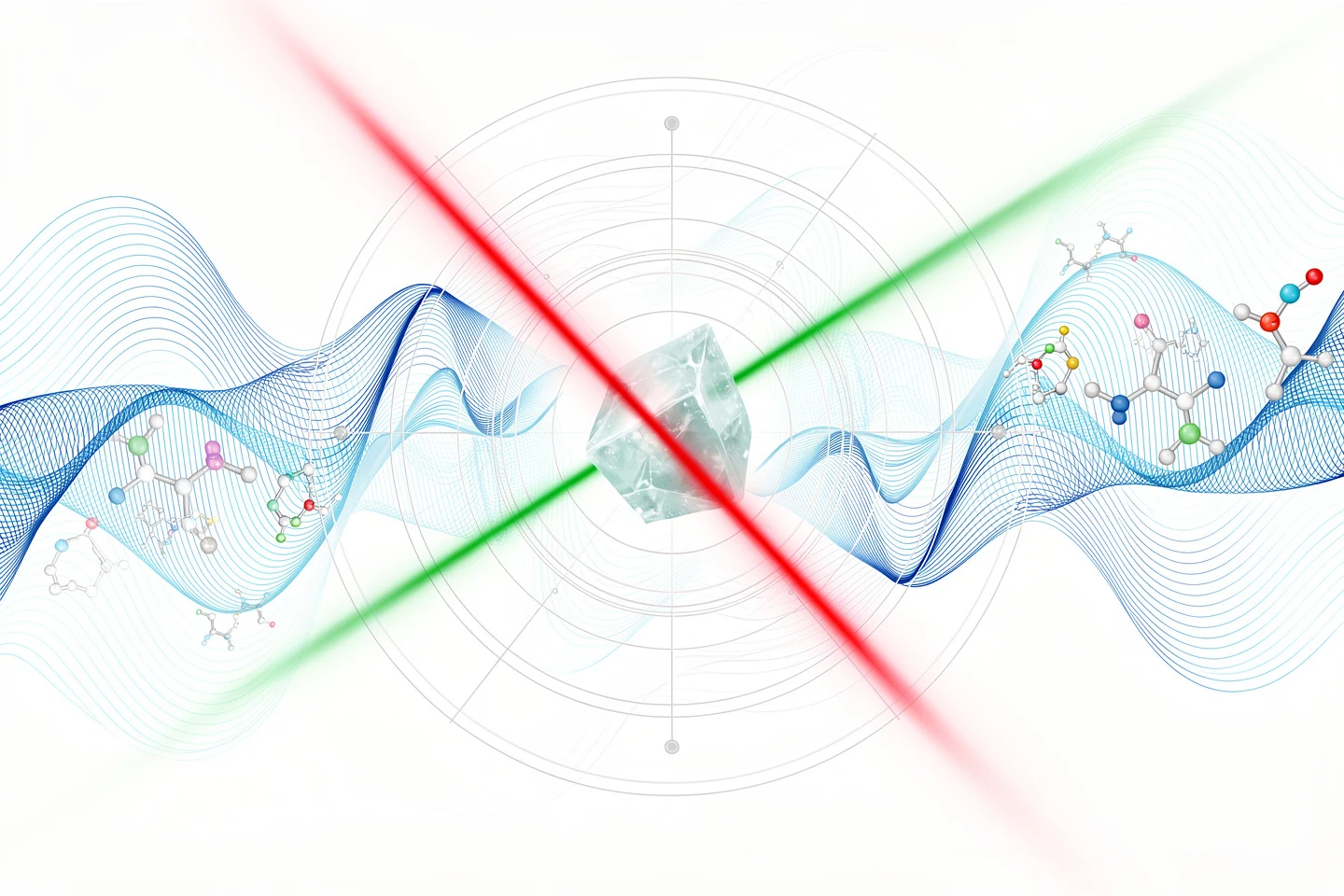
Spectroscopy has always been a way to hear the unheard. Back in the 19th century, Johann Balmer deciphered the elegant lines of hydrogen — a simple numerical harmony that foreshadowed quantum theory. Later, Edwin Hubble used the redshift of galaxies racing away from each other at speeds comparable to the speed of light to discover the expansion of the Universe, which became the basis for the Big Bang. And Cecilia Payne-Gaposchkin proved that stars are three-quarters hydrogen, turning astrophysics on its head. Today, spectroscopy is learning to listen to the molecular heat of icy worlds, and the new tool for this is O-PTIR.
Ice is a giant crystalline organ. Each water molecule vibrates, striking a note, and their synchronized chorus produces a characteristic infrared spectrum. But when an outsider sneaks into the orchestra, an amino acid molecule, it doesn't play its own part loudly. Instead, it sort of presses on the neighboring pipes, slightly altering their tuning. O-PTIR catches these subtle distortions: a laser pulse heats the absorbing molecules, causing thermal expansion, and a visible probe beam reads the resulting topography with submicron precision. This way, the method bypasses the classical diffraction limit inherent in traditional IR spectroscopy.
But the real intrigue isn't the record sensitivity. Experiments with heavy water (D₂O) showed that the H-O-H bending band near 1650 cm⁻¹ shifts and broadens in the presence of organics. This means the amino acid isn't just present: it actively interacts with the water matrix, reshaping the spectral landscape. In other words, even if the organic's own lines are masked or lost in noise, the distortion of the icy background itself can serve as a marker. Thus, we learn to recognize biomolecules not by their direct 'voice,' but by how the surrounding medium's sound changes. This approach echoes how physicists search for gravitational waves — not by the glow of stars, but by the trembling of spacetime, or how dark matter reveals itself through gravitational influence on visible objects. O-PTIR does something similar for icy bodies.
These findings challenge established planetary science models that for decades attributed the shape of water bands solely to temperature, crystallinity, and grain size. It's now clear that even trace amounts of organics can mimic or mask these effects. For future missions to Enceladus and Europa, this means any ultraviolet or infrared telescope, from JWST to an orbital spectrometer, must analyze not absolute values but anomalies in H₂O spectra. The Universe itself may have placed clues for us in the most mundane molecular vibrations.
The technology is already stepping out of the lab into space. Engineers are shrinking the system size, optimizing thermal sensors, and preparing prototypes for vacuum operation. In the future, O-PTIR could join the arsenal of landers that will drill through Enceladus's icy crust, allowing us to read molecular chronicles billions of years old. This would be true paleontology of another world — except instead of fossilized bones, we'll see the thermal shadows of ancient amino acids. From the simple spectral lines of hydrogen to the complex patterns of icy organics: it seems the story of spectroscopy is only entering its most thrilling act.
The method is sensitive enough to detect L-glycine in an amount equivalent to one aspirin tablet dissolved in a 25-meter Olympic-size swimming pool.
In Arthur C. Clarke's novel '2010: Odyssey Two,' a probe finds organics beneath Europa's icy crust — O-PTIR could be the real-world embodiment of that foresight.