The Stellar Conductor of Planetary Atmospheres ✛
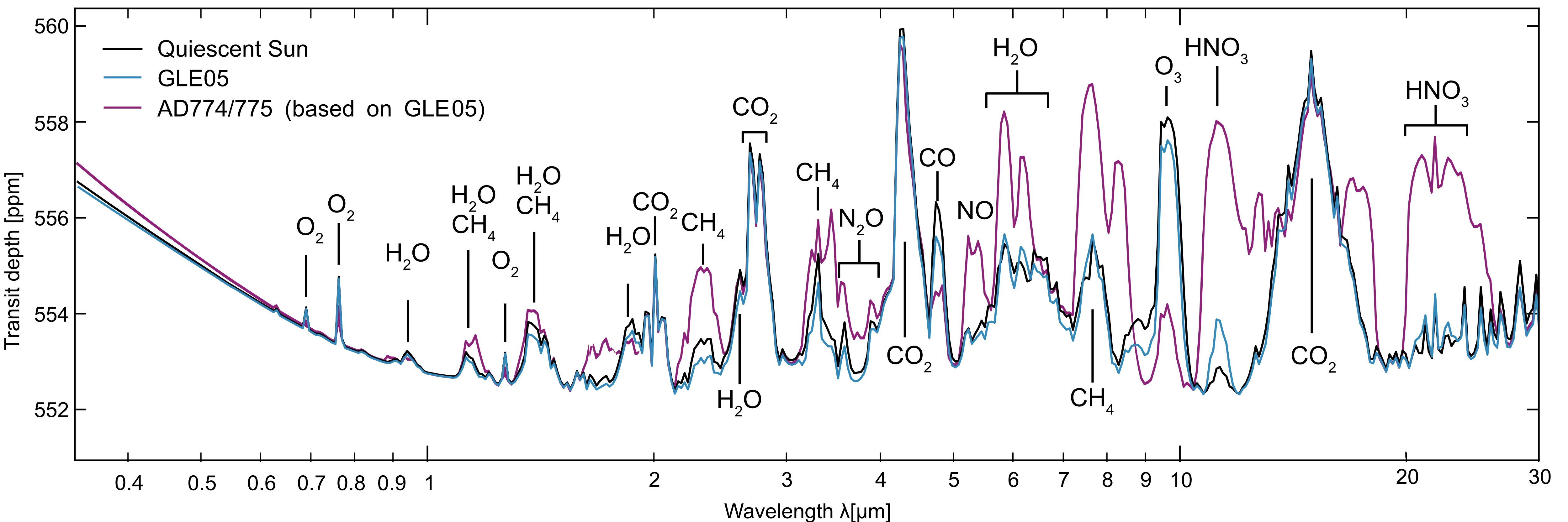
A planet in the habitable zone is no guarantee of life. Like a conductor leading an orchestra, a star dictates the tempo and character of planetary atmosphere evolution over billions of years. Stellar evolution shifts the boundaries of the liquid-water zone, while magnetic activity in X-ray and ultraviolet (XUV) bands can strip a planet's gaseous envelope. This struggle is especially dramatic around red dwarfs, whose planets receive hundreds of times more high-energy radiation than the early Earth.
Researchers combined several computational platforms. The evolution of stellar luminosity and X-ray flux was calculated using models by Johnstone and colleagues, linking stellar rotation rate to age and magnetic dynamo. For atmospheres, they used the one-dimensional thermochemical code Kompot, accounting for radiative heating, chemical networks, and radiative cooling. The contribution of cosmic rays was estimated via the Bethe–Bloch equation and cascade models, while magnetic field effects were assessed with magnetohydrodynamic simulations of planetary dynamos.
Models show that retaining an Earth-like atmosphere in the Archean required at least 40% CO₂, and only the slow rotation of the young Sun leaves a chance to hold onto the gas envelope. For M dwarfs, the habitable zone shrinks by a factor of 6 over the first billion years, and the X-ray flux there remains lethally high for another 1–7 billion years. Planets like TRAPPIST-1, according to calculations by Van Looveren and co-authors, could not retain a CO₂/N₂ atmosphere for most of the system's history.
At the same time, James Webb observations confirm that LHS 1140 b has retained a dense gas envelope, while 55 Cancri e, in contrast, exists in a regime of volcanic replenishment of volatiles. The concept of the "cosmic shoreline" by Zahnle and Catling transforms from a binary boundary into a transition zone, depending on atmospheric composition and initial volatile inventory. A planet's magnetic field is no longer an unambiguous protector: with strong stellar and planetary fields, atmospheric losses can even increase due to a larger reconnection area.
Future research should combine three-dimensional climate models with realistic space weather, including flares and coronal mass ejections. A key goal is direct detection of exoplanetary magnetic fields via cyclotron emission or transit asymmetries in the ultraviolet. This would close the chain from stellar dynamo to the fate of biosignatures.
The star's baton is relentless. It sometimes quickens the tempo, stripping atmospheres from young planets, and sometimes lingers in a long adagio, allowing life to gain strength. Only by observing the entire symphony, from the first flares to the final dimming, can we understand where in the universe the music of life plays.
Mars lost most of its atmosphere not only because of weak gravity, but also because its dynamo fell silent about 3.5 billion years ago. If Earth's core had cooled a bit faster, our planet might have shared its fate.
In Kim Stanley Robinson's Mars trilogy, colonists face the challenge of retaining an artificial atmosphere — essentially the same problem nature solves for exoplanets in the habitable zone.