The Stellar Conductor of Planetary Atmospheres ✛
Context
A planet in the habitable zone is no guarantee of life. Just as a conductor leads an orchestra, a star dictates the tempo and character of planetary atmospheric evolution over billions of years. Stellar evolution shifts the boundaries of the liquid-water zone, while magnetic activity in X-ray and ultraviolet (XUV) bands can strip a planet's gaseous envelope. This battle is especially dramatic around red dwarfs, whose planets receive hundreds of times more high-energy radiation than the early Earth did.
Methods
The researchers combined several computational platforms. The evolution of stellar luminosity and X-ray flux was calculated using models by Johnstone and colleagues, linking stellar rotation rate to age and magnetic dynamo. For atmospheres, they used the one-dimensional thermochemical code Kompot, which accounts for radiative heating, chemical networks, and radiative cooling. The contribution of cosmic rays was estimated using the Bethe–Bloch equation and cascade models, while the influence of magnetic fields was assessed via magnetohydrodynamic simulations of planetary dynamos.
Results
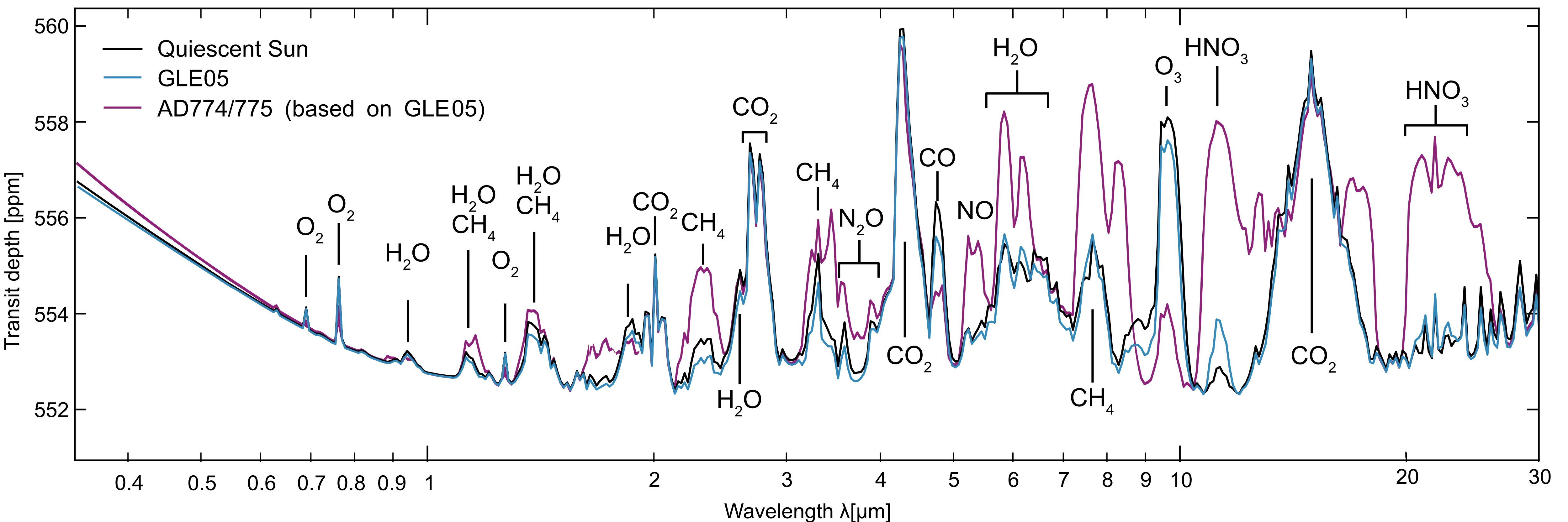
The models show that retaining an Earth-like atmosphere in the Archean required at least 40% CO₂, and only the slow rotation of the young Sun leaves a chance to hold onto the gas envelope. Around M dwarfs, the habitable zone shrinks by a factor of 6 over the first billion years, and the X-ray flux within it remains lethally high for another 1–7 billion years. Planets like TRAPPIST-1, according to calculations by Van Looveren and co-authors, could not retain a CO₂/N₂ atmosphere for most of the system's history. Meanwhile, James Webb observations confirm that LHS 1140 b has retained a dense gas envelope, while 55 Cancri e exists in a regime of volcanic replenishment of volatiles. Cosmic rays can increase ionization and NOₓ production by orders of magnitude, destroying ozone and creating detectable spectral features, such as the HNO₃ band at 12 μm.
Implications
The concept of the “cosmic shoreline” by Zahnle and Catling transforms from a binary boundary into a transition zone that depends on atmospheric composition and initial volatile inventory. A planetary magnetic field is no longer a clear-cut protector: with strong stellar and planetary fields, atmospheric losses may even increase due to a larger reconnection area. Habitability requires considering the entire evolutionary history of the system, not just a snapshot.
Future development
Future research should combine three-dimensional climate models with realistic space weather, including flares and coronal mass ejections. A key goal is the direct detection of exoplanetary magnetic fields via cyclotron radiation or transit asymmetries in the ultraviolet. This would close the chain from stellar dynamo to the fate of biosignatures.
Impact
The results will directly influence target selection for future missions characterizing Earth-like planet atmospheres (Habitable Worlds Observatory) and the interpretation of JWST data.
Next steps
Perform an intercomparison of one-dimensional and three-dimensional atmospheric chemistry models under identical stellar flare scenarios. Investigate in detail the role of volcanic replenishment of volatiles on planets with stagnant lithospheres.
Key open problems
This work addresses the origin of life (prebiotic chemistry driven by UV radiation), the faint young Sun paradox (resolved by high CO₂ levels in the Archean), and the question of whether Earth is unique as a habitable planet.
The knowledge machine's view
This section is addressed to the author of the paper and their colleagues. Neighbouring works were found by meaning-based search across our archive, not by word overlap. We do not review: we show the field around the work.
What the work does
The review examines the role of stellar radiation and magnetic activity in the evolution of planetary atmospheres and habitability. The authors combined stellar evolution models, the one-dimensional thermochemical code Kompot, cosmic ray considerations, and magnetohydrodynamic simulations to trace the fate of atmospheres around red dwarfs and Sun-like stars.
Where its strength is
The strength of the work lies in its comprehensive approach, linking the long-term evolution of a star's luminosity and magnetic activity with atmospheric chemistry, escape, and observable spectral features. This provides a holistic picture where habitability is not a static property but the result of the entire system's history.
Where it could go next
- It might be interesting to compare the predicted spectral markers (e.g., HNO₃ at 12 μm) with the capabilities of future observations. A nearby work shows, using sulfur as an example, how chemical indicators in an atmosphere can reveal information about a planet's interior and geological activity.based on: Atmospheric Palimpsest: Sulfur as the Key to Exoplanet Interiors arXiv:2607.15204
- The influence of stellar flares on atmospheric chemistry is examined in an article about how flares alter the air of distant planets. It would be interesting to integrate such impulsive events into a long-term evolutionary model to assess their cumulative effect on habitability.based on: How Stellar Flares Change the Atmosphere of Faraway Planets arXiv:2604.20325
- The link between a star's color and its ability to support life is explored in a work that answers in color the question of which stars might host life. One could check how well your model's predictions for red dwarfs align with these color criteria.based on: Which Stars Can Give Birth to Life? The Answer's in the Color arXiv:2511.08624
Worth trying
- Try adding impulsive flares to the model following scenarios from a neighboring work and track the accumulation of NOₓ and ozone destruction over billions of years.
- Compare the spectral features you predict for different epochs with the geochemical activity indicators proposed in the 'Atmospheric Palimpsest'.
- Check how a planet's position relative to 'color' habitability criteria changes along the stellar evolutionary track.
Why this may matter
Such development could provide direct observational tests for models of long-term atmospheric evolution and help prioritize targets for future missions, bridging geophysics, stellar astrophysics, and astrobiology.
Nearby works in our archive
- Dark Matter Waves Stir Stars in Dwarf Galaxiessimilarity 0.63
- Dust That Never Agessimilarity 0.62
- How Stellar Flares Change the Atmosphere of Faraway Planetssimilarity 0.62
- How a Planet's Breath Shapes Its Fatesimilarity 0.62
- Atmospheric Palimpsest: Sulfur as the Key to Exoplanet Interiorssimilarity 0.61
- Which Stars Can Give Birth to Life? The Answer's in the Colorsimilarity 0.61
The closest work in the archive sits at 0.63 by meaning — the usual level for our corpus.
Original abstract
as written by the authors arXiv:2607.27531v1
This chapter will review the deep connection of planetary habitability and stellar irradiation. We present the long-term stellar evolution as one of the drivers of atmospheric escape and climate changes on exoplanets, as well as the chemistry driven by stellar UV and stellar energetic particles. Habitability is presented in the context of short and long-term stellar variability and evolution to layout what we understand and what we need to know about stellar irradiation to constrain our planetary atmospheric models and choose the best targets for future missions that may characterize those exoplanets.
Mars lost most of its atmosphere not only because of weak gravity, but also because its dynamo fell silent about 3.5 billion years ago. If Earth's core had cooled a bit faster, our planet might have shared its fate.
In Kim Stanley Robinson's Mars trilogy, colonists face the challenge of retaining an artificial atmosphere — essentially the same problem nature solves for exoplanets in the habitable zone.
Key numbers
- shrinkage of the habitable zone around a 0.1 M⊙ star over 1 billion years: by a factor of 6
- X-ray flux in the habitable zone of TRAPPIST-1 over 1–1000 million years: hundreds of times higher than Earth's
- minimum CO₂ fraction in the Archean Earth's atmosphere for retention: 40%
- age of the TRAPPIST-1 system: 7.6 ± 2.2 billion years
- energy of one powerful X-ray flare: 10³² erg