A Silicon Atom in the Dark: A Trap That Doesn't Glow ✛ ✎
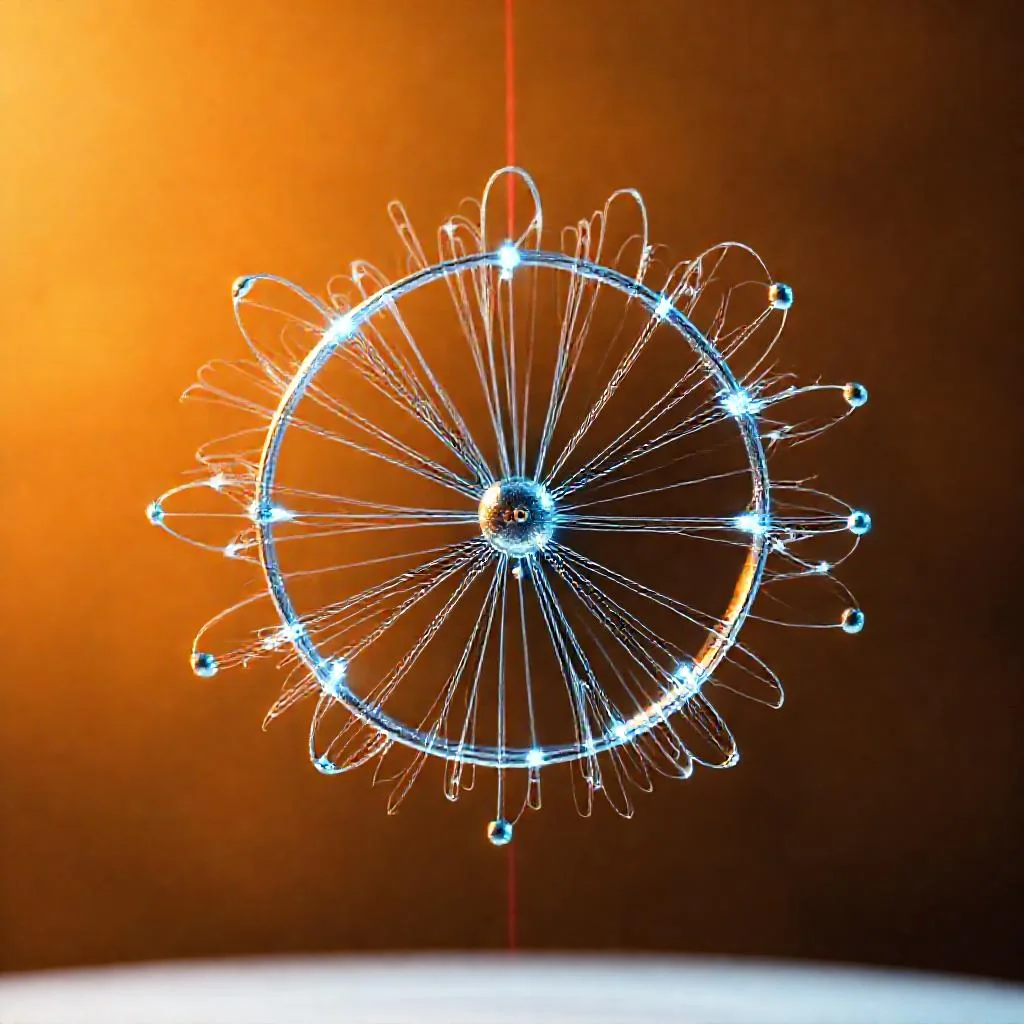
The laser beam in an optical tweezer is not just a spot of light but a force bag. A particle caught in it usually rolls toward the brightest point, like a ball into a dimple. But in the ETH Zurich lab, they caught a silicon cylinder about a hundred nanometers in size and held it in the darkest place of a standing wave — where light cancels itself out. The particle didn't escape; it just levitated calmly at the node, as if the light were pushing it away.
The secret is in the material. A glass sphere is always attracted to light because light slightly nudges the electrons inside it, and they drag the sphere along. Silicon is different: for certain cylinder sizes, the response to light changes sign. Then the particle behaves like a float that seeks not the wave crest but the trough. This is called negative polarizability, and previously it could only be used for atoms, not for solid particles.
The physicists fabricated the cylinders using lithography — the same technique that draws circuits in microchips. Then they suspended them in vacuum between two counter-propagating laser beams. The result was a standing wave: alternating bright and dark fringes. Glass spheres, as expected, gathered in the bright fringes. Silicon cylinders — in the dark ones. To confirm that the particle was indeed sitting in the dark, the scientists rotated the light's polarization and watched the scattered radiation: the pattern shifted by exactly 90 degrees, as it should for a node.
Before this work, it was thought that a solid particle could be held at a light minimum only with complex feedback or cleverly shaped beams. Here, the trap works on its own — simply due to the material and particle size. It's like learning to pitch a tent not on a sunny clearing but in the shade, where it's not hot and not windy.
Now that the dark trap is proven, particles can be brought almost touching surfaces — at distances smaller than the light wavelength. This will allow measuring forces that act only at such tiny distances and building quantum sensors from levitating objects. And if the particle is cooled to the ground state, the dark trap becomes an ideal stage for observing quantum behavior of large bodies.
Silicon cylinders can withstand laser power that would vaporize a glass sphere of the same size, because at an intensity minimum they absorb almost no light.
The idea of holding an object in darkness echoes the concept of a 'dark trap' from science fiction, such as the stasis field in the series 'Star Trek', where matter is held without visible interaction.