A Magnetic Score from Ions: How Irradiation Rewrites the Notes of CrSBr ✛
In the layered crystal CrSBr, the magnetic moments of atoms are arranged like notes in a score: within each layer they point in the same direction, but between layers they point in opposite directions. This antiferromagnetic melody plays up to 132 kelvin, beyond which thermal motion destroys the order. Physicists have learned to rewrite this score by bombarding the crystal with helium ions. The defects left behind act like inserted rests: they alter the interlayer interactions and make the notes sound different.
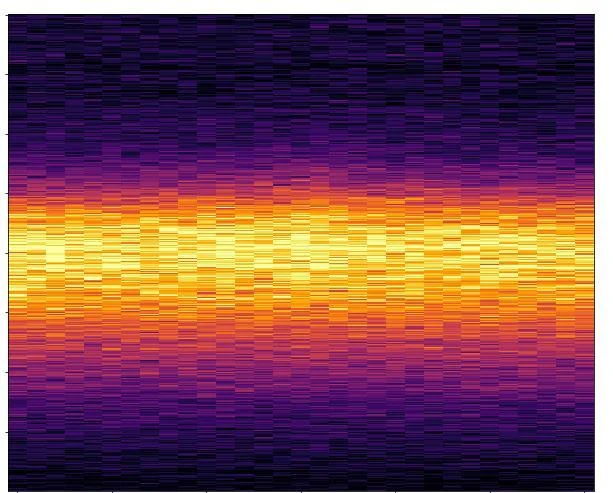
To hear the new key, the researchers used Raman scattering of light. A laser beam entering the crystal gives or takes energy from lattice vibrations, and the frequency shift reveals the material's state. But the key is light polarization. In pristine CrSBr, one component of the scattering tensor changes sharply at 132 K, marking the transition to the antiferromagnetic state. In irradiated samples, two new dips appear: around 40 K and 105–110 K. The first likely relates to ferromagnetic ordering of defects or spin freezing; the second to the establishment of a modified magnetic order.
The higher the irradiation dose, the louder the new notes sound: the anomalies grow, and in thick samples after double irradiation, the antiferromagnetic order is completely replaced by ferromagnetic order. Magneto-optical measurements at 4.7 K confirm that the material no longer responds to an external field because all spins are already aligned in one direction. Previously, such a flip required strong magnets or complex techniques; now, bombarding the crystal with helium suffices.
The method used in this work is a sensitive listener that catches the change in key without destroying the score. Polarization-resolved Raman spectroscopy proved sensitive to changes in the scattering tensor caused by magnetic ordering and allowed distinguishing transitions invisible in phonon frequency spectra. This is a fast, non-destructive way to control magnetic phases in thin layers, which could be useful in developing spintronic devices. The CrSBr score can now play in different keys, and researchers have learned to conduct it with ions.
The helium ions used for irradiation are the same alpha particles emitted during radioactive decay, but here they serve as a tool for precise material modification.
The idea of controlling material properties via irradiation echoes science fiction plots where radiation alters matter, yet here the process is controlled and reproducible.