Order That Doesn't Interfere: Topology in a Thin Film express
A mosaic floor made of many small tiles, each turned in a different direction. It seems that any pattern trying to cross such a floor would get scrambled and vanish. That's how people usually think about disorder in crystals: if atoms aren't arranged in a perfect lattice, delicate quantum effects should fall apart. But in a thin film of iron silicide (ε-FeSi), just 65 nanometers thick, things are different.
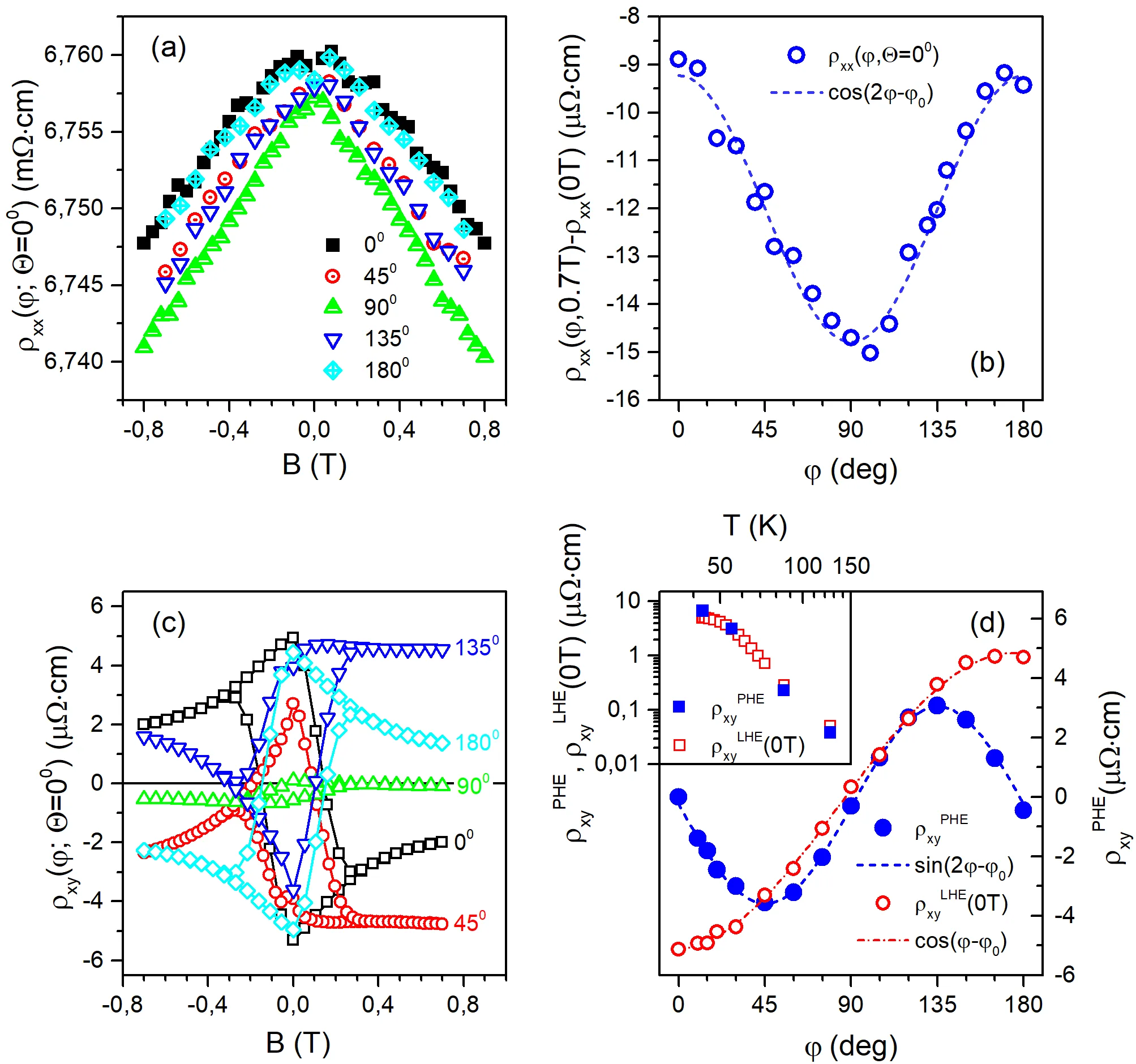
In this material, researchers found a robust anomalous Hall effect: a transverse voltage appears without any external magnetic field and doesn't change when cooling from 200 K down to the lowest temperatures. Such constancy is like a compass needle that always points north, even if you shake the compass or turn it upside down. This is a direct sign that the effect doesn't arise from scattering off defects but from the intrinsic geometry of electron clouds — the so-called Berry phase (the twist of an electron's wavefunction when it travels a closed loop in the crystal).
Additional measurements revealed another hallmark of Weyl semimetals — materials where electrons behave like massless particles with a definite "handedness" (chirality). In magnetoresistance and the planar Hall effect, a so-called chiral anomaly appeared: when electric and magnetic fields are parallel, the number of electrons with one "handedness" is no longer conserved, creating an unusual contribution to the current. From the magnitude of the anomalous Hall conductivity, the team even estimated the distance between the two Weyl points in momentum space — about 0.36 in arbitrary units.
The ε-FeSi film turned out to be surprisingly tough against disorder. Its topological character survives at room temperature and doesn't require expensive rare metals. This opens the way to cheap and reliable devices that exploit quantum properties under ordinary conditions. So the mosaic pattern of grains doesn't destroy the delicate dance of electrons: it only adds resilience.
The anomalous Hall effect in this film is so stable that it could serve as a resistance standard: the conductivity remains constant over a wide temperature range, as if frozen.
In Arthur C. Clarke's novel *Childhood's End*, aliens use materials with unusual internal geometry to control gravity. Topological semimetals are a step toward controlling electrons through the geometry of their quantum states.