Quiet Quark Waltz: New Data Tighten Bounds on Color Superconductivity ✛ ✎ ✦
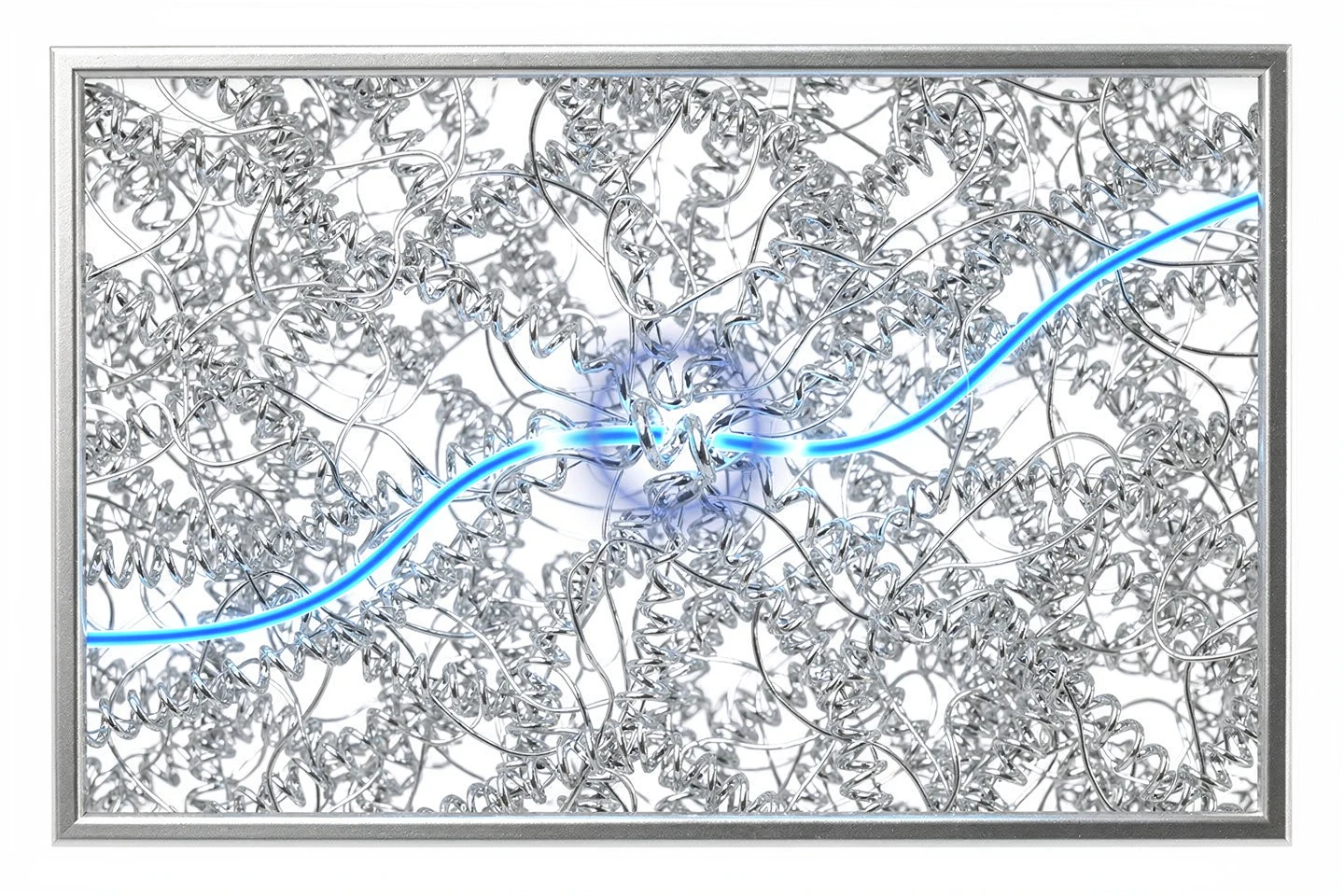
In the depths of a massive neutron star, where a teaspoon of matter weighs as much as a mountain, quarks are squeezed to unimaginable proximity. Long before these objects were discovered, Subrahmanyan Chandrasekhar calculated the limit for white dwarfs, and Fritz Zwicky boldly predicted that supernovae leave behind clumps of neutrons. Three decades later, Jocelyn Bell Burnell caught the strict rhythm of pulsars — and these remnants became the most precise clocks in the Universe. Now we know: at even greater depths, neutrons melt into quarks, and by the laws of quantum chromodynamics they stick together in pairs — like duets destined to spin in unison. Thus is born color superconductivity: a current of quarks flows without resistance, like in an ideal, frictionless ballet.
Imagine the star's core as a vast ballroom, where quarks are pairs of dancers. In the color-flavor locking (CFL) phase, every color rotation is inseparable from a flavor step: change the color — and the flavor instantly responds with a new move. The order parameter Δ is the strength of the music dictating the coherence. The louder the orchestra, the tighter the choreography and the more energy needed to break a duet apart. Theory promised deafening chords, but our 'telescopes' — LIGO, NICER, and spacetime curvature itself — only heard a quiet, barely discernible melody.
To eavesdrop on this dance, scientists wove together a polyphony of data: X-ray photometry of hot spots from NICER, spectroscopy of the gravitational-wave chorus of the GW170817 merger recorded by LIGO, and the record masses of pulsars. This cocktail was fed through a hybrid of neural networks and Gaussian processes — and it reconstructed the equation of state of matter up to the domain of perturbative QCD. The Bayesian verdict was inexorable: at a chemical potential of 2.6 GeV, the CFL parameter does not exceed 66 MeV (with 95% probability), and the most probable value is a mere 34 MeV. Most microscopic models expected between 50 and 150 MeV.
Such a small order parameter means: color superconductivity is just a delicate ripple on the mighty ocean of pressure, not its main wave. This is a wonderful simplification: now we can draw an almost straight line from astrophysical observations to the QCD phase diagram, without wandering in the fog of superconducting hypotheses. But why did nature choose such a modest symphony? Perhaps, at extreme densities, other, yet unknown states hold sway — quark crystals or vortices, awaiting their discovery.
When next-generation telescopes like eXTP and gravitational wave detectors like the Einstein Telescope begin delivering data with unprecedented clarity, we will either tighten this knot of constraints even further, or — and this is the most thrilling moment — catch the faint sigh of color superconductivity, the first true signal from the depths of quark matter. Then our dance score will be complete, incorporating notes that we are still only guessing at in the noise of the Universe.
The name 'color-flavor locking' sounds like a command for a synchronized dance: turn in color — and the flavor will mirror the movement. This symmetry turns a chaotic swarm of quarks into a harmonious ensemble, where each knows its step.