Cosmic Genealogy: How Black Holes Reveal Their Origins ✛ ✎ ✦
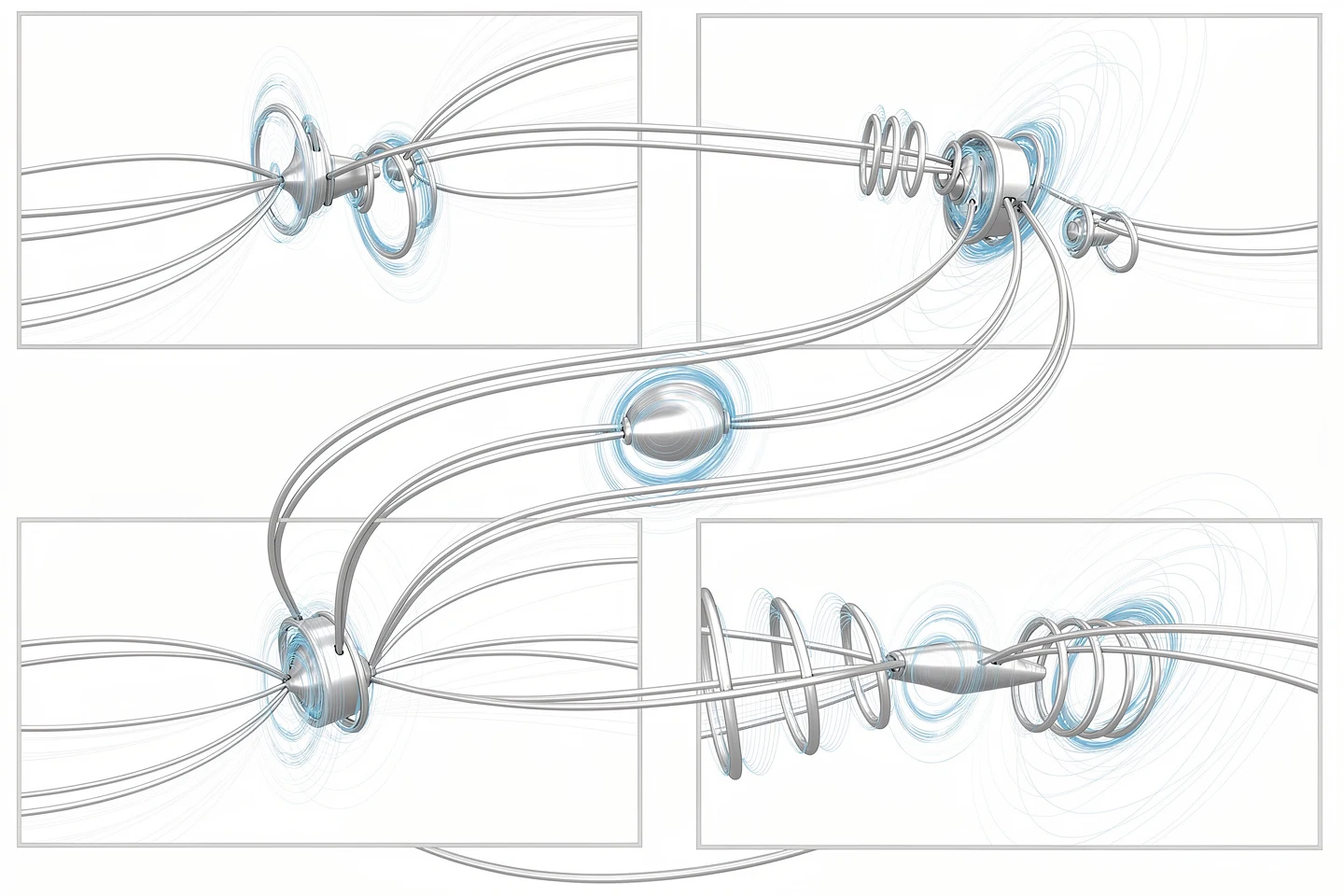
A hundred years ago, Einstein predicted gravitational waves, and Schwarzschild found the first solution for a black hole. Today, the LIGO, Virgo, and KAGRA detectors, to which Rainer Weiss contributed immensely, have turned these mathematical abstractions into observable reality. The latest catalog GWTC-5 contains 259 black hole mergers, and one puzzle keeps haunting us: where do pairs with anomalously large masses and rapid spins come from? Two hypotheses vie for the title of the main 'sculptor' of these giants: repeated collisions in dense clusters, hierarchical assembly, or quiet gas accretion onto an isolated hole.
Imagine the mass function as the genealogical DNA of black holes. Comparing the 'genetic fingerprints' of the low-spin population (the first generation, born in supernovae) and the high-spin one (candidates for descendants), astrophysicists saw an incredible kinship. Accounting for redshift and selection effects, the model showed: the distribution curve of remnant masses after mergers of the first group exactly mirrors the shape of the mass function of the second. Daughter holes inherit the traits of their parents, like a cosmic aristocracy passing down its coat of arms. The Bhattacharyya coefficient, a mathematical measure of similarity, reaches 0.95 in the key range of 40 to 80 solar masses. This is no accident, but direct evidence: high-spin massive objects do not arise on their own, but are assembled from the remnants of previous collisions.
Hierarchical assembly not only explains the origin of the 'heavyweights' but also sheds light on other mysteries. The sharp cutoff of the low-spin population at 54.2+7.7-7.2 solar masses, the lower edge of the mass gap, served as a natural ruler for nuclear physics. This gap is caused by pair-instability supernovae, which leave almost no black holes of certain masses. From the position of the cutoff, it was possible to compute the S-factor of the ¹²C(α,γ)¹⁶O reaction — key to nucleosynthesis in massive stars. The result S₃₀₀ ≈ 151 keV·barn agrees brilliantly with theory, confirming the method's reliability. Alternative scenarios, such as growth via an accretion disk, would require fine-tuning to mimic the same spectral features — nature dislikes such fussiness.
With each new observing run of LIGO, Virgo, KAGRA and future giants like the Einstein Telescope, we will trace this family tree to the third, fourth generations. Data on intermediate-mass black holes will emerge — a bridge to the supermassive monsters in the centers of galaxies. Stellar evolution physics will face strict constraints: no isolated models can ignore the hierarchical contribution. And the fastest of these holes spin almost at the speed of light, challenging our ideas about accretion. We are learning to read the history of star life and death from gravitational-wave chronicles: each black hole becomes a node on the branching tree of cosmic evolution.
The mass gap of pair-instability supernovae, where black holes are almost never born, was long considered a 'forbidden zone,' but now we see how hierarchical mergers fill it with remnants of previous generations, like a cosmic matryoshka.
As in Liu Cixin's 'The Three-Body Problem,' where civilizations nest worlds within worlds, here the Universe itself assembles black hole matryoshkas in galactic nurseries — a cascade of collisions gives birth to ever more massive objects.