Lead Archives: Ancient Minerals vs. Higgsino ✛ ✎ ✦
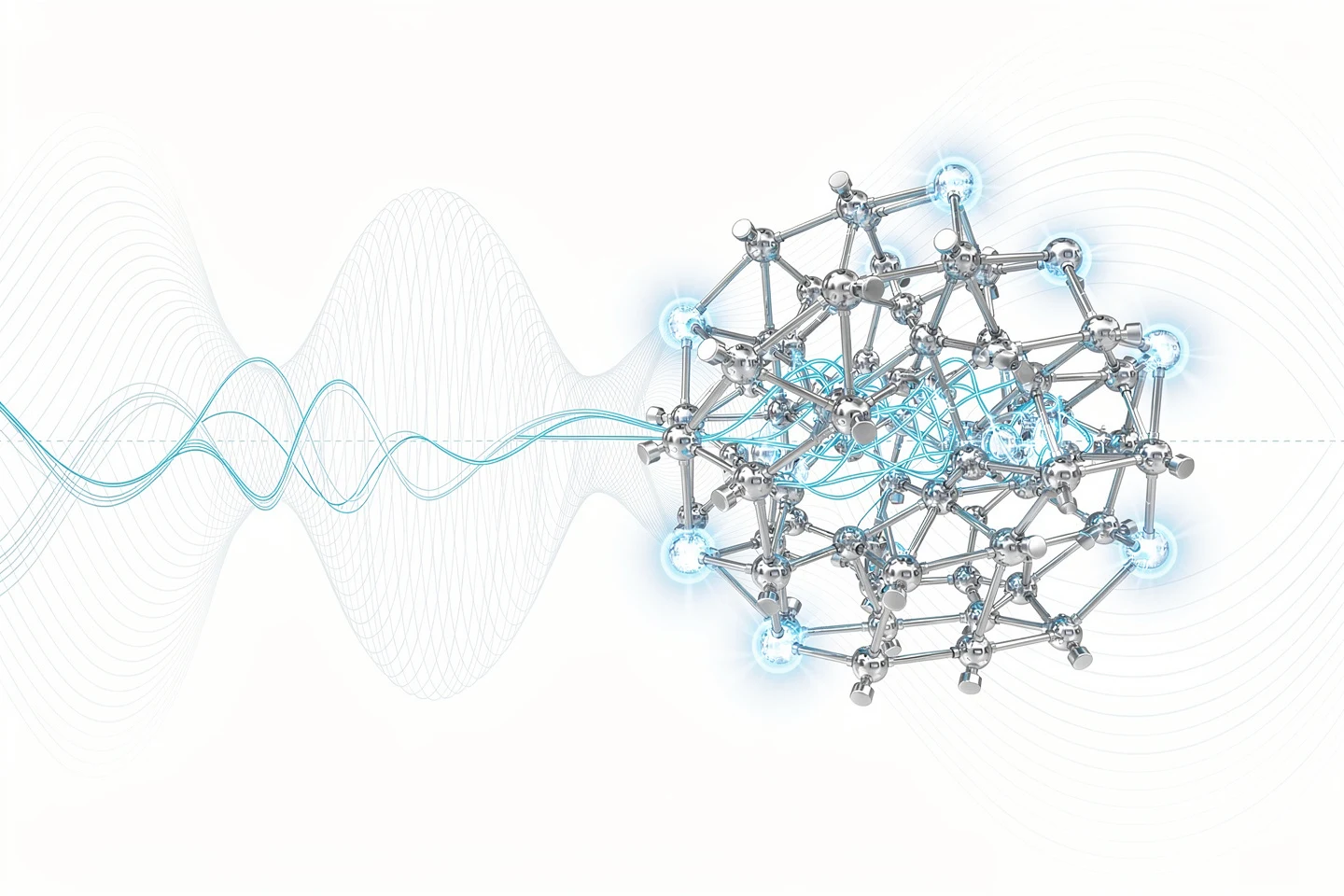
The story began almost a century ago, when Edwin Hubble showed that galaxies are receding, and Fritz Zwicky and Vera Rubin later realized: to explain their motions, invisible mass is needed — dark matter. Today, the relic light of the cosmic microwave background — the fossilized echo of the Big Bang — confirms: it makes up a quarter of the Universe's energy. Yet its particles barely interact with ordinary matter. The Higgsino is particularly treacherous — the superpartner of the Higgs boson. When it collides with a nucleus, part of the energy goes into exciting it: inelastic scattering. Ordinary xenon detectors are powerless — the kinematics just aren't there. We need a fundamentally different instrument.
The planet's own depths became that instrument. Minerals that have lain in the depths for millions of years are stone archives, where each strike of a dark particle leaves a nanoscopic scar. To read such a record, you need a heavy target nucleus: the more massive the nucleus, the more readily it accepts an inelastic hit. The ideal candidate is laurionite, PbClOH, a mineral of lead, hydrogen, oxygen and chlorine. It is born in hot underground waters, where the decomposition of organic matter rich in carbon creates a reducing environment that barely dissolves uranium and thorium. Because of this, laurionite crystals have incredible purity — uranium concentration reaches 3×10⁻¹² g/g, two orders of magnitude lower than in ordinary rocks. And the presence of light hydrogen nuclei further reduces the neutron background.
Two methods are used to read the accumulated information: small-angle X-ray scattering (SAXS) and helium-ion microscopy (HIBM). A beam of helium ions scans the mineral cleavage, like a read head on an ancient record, and reveals tracks nanometers long. Additional mass spectroscopy refines the contamination level. Calculations show: if 50 million years ago a close encounter with the Large Magellanic Cloud generated a stream of fast dark matter, a laurionite paleodetector would register Higgsino with a cross-section of about 10⁻³⁹ cm² and a mass splitting of almost 920 keV. Young minerals are preferred here: they "turned on" only at the right moment, avoiding extra noise from calmer epochs. Imagine: these tiny lead witnesses began recording when the world was utterly different — warm oceans, first primates, no ice caps.
The technology paves the way for direct detection of inelastic dark matter, which has eluded detectors for years. For the first time, there is a chance to test the existence of the Higgsino — one of the few viable supersymmetry candidates. Moreover, paleodetectors become a bridge between laboratory physics and astrophysics: by studying tracks in minerals of different ages, one can reconstruct the history of the high-speed tail of dark matter in our Galaxy. In the future, simulations of the Milky Way's collisions with dwarf satellites will pinpoint epochs with maximum speeds, and the search for new minerals — for example, bismuth halides — will expand the detector arsenal. Even today, experimenters are encouraged to examine deep well cores from the Gulf Coast. The stone archives await their reader — and perhaps already hold a tale of cosmic storms we never saw.
Constraints on uranium content in deep brines, obtained by geophysicists in the 1980s, unexpectedly became useful decades later for paleodetector developers.
It's as if the characters of Arthur C. Clarke's 'Rendezvous with Rama' studied not an alien spaceship, but the rocks themselves — the silent witnesses of cosmic dramas.