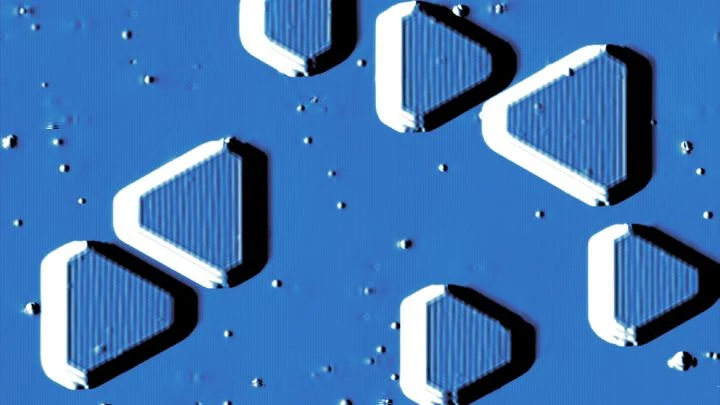
Quantum confinement is a phenomenon that occurs when the movement of electrons or other charge carriers is restricted in one or more spatial dimensions to a scale comparable to their de Broglie wavelength. In bulk materials, electrons move freely and their energy levels form continuous bands. When a material's size shrinks to the nanoscale, typically a few nanometers, the electrons' allowed energies become discrete, quantized levels, much like the energy levels of an atom. This fundamentally changes the material's optical and electronic properties, such as its band gap and absorption spectrum.
History
The concept was developed in the early 1980s, with key contributions from researchers like Alexei Ekimov and Louis Brus, who independently observed size-dependent optical properties in semiconductor nanocrystals. The theoretical framework was built on earlier quantum mechanics work from the 1930s.
How it works
The effect arises from the wave nature of electrons. In a confined space, the electron's wavefunction must satisfy boundary conditions, leading to standing waves with only specific wavelengths and hence specific energies. The smaller the confinement region, the larger the energy spacing between these allowed levels. This is analogous to a particle in a box in quantum mechanics, where the energy levels scale inversely with the square of the box size. The confinement can be in one dimension (quantum wells), two dimensions (quantum wires), or three dimensions (quantum dots).
In practice
Quantum confinement is exploited in quantum dots used in displays (QLED TVs), biological imaging, and solar cells, as well as in quantum well lasers used in optical communications and CD/DVD players.
Fun fact
The color emitted by a quantum dot can be tuned simply by changing its size—smaller dots emit blue light, larger dots emit red—without changing the material's chemical composition.
A layered cake of molybdenum disulfide MoS2 sits on the lab bench. It is prepared in the usual way: adhesive tape peels off the top layers to obtain a thin sample. But beneath the tape remains an invisible cavity where the atomic floors are no longer pressed together. It is there that electrons begin to behave differently than in the crystal bulk.
A layered cake of molybdenum disulfide MoS2 sits on the lab bench. It is prepared in the usual way: adhesive tape peels off the top layers to obtain a thin sample. But beneath the tape remains an invisible cavity where the atomic floors are no longer pressed together. It is there that electrons begin to behave differently than in the crystal bulk.
A thin silver thread nearly as long as a hair's width, and inside it, pristine quantum laws hold sway. Physicists built a conductor where electrons can only move forward or backward, like on a perfectly straight single-lane road with no shoulders. On such a road, any pothole or pebble would normally destroy the fragile quantum state.
The hot broth of the early universe cooled unevenly. At some point, bubbles of a new phase began to pop within it, like steam bubbles in boiling water. But these bubbles weren't made of steam; they were made of a new state of matter in which particles of the dark sector clumped into larger lumps. That's how dark matter could have been born.
Light or sound can be confined in a tiny region of a crystal, like a pearl in a shell. Usually, two methods are used. The first is like a heavy ball in a pit: a particle with large mass simply cannot roll out. The second is a perfect cage of mirrors, where waves cancel each other everywhere except in the trap itself.
An ordinary crystal is like an apartment building: electrons move through shared hallways and staircases, influencing each other through the walls. Now, imagine removing all the walls, leaving just a single line of apartments. How would the residents behave?
Hydrogen has nothing to do with it, but the collective behavior of electrons takes center stage.
Conventional photolithography, used to make chips, hits a fundamental limit: light cannot draw features smaller than its wavelength. Here, they took a different route. First, they made sparse vertical ridges of oxide, then deposited layers of aluminum oxide, each one atom thick, onto them.
A drop of metal on a semiconductor is like an island in the sea. For an electron to reach that island, it must pay a "toll": overcome a barrier that arises because the island is tiny, and each extra charge significantly changes its energy. This phenomenon is called Coulomb blockade. It underpins single-electron transistors, where current flows one electron at a time.
In a thick metal, electrons are like a discordant orchestra: each instrument plays on its own, the overall sound is noise. But roll the metal into a film just a couple of atoms thick, and electrons suddenly begin to "play" in harmony, conducting current without dissonance. Even John Bardeen explained that in superconductors, electrons form pairs — duets that move unimpeded.
Since Vera Rubin first convincingly showed that galaxies are surrounded by invisible matter, the quest to understand the nature of dark matter has remained one of physics' greatest challenges.