Heat bends sideways under a magnet express
If you push heat through a piece of quartz, it usually goes straight, like water through a pipe. But switch on a magnetic field, and the flow veers slightly sideways, as if the pipe suddenly grew a side branch. This effect is called the thermal Hall effect, and until now it was unclear what exactly makes heat deflect: disorder in the crystal or something more fundamental.
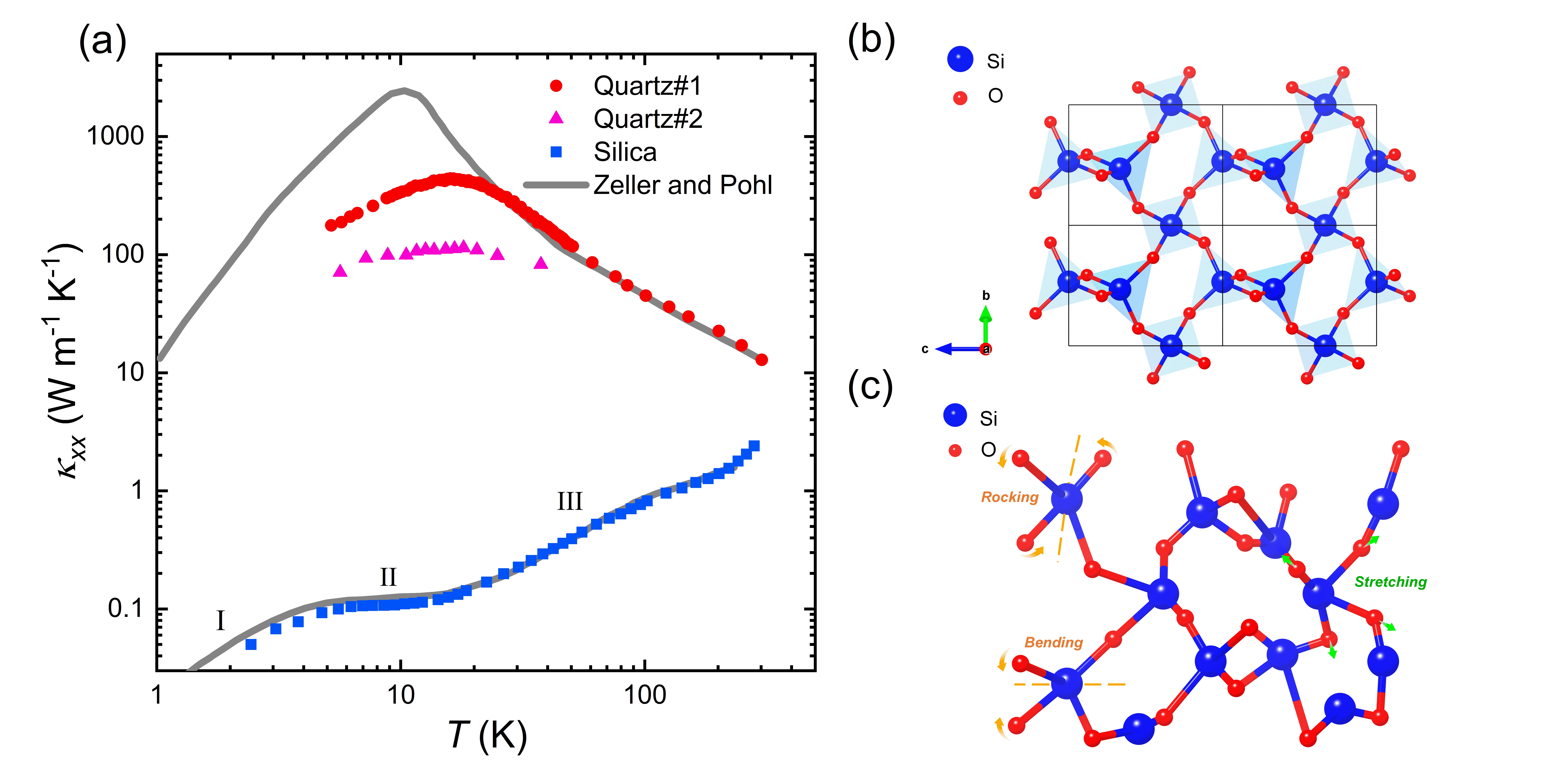
Spectroscopy has nothing to do with it, but comparing crystal and glass gave the answer. The researchers took two samples of the same substance — silicon dioxide: one as an ordered quartz crystal, the other as amorphous glass where atoms are arranged randomly. They pushed heat through both and measured temperature with identical thermometers. The crystal showed a transverse signal; the glass did not, even though the instruments' resolution could have detected it.
The authors build their explanation on the idea that heat in a solid is carried not by a single flow but by two channels, like two traffic lanes. If these channels respond differently to the magnetic field, the total heat flow no longer has to go strictly along the temperature gradient. A sideways component emerges. A similar effect is known for gases, there it is called the Senftleben–Beenakker effect, and now it has been seen in a crystal.
The magnitude of the deflection turned out to be surprisingly simple to estimate. The heat flow makes atomic nuclei drift slightly; the magnetic field acts on this drift with a sideways force; and the system is brought back to equilibrium by a force related to entropy. Three forces, and the transverse thermal resistance comes out the same for both crystals, about one millionth of a meter-kelvin per watt at a field of one tesla.
Original abstract
as written by the authors arXiv:2604.01908
The observation of a misalignment between the applied heat flux and the measured temperature gradient in insulating solids induced by magnetic field has become a subject of experimental investigation, theoretical speculation, and unsettled controversy. To identify the origin of this phonon thermal Hall effect, we performed a comparative study of longitudinal and transverse heat transport in crystalline (quartz) and vitreous (silica) SiO$$_2$$ using identical experimental set-ups and thermometers. A finite signal was detected in the crystalline samples and none in the amorphous sample, within our resolution. The cleaner crystal exhibited a larger thermal Hall conductivity than the dirtier one, ruling out disorder as the driver of the effect. On the other hand, the amplitude of the transverse thermal resistivity is almost identical in the two crystalline samples (W$$_{\perp}$$/B$$\approx 10^{-6}$$ m.K.W$$^{-1}$$.T$$^{-1}$$). We show that in a phonon gas, as in a molecular gas displaying the Senftleben-Beenakker effect, heat is conducted through two channels, and argue that a thermal Hall response is unavoidable whenever these channels differ both in entropy production and in their coupling to the magnetic field. Under such conditions, the conserved energy current and the non-conserved entropy current cease to be parallel. Finally, the magnitude of the transverse thermal resistivity can be accounted for by a surprisingly simple picture. The heat flux induces a tiny drift velocity of the lattice nuclei, the magnetic field exerts a transverse Berry force on this drift, and this force is balanced by an entropic restoring force.
The transverse thermal resistance of pure and dirty quartz turned out to be the same within experimental error — about 10⁻⁶ m·K/W per tesla. It's as if the width of the side stream didn't depend on how murky the water in the main pipe is.