Holographic Quantum Scars: Boson Stars as Islands of Integrability in a Chaotic Sea ✛ ✎ ✦
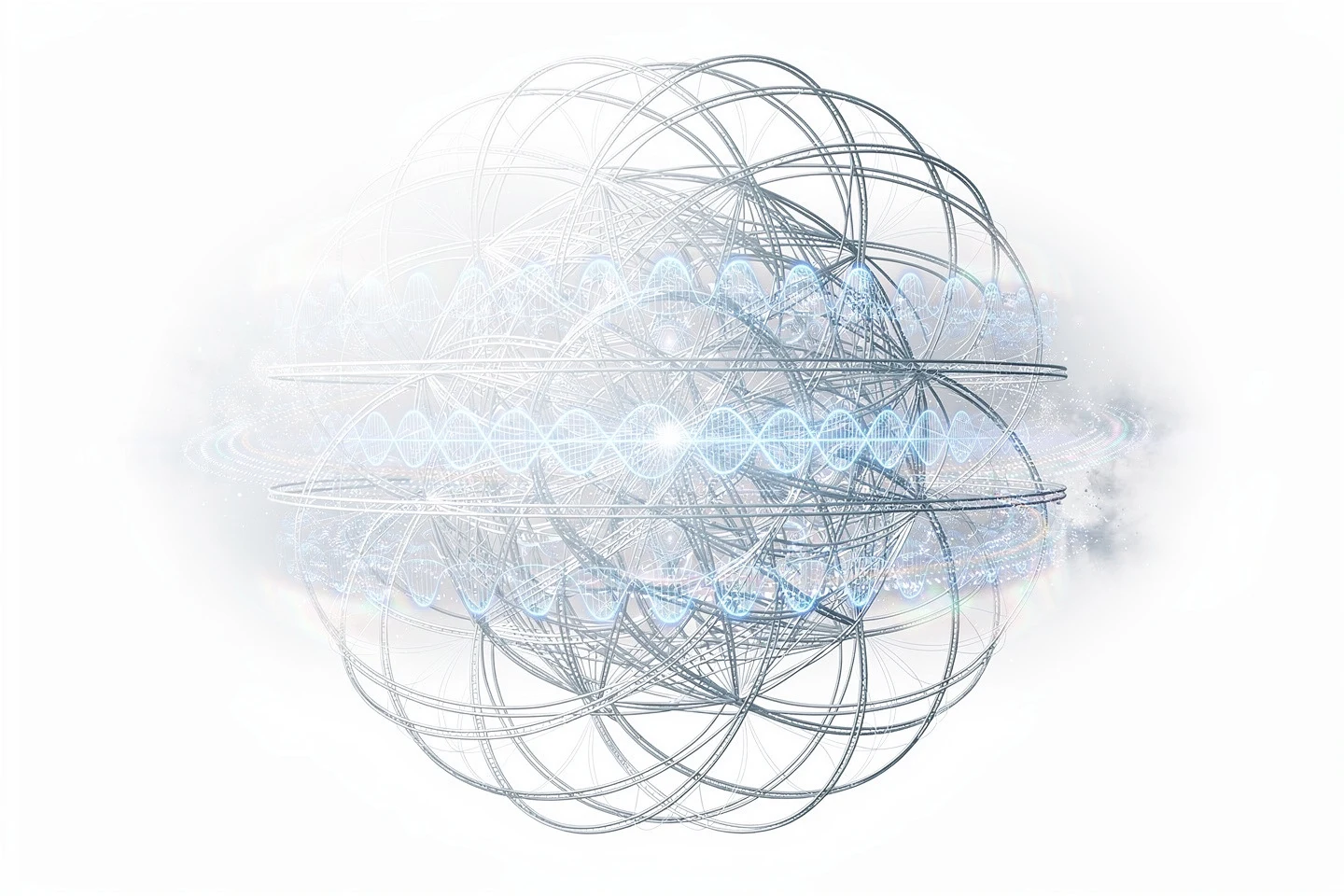
Context
Understanding how isolated quantum systems reach thermal equilibrium, and how this process can be violated, remains a central problem at the intersection of quantum chaos, statistical mechanics, and gravity. A classic exception to the ergodic hypothesis is provided by quantum many-body scars — atypical non-thermal states immersed in a chaotic spectrum that exhibit hidden integrability, suppressed entanglement, and anomalous revivals. First discovered in Rydberg atoms, scars are now identified in many models. In parallel, holographic systems offer an arena to study thermalization in strongly coupled quantum matter: black holes correspond to maximally chaotic thermal states obeying the eigenstate thermalization hypothesis (ETH), while horizonless geometries can encode non-thermal sectors. This distinction raises the question: can quantum scars have a gravitational or holographic realization?
Methods
The authors investigated the simplest horizonless solution — a spherically symmetric static mini-boson star in 3+1-dimensional anti-de Sitter (AdS) space within Einstein gravity minimally coupled to a complex scalar field. Families of regular background solutions were first constructed via a shooting method. Then a linear perturbation analysis was performed in the parity-even sectors with multipole numbers ℓ = 0 and ℓ ≥ 2. The normal mode spectrum was obtained numerically and analyzed in the WKB approximation for high frequencies. To diagnose quantum chaos, random matrix theory (RMT) was applied: the average ratio of consecutive spacings ⟨r⟩ was computed for low-lying modes. Entanglement entropy was estimated holographically via the Ryu–Takayanagi (RT) formula, and dynamics was probed using Krylov complexity, where operator growth was modeled by the infall of a massive test particle into the star along a timelike geodesic.
Results
The normal mode spectrum of the boson star shows a striking duality. At low mode numbers, the level spacing distribution conforms to random matrix statistics: the mean gap ratio ⟨r⟩ falls in the regime between the Gaussian Orthogonal Ensemble (GOE, ≈0.536) and the Symplectic Ensemble (GSE, ≈0.676), indicating global chaos. However, at high frequencies, the modes split into distinct branches with nearly equidistant levels — a hallmark of hidden integrability. This coexistence is the spectral signature of scars. A comparison of holographic entanglement entropy for a hemisphere showed that boson stars have significantly lower entropy than Schwarzschild–AdS black holes of the same mass: for mass M ≈ 5, the star's entropy is about one-third that of the black hole. Finally, Krylov complexity for boson stars experiences clear periodic revivals with period Trev ≥ Tg, where Tg is the oscillation period of the ground state. For comparison, in a black hole, complexity grows monotonically. The revival period increases with the star's mass and is larger for excited states, reflecting the 'dressed' collective dynamics of the scarred subsector.
Implications
This work presents, for the first time, compelling evidence that mini-boson stars in AdS serve as holographic realizations of quantum many-body scars. It unifies three seemingly disparate fields: the physics of scars in many-body systems, quantum chaos in holography, and horizonless gravitational dynamics. The discovered coexistence of chaotic low-frequency statistics and integrable high-frequency tower structures echoes the axiom that scars are not isolated integrable systems but rather weak violations of ETH in overwhelmingly chaotic environments. The suppressed entanglement entropy and revivals of Krylov complexity further confirm the non-thermal, scar-like character of these configurations, prompting a reassessment of the role of coherent gravitational structures in thermalizing quantum matter.
Future development
The results pave the way to search for other horizonless geometries capable of realizing scars: rotating boson stars, fermion stars, wormholes, and even dynamical collapse scenarios. One can expect a whole zoo of scarred states in holographic systems, each with its own spectral, entanglement, and dynamical portrait. Studying transitions between these states and black holes could shed light on mechanisms of thermal equilibrium violation in quantum gravity and resolve paradoxes related to information loss.
Impact
The results will impact quantum chaos theory, condensed matter physics (where scars are studied experimentally), and quantum gravity, especially in the context of the AdS/CFT correspondence.
Next steps
Immediate tasks include studying the stability of scars under rotation, exploring dynamical revivals in nonlinear regimes, and seeking analogies in flat spacetime, potentially linked to astrophysical objects.
Key open problems
The discovered connection directly addresses unresolved problems: the mechanism of thermalization in closed quantum systems, the nature of quantum chaos in gravity, and the black hole information paradox, as scars offer natural non-thermal channels of evolution.
The knowledge machine's view
This section is addressed to the author of the paper and their colleagues. Neighbouring works were found by meaning-based search across our archive, not by word overlap. We do not review: we show the field around the work.
What the work does
The paper constructs spherically symmetric boson stars in AdS, computes the normal-mode spectrum, and demonstrates the coexistence of chaotic and integrable level statistics. The holographic entanglement entropy and Krylov complexity are compared with those of a black hole.
Where its strength is
The work combines gravitational solutions, spectral statistics, and holographic measures, revealing quantum scars in a horizonless background.
Where it could go next
- It might be interesting to see how the spectral properties of boson stars relate to other regular horizonless geometries, such as wormholes or gravastars, where deviations from the black-hole spectrum are also expected.based on: A Black Hole Rings Differently If There's No Singularity at Its Core arXiv:2605.11364
- Closely related is work on quantum circuits with hidden integrability; perhaps similar mechanisms of protection against thermalization can be sought in holographic models with additional symmetry.based on: Quantum Chain with a Secret Shelf arXiv:2607.09504
- It would be interesting to compare the Krylov complexity for boson stars with results for gravitational atoms, where the dynamics of test particles in regular backgrounds is also studied.based on: Gravitational Atoms: The New Voice of Black Holes arXiv:2511.13848
Worth trying
- Test whether the mixed level statistics persist when rotation or self-interaction of the scalar field is included.
- Compute the spectral form factor for boson stars and compare with RMT predictions at different energy scales.
- Investigate how the entanglement entropy changes as one transitions from a boson star to a black hole by varying compactness.
Why this may matter
Identifying quantum scars in holographic systems could shed light on the mechanisms that break thermalization in strongly coupled theories and point to new nonthermal sectors of quantum gravity.
Nearby works in our archive
- The Spectral Butterfly Effect in Thick Branessimilarity 0.67
- Gravitational Atoms: The New Voice of Black Holessimilarity 0.63
- A Black Hole Rings Differently If There's No Singularity at Its Coresimilarity 0.63
- Chaos in a Crystal: How Disorder Awakens Quantum Unpredictabilitysimilarity 0.62
- Two Orders in One Crystalsimilarity 0.62
- Quantum Chain with a Secret Shelfsimilarity 0.62
The closest work in the archive sits at 0.67 by meaning — the usual level for our corpus.
Boson stars — hypothetical objects made of a self-gravitating condensate of ultra-light bosons — may constitute part of dark matter, and their observational signatures (microlensing, gravitational waves) are actively searched for.
In the movie Interstellar, the heroes enter a black hole; a boson star, however, lacks a horizon, so a traveler could pass through and return — almost like a wormhole, but without singularities.
Key numbers
- Mean gap ratio for GOE: 0.536
- Mean gap ratio for GSE: 0.676
- Maximum mass of studied boson stars: about 5 in dimensionless units
- Revival period of Krylov complexity for the ground state: T_g = \pi in the vacuum limit
- Entanglement entropy of boson star relative to black hole of the same mass: approximately 70% smaller