The Radio Forest: How Hydrogen Unveils the Mystery of Dark Matter ✛ ✦
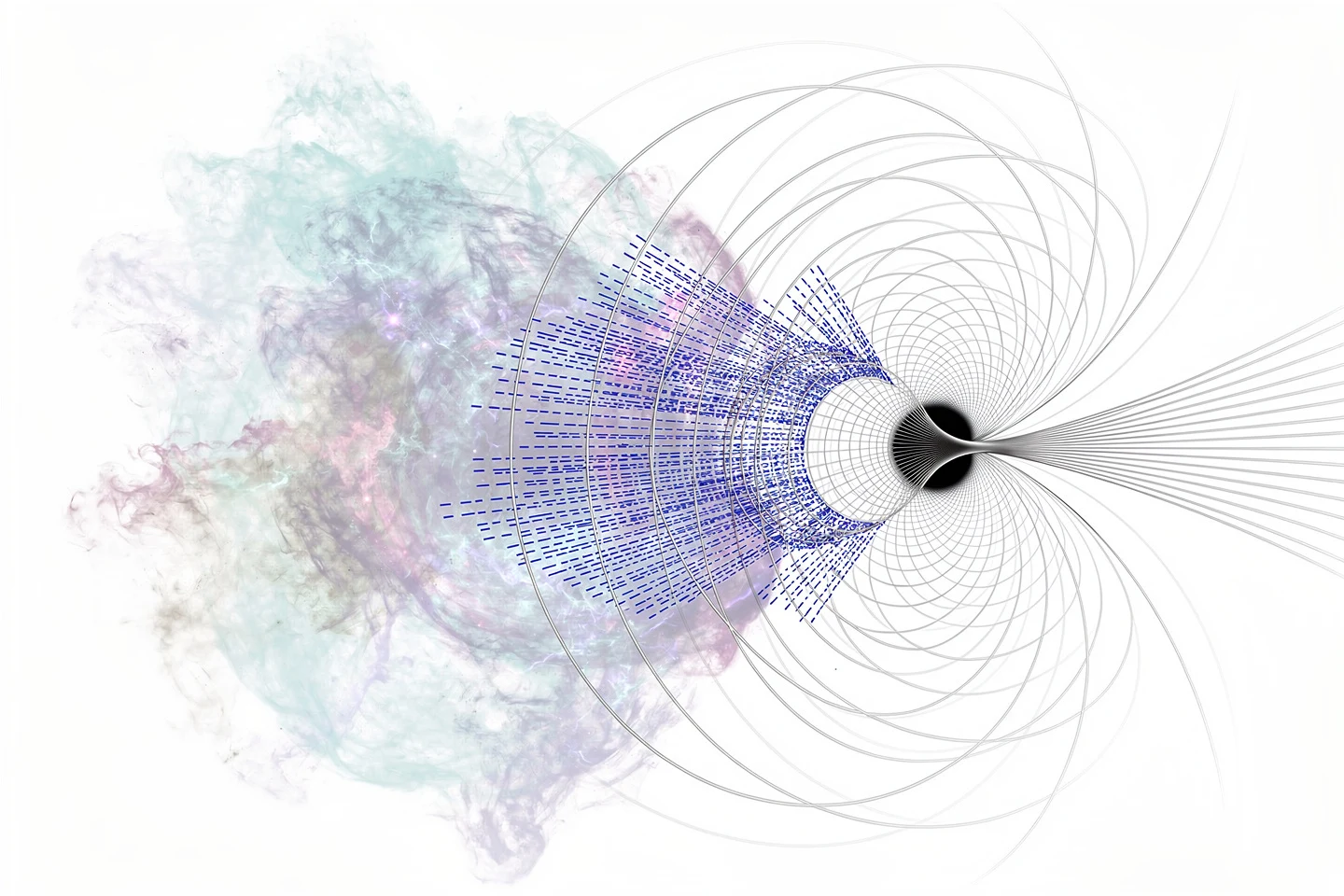
In the interstellar medium, hydrogen atoms in nebulae — regions of star formation — usually emit a single clean radio signal, like a lone note. But when a primordial black hole zooms past (with the mass of an asteroid, yet smaller than an atomic nucleus), its gravity slightly shifts the frequency — a quantum effect of spacetime curvature. Thousands of such encounters turn that single line into a 'radio forest' of many detuned signals.
This forest can be captured with radio telescopes, and its exact pattern is predicted through computer simulations. The idea traces back to Stephen Hawking and the puzzle of dark matter: Vera Rubin showed that galaxies spin too fast for their visible mass, and even earlier Edwin Hubble discovered the universe is expanding — all of which pointed to hidden mass.
The most unexpected twist: to find the invisible mass, astronomers don't hunt the black holes themselves — they listen as the universe's most common element goes off-key under their weight.
These primordial black holes are so tiny they could pass right through Earth without a trace — yet their gravity can alter an atom's internal structure from less than a centimeter away.