Gravitational Radio Forest: How Quantum Spectroscopy of Hydrogen Reveals Dark Matter ✛ ✦
Context
The history of astrophysics knows many examples where subtle atomic spectra overturned our view of the Universe. In 1929, Edwin Hubble proved the expansion of the Universe via the redshift of calcium lines. Later, the discovery of the Lyman-alpha forest in the spectra of distant sources revealed the cosmic web of dark matter, and the 21-cm line of neutral hydrogen allowed us to map galaxies. Today, the main mystery is the nature of dark matter. Observations by Vera Rubin in the 1970s showed that visible matter is insufficient to explain galaxy rotation. Among the many candidates, primordial black holes (PBHs) stand out as a purely gravitational solution, requiring no new particle physics. According to ideas from Stephen Hawking, they could have formed from overdense clumps in the early Universe. However, no direct evidence of their existence has been found so far. If PBHs make up a significant portion of dark matter, they must leave an imprint in baryonic matter—but what is it?
Methods
Researchers proposed treating interstellar hydrogen as a quantum sensor for gravity. In HII regions—clouds of ionized gas around hot stars, indicative of star formation—hydrogen atoms are actively excited by ultraviolet radiation. Especially important is the metastable 2S₁/₂ level, which is much more populated than the ground state due to suppressed two-photon decay. The 2S₁/₂ → 2P₃/₂ transition produces an absorption line at 9.9 GHz. Near asteroid-mass PBHs (10¹⁷–10²³ g), spacetime curvature is so large (the Kretschmann scalar reaches 10⁵¹ m⁻⁴) that it affects atomic levels. Using the Fermi formalism and solving the Dirac equation in a curved background, back in the 1980s Parker and Pimentel showed that the tidal part of the Riemann tensor splits the 2P₃/₂ level into two symmetric components. This effect is purely gravitational and does not reduce to Doppler broadening or line blending. To obtain a macroscopic signal, the authors construct a statistical ensemble: they assume distributions of PBHs in mass and space consistent with astrophysical data, as well as a distribution of atoms in a gravitationally bound shell around each hole. Additionally, gas accretion is included via the Bondi model: hydrogen density inside the Bondi radius grows as r⁻³/₂, and since absorption is proportional to the square of density, the contribution from regions near the inner radius becomes dominant.
Results
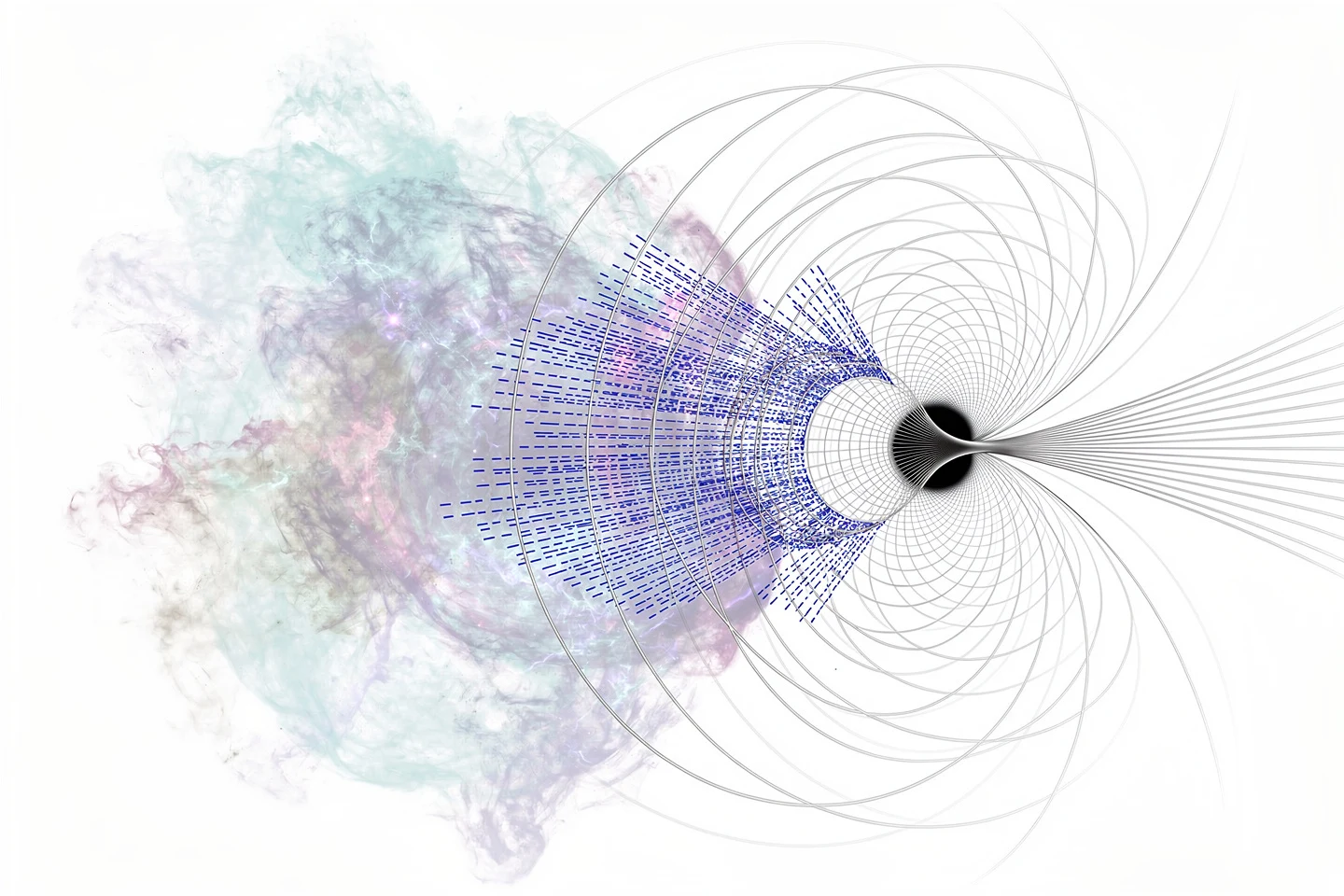
Convolving individual energy shifts over the PBH ensemble yields a 'gravitational spectral radio forest'—instead of a single line at 9.9 GHz, a symmetric set of sidebands of absorption appears, spread over a band about 2 GHz wide. This pattern is unique and not reproduced by any other astrophysical effect. Detailed calculations showed that the signal amplitude directly depends on the local dark matter density and the fraction of PBHs in it, $f_{PBH}$, but is almost independent of the specific peak of the mass function. Thus, by measuring the depth of dips in the radio continuum, radio observations can determine $f_{PBH}$ without prior assumptions about black hole masses. Remarkably, although the individual Bondi volume for a PBH with mass ~10¹⁹ g is microscopic (~1 cm), their enormous number density (14 orders of magnitude greater than stellar-mass black holes) and the quadratic dependence of absorption on density yield an integrated optical depth that is potentially detectable.
Implications
This work builds a bridge between the quantum theory of atoms in curved space and observational plasma astrophysics. For the first time, a concrete and measurable imprint of a macroscopic quantum system responding to metric tides generated by dark matter objects is proposed. This could be as revolutionary as the discovery of the cosmic microwave background or the Lyman-alpha forest, and mark the birth of 'gravitational radio astronomy.' Moreover, the method does not require knowledge of the exact shape of the PBH mass spectrum, sidestepping many uncertainties of cosmological modeling.
Future development
The coming decade promises progress both in numerical simulations and in observational campaigns. The authors are preparing detailed 3D hydrodynamic modeling of accretion and radiation transfer to precisely predict the shape of the spectral forest while accounting for competition from Rydberg lines. Next-generation ground-based radio telescopes operating in the centimeter band could conduct long integration observations of selected dense HII regions, especially toward the Galactic center where dark matter density is highest. If the signal is detected, it will not only confirm the existence of PBHs but also provide unprecedented information about quantum fluctuations during the inflationary epoch.
Impact
The results will impact several areas: the search for dark matter, extragalactic radio astronomy, quantum physics in strong fields, and early Universe cosmology. Crucially, the method uses known atomic transitions as a natural spectrograph of gravitational tides.
Next steps
First, detailed numerical simulations are needed, incorporating realistic distributions of temperature, density, and ionization state of the gas around PBHs. In parallel, test radio surveys of bright HII regions with high sensitivity should begin to assess current instrumental limits.
Key open problems
The proposed approach is directly linked to three fundamental problems: the nature of dark matter, the quantum description of particles in classical gravity, and the formation of primordial black holes in the early Universe. If the spectral forest is detected, it will be the first evidence that quantum mechanics and general relativity interact at the level of atomic spectra, and that dark matter is purely gravitational in nature.
The knowledge machine's view
This section is addressed to the author of the paper and their colleagues. Neighbouring works were found by meaning-based search across our archive, not by word overlap. We do not review: we show the field around the work.
What the work does
The paper calculates how primordial black holes of asteroid mass, passing through clouds of ionized hydrogen, split the absorption line at 9.9 GHz (the 2S₁/₂ → 2P₃/₂ transition) through a tidal gravitational effect. The authors build a statistical ensemble of PBHs and atoms, accounting for Bondi accretion, and obtain a 'gravitational radio forest'—a characteristic broadening and splitting of the spectral line that could be detected by radio observatories.
Where its strength is
The strength of the work lies in proposing a fundamentally new, purely gravitational method to search for PBHs via quantum spectroscopy of interstellar hydrogen, requiring no electromagnetic interaction of dark matter. The use of the metastable 2S₁/₂ level and the precise calculation of tidal splitting in curved spacetime yield a quantitatively predictable signal.
Where it could go next
- It might be interesting to compare the proposed radio forest with the signal from axions converting to photons in magnetic fields: in our archive there is a review of work on 'singing' dark matter in magnetic fields. This would allow assessing how distinguishable the gravitational and electromagnetic contributions to the 9.9 GHz spectrum are.based on: Dark matter sings in magnetic fields arXiv:2605.21092
- Nearby there is a paper considering the clumping of dark matter into dense cores; one could examine how PBH clustering on small scales would affect the radio forest statistics and the shape of the spectral line.based on: Dark Matter Clumps into Dense Cores arXiv:2606.12909
- The archive contains a review on compact objects in the early Universe; perhaps it is worth considering how the proposed method might work at high redshifts, where the density and ionization of hydrogen were different.based on: Red Lanterns of the Cosmos: What Compact Objects from the Early Universe Conceal arXiv:2606.03522v1
Worth trying
- Check whether Bondi accretion provides sufficient signal enhancement to be distinguished from thermal noise and other lines in real observations.
- Estimate the contribution of PBHs with masses outside the considered range (e.g., sub-asteroid or planetary) to the radio forest.
- Compare the predicted line profile with data from existing surveys, such as HII region surveys at frequencies around 10 GHz.
Why this may matter
If such a radio forest is detected, it would be the first direct proof of the existence of primordial black holes and would allow measuring their mass distribution, which is critically important for understanding the nature of dark matter.
Nearby works in our archive
- Dark matter sings in magnetic fieldssimilarity 0.65
- Dark Matter Clumps into Dense Coressimilarity 0.62
- How Light's Bends Reveal the Universe's Secretssimilarity 0.62
- Red Lanterns of the Cosmos: What Compact Objects from the Early Universe Concealsimilarity 0.61
- Hidden Sector Prepares a Gravitational Concertsimilarity 0.61
- Magnetars as Gravitational Echoessimilarity 0.61
The closest work in the archive sits at 0.65 by meaning — the usual level for our corpus.
Original abstract
as written by the authors arXiv:2605.13042v1
We propose a novel gravitational signature to detect Primordial Black Hole (PBH) dark matter by treating interstellar hydrogen as a quantum sensor for spacetime curvature. Focusing on H II regions, we demonstrate that the Riemann tidal tensor of an \emph{asteroid-mass} PBH induces a symmetric splitting of the $$2P_{3/2}$$ state in bound hydrogen atoms. This relativistic effect redistributes $$9.9\,\mathrm{GHz}$$ absorption line into a gravitational spectral radio forest with a bandwidth $$\sim 2\,\mathrm{GHz}$$. By accounting for active accretion of Hydrogen atoms and the resulting density-squared emission measure within the Bondi radius, we find a relatively enhanced absorption spectrum. This feature presents a concrete, high-contrast target for upcoming radio-surveys to constrain PBH populations in the dark matter sector.
The predicted 'radio forest' resembles the Lyman-alpha forest in structure, but instead of a scattering of neutral hydrogen lines at cosmological distances, we see 'shadows' from myriads of microscopic black hole-asteroids cruising through the interstellar medium. Each such object weighs about as much as a large asteroid but is confined within an event horizon smaller than an atomic nucleus.
Key numbers
- 2S₁/₂ → 2P₃/₂ transition frequency: 9.9 GHz (wavelength ~3 cm)
- gravitational forest width: ~2 GHz
- primordial black hole mass: 10¹⁷–10²³ g (comparable to asteroids)
- Bondi radius for a 10¹⁹ g PBH: ~1 cm
- gas temperature in HII regions: ~10,000 K