Magnetic Thermos of Stars: Birth of a Micronova ✛ ✦
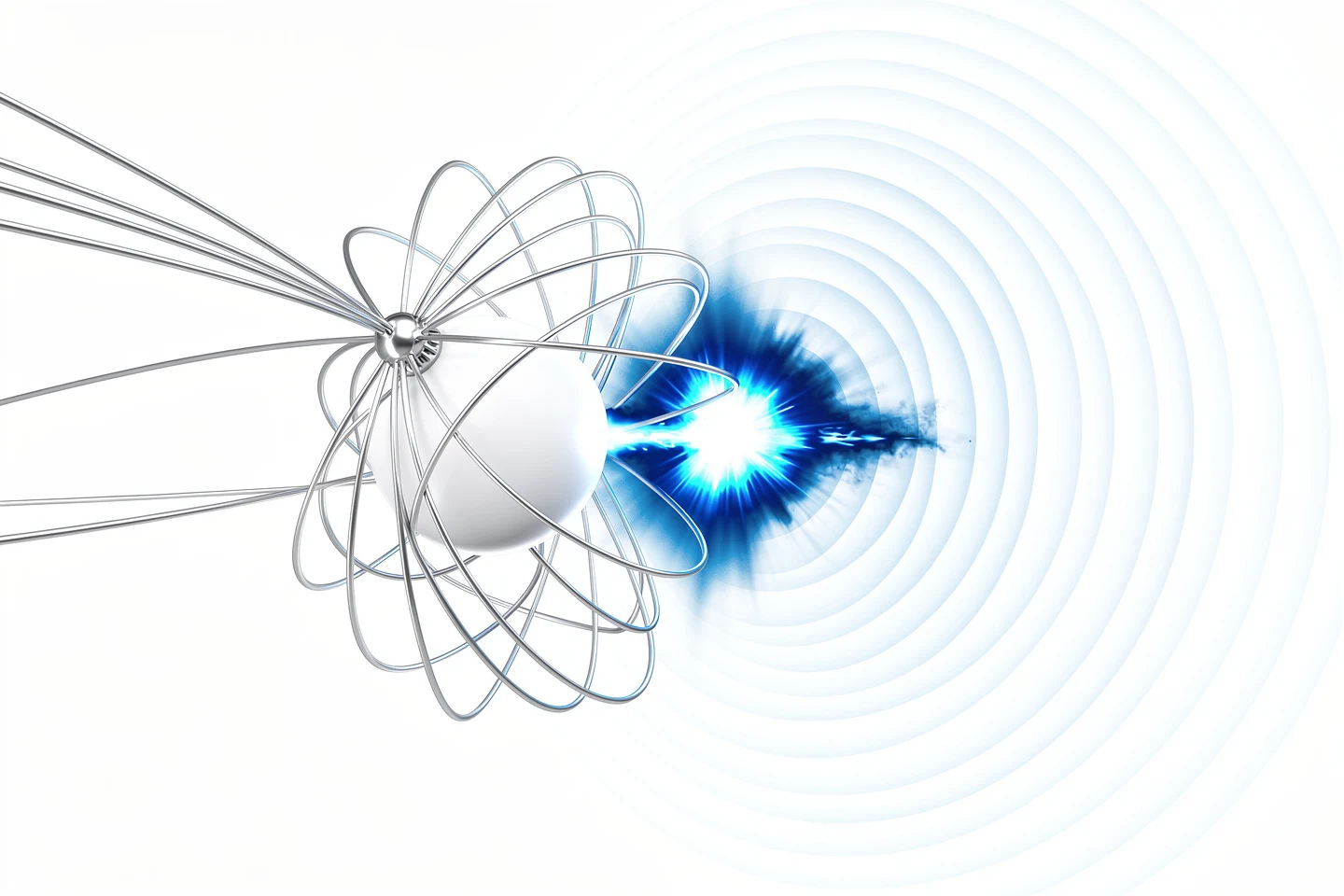
In the constellation Scorpius, 3,000 light-years from Earth, a dead star steals matter from a living one. A white dwarf in the system IGR J17014-4306 — a superdense carbon-oxygen ball with the mass of the Sun but the size of Earth — siphons hydrogen from a normal companion star. But the dwarf's strong magnetic field funnels the infalling gas not into a disk, but into a thin column — a kind of cosmic fuse, locked in a magnetic thermos. In December 2021, this fuse lit up.
Actually, it exploded. The space telescope TESS, armed with ultra-precise photometry, registered a sharp spike: over a day and a half, the system became several times brighter, then faded. Peak luminosity reached 9.3×10³³ erg/s — negligible compared to classical novae, but monstrous for such a compact patch of surface. The total energy released — 3.25×10³⁸ erg — is roughly what the Sun emits in ten years. And it all came from a volume comparable to a small asteroid. This is a micronova.
The secret lies in the magnetic field. In classical novae, hydrogen spreads across the entire surface of the white dwarf and explodes globally — hence the colossal energies. Here, a field of millions of gauss squeezes the flow into a magnetic bottle. The hydrogen plasma is trapped in a narrow channel, doesn't mix with adjacent layers, and heats up until it ignites the carbon-oxygen CNO cycle. The thermonuclear reaction races along the column like flame along a fuse, releasing exactly as much energy as had accumulated in that microscopic volume. The temperature in the channel skyrockets to hundreds of millions of degrees — several times hotter than the Sun's core — but invisible magnetic walls keep the heat in, like the vacuum layer of a thermos. The mass of burned hydrogen is just 1.6×10⁻¹¹ solar masses, about that of a small asteroid. For comparison: a classical nova burns the mass of the Moon. And on neutron stars, X-ray bursters occur — even more powerful relatives of micronovae with magnetic confinement, but in extreme fields of trillions of gauss.
Such a cosmic thermos is an ideal laboratory for physicists. The magnetic field prevents the column from expanding and cooling, so we see an experimentally clean explosion without contamination by accretion instabilities. The work of Chandrasekhar once described the mass limit of a white dwarf; now his "progeny" demonstrate the quantum limit of thermonuclear burning in a magnetic trap. The discovery by Payne-Gaposchkin that stars are mostly hydrogen got yet another confirmation — it is hydrogen that fuels these miniature explosions.
The future promises a goldmine of data. The Vera Rubin Observatory (LSST) is expected to find dozens of micronovae per year, and high-resolution spectroscopy will for the first time peer into the composition of the ejecta — providing direct tests of CNO-cycle nucleosynthesis. Magnetohydrodynamic simulations that include Rayleigh-Taylor instability will help us understand how the column is held together at such temperatures without breaking apart prematurely. This is directly linked to the challenge of magnetic plasma confinement — not only in astrophysics, but also in Earth-based fusion reactors. The micronova thus becomes a bridge between laboratory plasmas and explosions on neutron stars, shrinking the scale down to something we can almost "touch" with telescopes.
The system IGR J17014-4306 was once linked to the Nova Scorpii of 1437, recorded by Korean astronomers. But it turned out to be a chance projection onto a planetary nebula. Instead, it now holds its own record: the longest orbital period among micronovae — 12.8 hours.