A filter around a black hole controls the bright lines ✛ ✎
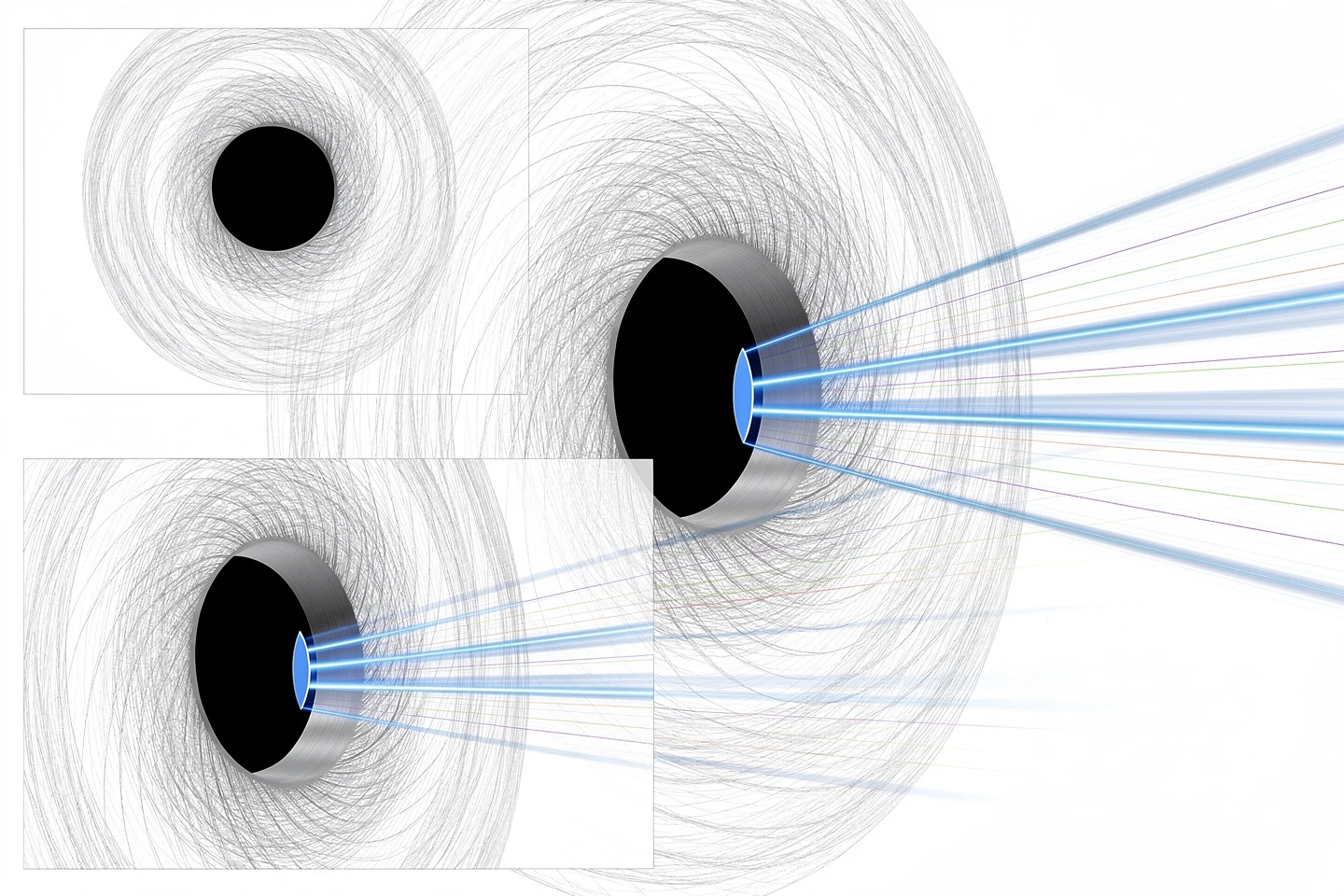
At the centers of many galaxies lurk supermassive black holes — true monsters with masses from millions to billions of suns. Their existence is described by the solutions of Karl Schwarzschild. As matter falls into the hole, it heats up in a disk and sometimes causes surrounding gas clouds to glow, creating bright broad lines in the spectrum — for example, the series discovered by Johann Balmer. But a surprising fact: these lines vanish not only when the hole is poorly fed, but also when there's too much gas. The usual logic of 'more food means brighter light' doesn't work here.
It turns out a similar mechanism works in galactic cores. The radiation from the black hole, capable of ionizing hydrogen and helium, must pass through the inner dense region of the disk. This 'filter' lets through only a fraction of the photons, and its transparency drops sharply as activity increases. When matter falls slowly, there are too few photons. At moderate accretion, the flux is optimal — the lines shine brightly. But once a certain threshold is crossed, the disk becomes nearly opaque to the needed radiation: the lines fade, even though the black hole itself blazes. This picture explains both the mysterious 'weak-line quasars' and the long-known Baldwin effect — the more powerful the quasar, the weaker its lines.
This discovery forces a rethink of how we estimate black hole masses. Previously, we relied on continuum brightness, but if the filter 'eats' the ionizing radiation, old relations give errors. New calculations predict how line strength relates to X-ray weakness, and this can be tested with telescopes like JWST and Hubble. Moreover, due to vast distances and the finite speed of light, we see different regions with a delay, which in the future will allow building a three-dimensional 'tomogram' of the central parts of quasars — almost as Edwin Hubble once revealed the realm of galaxies through their spectra.
To light up the hydrogen line in a quasar, a cascade of 300 million billion ionizing photons every second per square centimeter is needed: that's trillions of times more powerful than the Sun's ultraviolet at Earth.