The Cosmic Club with Face Control: The Mystery of Quasar Broad Lines Solved ✛ ✎
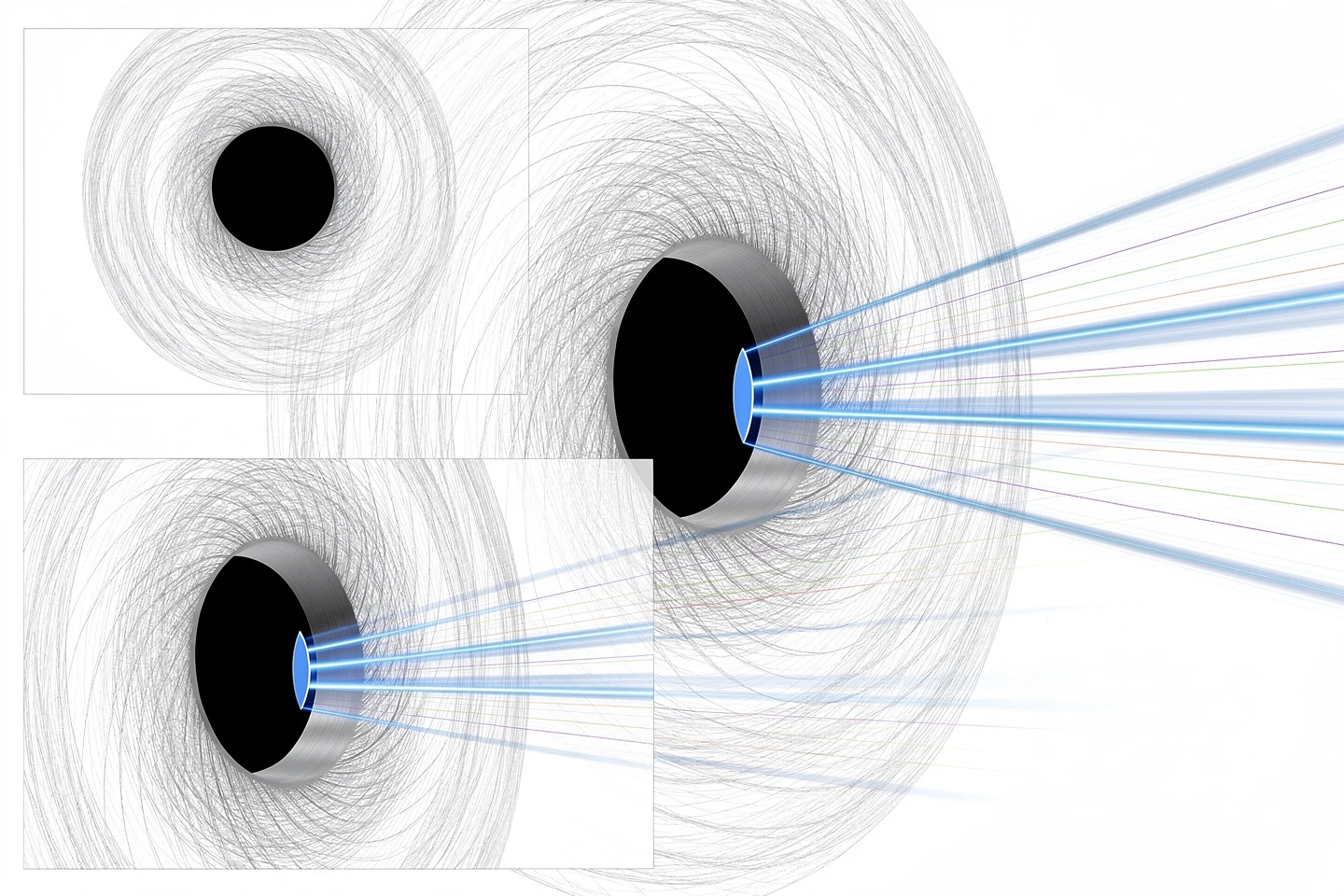
In the center of almost every large galaxy lurks a supermassive black hole, whose gravitational abyss was first mathematically described by Karl Schwarzschild. When it swallows gas, a dazzling active nucleus is born — a quasar. Its signature feature is broad emission lines in the spectrum. These are glowing swirls of hot hydrogen (the very Hβ series discovered by Johann Balmer), accelerated by gravity to thousands of kilometers per second. But here's the puzzle: the faintest and the brightest quasars both lack these lines. It's as if a cosmic lighthouse randomly switches its lamp on and off for no apparent reason.
Imagine an exclusive nightclub that only allows ultraviolet “guests” — ionizing photons. The more of them, the brighter the neon sign (broad lines). However, a stern bouncer stands at the entrance — the accretion disk, denser toward the center. With a moderate crowd, it lets enough light through and the sign blazes. But if the crowd is too sparse, there's too little light — no lines. And if it's too wild, the bouncer forms a wall: radiation gets absorbed, and only crumbs reach the gas. That's how the “visibility window” is born — a narrow corridor of parameters where the quasar's spectroscopic passport works.
The key formula is simple: $Φ_{eff}$ = $Φ_{int}$ · $T_{net}$. Effective ionizing flux is the product of the central engine's raw power and the transmittance $T_{net}$ — the dimensionless fraction that breaks through the curtain. At low accretion, $T_{net}$ is close to unity, but $Φ_{int}$ is small. At high accretion, $Φ_{int}$ is huge, but $T_{net}$ drops nearly to zero — a sigmoidal filter kicks in, like a smooth dimmer switch. The condition for line visibility: $Φ_{eff}$ ≥ $Φ_{min}$, where $Φ_{min}$ is the threshold needed to ionize hydrogen (accounting for helium's contribution). This formula doesn't just describe, it predicts where and when lines will appear. It also naturally gives rise to the well-known Baldwin effect: as luminosity increases, $T_{net}$ drops faster than $Φ_{int}$ rises, and the equivalent width of the lines shrinks.
This perspective turns conventional black hole weighing methods upside down. Previously, mass was inferred from line widths, assuming that luminosity directly reflected the ionizing flux. Now it's clear: in the “closed” phase, luminosity can be deceptively high, while the true flux reaching the clouds is negligible. That means many estimates may need revision. Moreover, the model unifies disparate types of active nuclei: faint Seyfert galaxies, powerful quasars, and even enigmatic weak-line objects — all are states of the same accretion “club,” just with varying bouncer strictness. This change of perspective is reminiscent of the revolution that Edwin Hubble once brought by showing that the spectra of galaxies hold the key to the structure of the Universe.
Up ahead is the era of telescopes like JWST and the legendary Hubble, which can track filter variability in real time. If we can catch the moment when the “bouncer” slightly opens the door, we'll see the true three-dimensional gas distribution. Accounting for the finite speed of light will turn time delays into a kind of tomography of the central engine. This isn't just a refinement of details; it's a new tool for studying galaxy growth and the feedback that regulates the expanding Universe.
To kick off Hβ emission, a flux of ionizing photons on the order of 300 million billion per second per square centimeter is required — trillions of times more than solar ultraviolet in Earth's orbit.