Radiation Filtration Dictates Broad-Line Visibility in Quasars ✛ ✎
Context
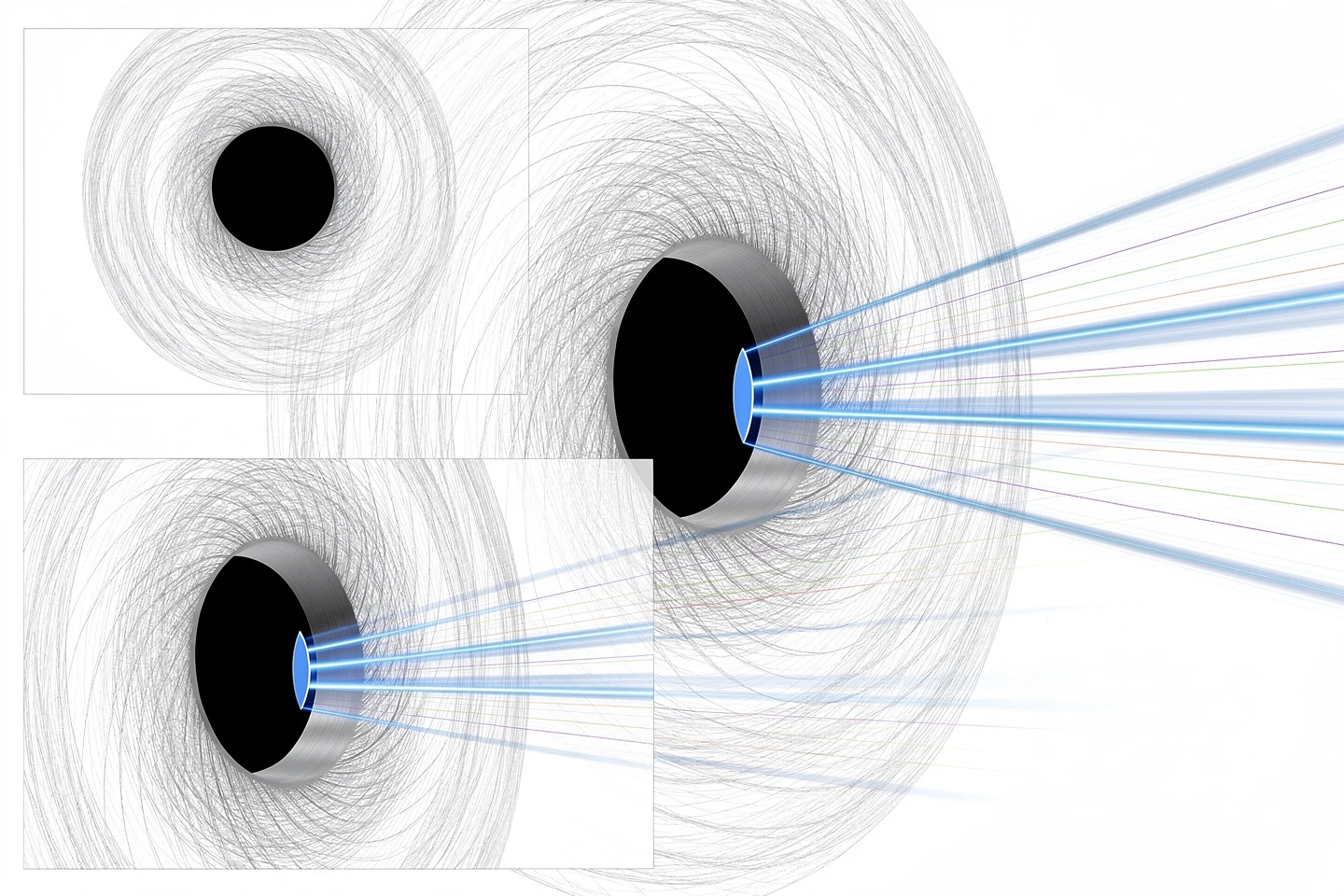
Active galaxies host some of the most powerful radiation sources in the Universe. At their centers lie supermassive black holes with masses from millions to billions of solar masses, described by the metric of Karl Schwarzschild and surrounded by an accretion disk. A key sign of an active nucleus is broad emission lines in the spectrum, produced by rapidly moving gas. However, it is puzzling that these lines, such as Hβ from the series discovered by Johann Balmer, disappear or weaken sharply at both very low and very high accretion rates. This challenges traditional models and calls for a new explanation. Why might the radiation flux reaching the gas clouds differ from what the black hole itself emits? The answer lies in the filtration of ionizing radiation by material along the path to the line-emitting region.
Methods
The key idea of this work is introducing an effective transmission $T_{net}$, which quantifies the fraction of ionizing photons reaching the gas. Calculations accounted for the ionization potentials of hydrogen and helium, which govern the absorption of photons of different energies. The condition for Hβ line formation is expressed as the product of the intrinsic ionizing power and the transmission: it must exceed a minimum threshold. The intrinsic flux is modeled from a standard thin disk with an anisotropy correction, while the transmission is modeled as a sigmoid function of the dimensionless accretion rate, black hole mass, and radiative efficiency. Calculations were performed over a wide parameter range: masses from $10^6$ to $10^{11}$ solar masses, efficiencies from 3.8% to 32%. This yielded a map of the 'window of opportunity' for Hβ as a function of the system's global characteristics.
Results
The results show that the effective ionizing field does not increase monotonically with accretion but exhibits a clear peak. For fixed black hole mass and efficiency, the Hβ line appears only within a certain interval of the logarithm of the dimensionless accretion rate (roughly from -2 to +0.5, but the boundaries shift with parameters). Below the threshold, there are too few photons; above it, filtration becomes so strong that the flux drops below the critical level again. This naturally explains the absence of broad lines in low-power active nuclei (low accretion) and in 'weak-line' quasars (high accretion but strong filtration). Moreover, the model automatically yields the Baldwin effect—the decrease in line equivalent width with increasing luminosity—because at high accretion, filtration suppresses the ionizing flux more than the optical continuum grows. The window is not universal: its shape and position depend on black hole mass and spin, consistent with the observed diversity.
Implications
The proposed picture shifts the focus from observed luminosity to the transmitted ionizing flux. This means that standard methods for estimating black hole masses from line widths and radius–luminosity relations may fail in extreme regimes because the visible continuum is no longer a reliable indicator of the radiation reaching the gas. The work unifies disparate populations of active nuclei—from BL Lac objects to weak-line quasars—under a single mechanism of radiative regulation. Essentially, it is not the mere presence of gas but the conditions of its illumination that dictate the visibility of broad lines. This is reminiscent of the early discoveries of Edwin Hubble, which showed that the spectra of galaxies hold the key to their nature.
Future development
In the future, it will be necessary to compute in detail the radiation transfer in the filtration medium to predict the spectra observed with JWST and Hubble. Temporal changes are of particular interest: how lines respond to filter variability, as already observed in monitoring campaigns. Models that incorporate the finite speed of light will enable a new interpretation of time delays, paving the way for three-dimensional tomography of the central regions.
Impact
The results will impact extragalactic astrophysics, accretion physics, cosmology (since quasars are used as standardizable candles), and the interpretation of large-scale spectroscopic surveys. Understanding how heavily filtered radiation governs lines will refine our picture of galaxy evolution and their central monsters.
Next steps
Next steps involve testing the predictions: correlation of line strength with filtration indicators (X-ray weakness, Δα_ox parameter), systematic deviations from the standard radius–luminosity relation for strongly filtered sources, and exploring the link between line profiles and accretion state. Self-consistent modeling of the geometry and ionization of the filtering layer is also needed.
Key open problems
This work touches on several fundamental problems at once: how matter falls onto black holes at rates near the Eddington limit; what is the nature of the feedback regulating galaxy growth; and why quasars exhibit dramatic variability. It also sheds light on the unification mystery of active nuclei—why objects that look different may be essentially the same.
The knowledge machine's view
This section is addressed to the author of the paper and their colleagues. Neighbouring works were found by meaning-based search across our archive, not by word overlap. We do not review: we show the field around the work.
What the work does
The paper proposes a model that explains the disappearance of broad emission lines in quasars through the effective transmission of ionizing radiation. The authors introduce a parameter T_net, which accounts for the filtering of photons by matter, and calculate the conditions for the formation of the Hβ line over a wide range of masses and accretion rates. They show that the line appears only in a limited window of parameters, and its absence at the edges is explained by a lack of photons or strong filtering.
Where its strength is
The strength of the work lies in shifting the focus from observed luminosity to the ionizing flux that actually reaches the gas, which naturally explains the observed diversity of active galactic nuclei.
Where it could go next
- One could compare the model's predictions with observational data on quasar halos: if filtering depends on the environment, then for objects with different gas densities the window for broad lines should shift systematically.based on: Cosmic Searchlight in the Fog: How Quasars Illuminate Their Halos arXiv:2607.21719v1
- It would be interesting to check how the proposed filtering mechanism aligns with active galactic nucleus feedback on the cluster: changes in transmission could affect heating and gas dynamics on cluster scales.based on: Breath of a Quasar: How a Black Hole Controls a Cluster arXiv:2607.24911v1
- Since the model predicts a link between the presence of broad lines and the accretion rate, it could be applied to samples of early-universe galaxies with observed neutral gas outflows to assess how filtering relates to galaxy evolution.based on: Galactic Exhalation: Neutral Gas Leaves Massive Galaxies in the Early Universe arXiv:2607.20606v1
Worth trying
- Test the model on quasars with known masses and luminosities to see if the Hβ window boundary matches observations.
- Assess how dust in the quasar halo affects transmission, using data on radiation scattering.
- Check whether the model predicts a correlation between the equivalent width of Hβ and cluster parameters for quasars in clusters.
Why this may matter
If filtering indeed controls the visibility of broad lines, this could change methods for estimating black hole masses and accretion rates, as well as clarify the physics of feedback in galaxies and clusters.
Nearby works in our archive
- A Black Hole Lights Up After a Galaxy Goes Dormantsimilarity 0.67
- Invisible Conductors of Galactic Diskssimilarity 0.63
- Cosmic Hot Tap: How Primordial Black Holes Rewrite the Speed of the Universesimilarity 0.62
- Black Holes: Neutrino Factoriessimilarity 0.62
- Mysterious Gamma Note: A Trace of Dark Matter?similarity 0.62
- Cosmic Searchlight in the Fog: How Quasars Illuminate Their Halossimilarity 0.61
- Breath of a Quasar: How a Black Hole Controls a Clustersimilarity 0.61
- Galactic Exhalation: Neutral Gas Leaves Massive Galaxies in the Early Universesimilarity 0.61
The closest work in the archive sits at 0.67 by meaning — the usual level for our corpus.
To trigger Hβ emission, a flux of ionizing photons on the order of 300 million billion per second per square centimeter is required — trillions of times more intense than solar ultraviolet at Earth's orbit. For comparison, such a flux could vaporize a water droplet in a nanosecond.
Key numbers
- minimum Hβ ionization flux: 3×10¹⁷ photons/s/cm²
- black hole mass range: 106 – 1011 solar masses
- typical dimensionless accretion rate interval for line appearance: log(ṁ) from -2 to +0.5
- radiative efficiency (fraction of rest energy): 3.8% – 32%
- irradiation anisotropy factor: ≈ 0.1