Invisible Planet in Warped Light ✛
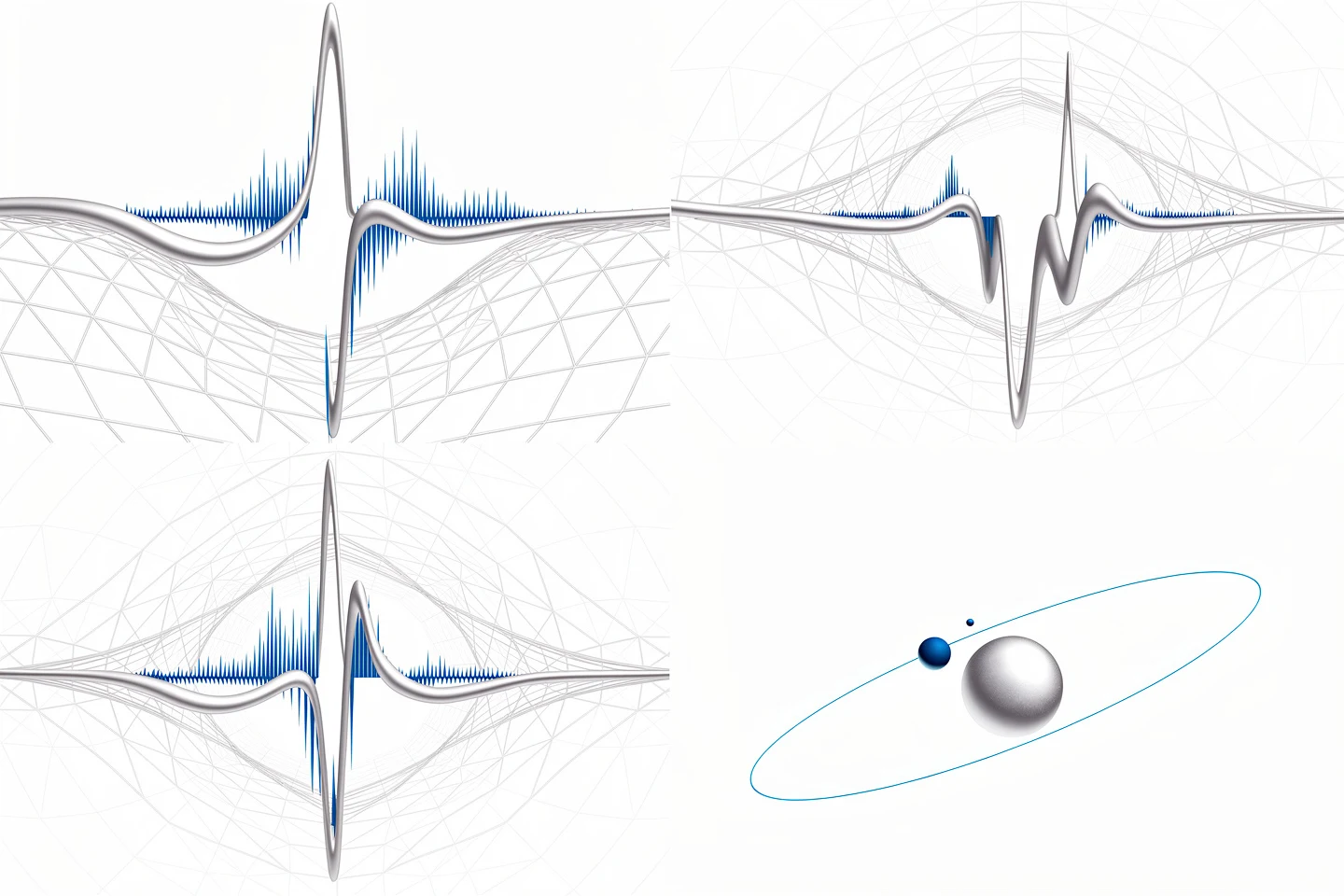
The light of a distant star is no perfect beacon. Passing through the gravitational field of another star, it bends, splits, and magnifies, creating a fleeting Einstein ring in the sky. This is how gravitational microlensing manifests, predicted by Fritz Zwicky back in the 1930s. The effect itself rests on an exact solution to Einstein's equations, obtained by Karl Schwarzschild in 1916. But if the lens has an unseen companion (say, a massive planet) the light curve stops being smooth. It develops sharp double peaks, like the flicker of a candle flame from an invisible draft. It was exactly this kind of flicker that TESS captured in April 2023, when its optics accidentally caught the event Gaia23bra.
Over 117 days, the lens star (a dim orange dwarf 15,000 light-years away) slowly slid across the background star in the plane of the Galaxy. Ground-based surveys recorded a smooth rise in brightness, and initially the event was classified as a single lens. But TESS's camera, snapping every 200 seconds, saw something more: two sharp peaks separated by a couple of weeks. These were caustic crossings — gravitational "glints" characteristic of a binary lens. Mathematical modeling showed that the lens consists of a star with 0.8 solar masses and a companion with 2.2 Jupiter masses, circling at a distance of 4.2 astronomical units — a cold exoplanetary giant akin to our Jupiter.
The discovery of Gaia23bra b is more than a curiosity. It vividly shows that routine sky surveys, originally aimed at transit planet searches, can become effective microlensing tools in regions beyond the reach of specialized telescopes. Unlike the bulge, where ground-based networks operate, this event occurred in the thick disk of the Galaxy, and that's where hundreds of similar worlds may hide, invisible to both the transit method and Doppler spectroscopy. Each such world is a witness to the evolution of matter from the primordial hydrogen of the Big Bang to planetary systems. Moreover, every planet found beyond the snow line adds to our statistics, helping us understand how gas giants form and why they migrate. And large-scale microlensing is one of the few ways to test whether dark matter might be made up, at least in part, of massive compact objects like black holes, whose lenses are sought in a similar way.
The prospects are exhilarating. Already, TESS and Gaia archives are being sifted for other anomalous light curves with sharp peaks. The next step will be the Vera Rubin Observatory, whose decade-long LSST survey will cover the entire Galactic plane, and the future Roman Space Telescope is specifically designed for continuous microlensing searches in the bulge. Together, they will enable us to catch planets by the gravitational tremor of starlight everywhere. And by 2030, when the lens and source have separated enough, the ultrasensitive cameras of Hubble or James Webb may directly glimpse the dim orange dwarf and its invisible companion, eliminating the remaining uncertainties once and for all.
TESS's 200-second cadence is roughly 70 times higher than the typical cadence of ground-based microlensing surveys (one data point per night), allowing a detailed tracing of the caustic peak shapes, each lasting only about 5 hours.