Galaxies without dark matter: a sieve for the invisible ✛
In the galaxy NGC 1052 DF2, stars move at only 8 kilometers per second, as if there were no invisible mass around. For comparison: in our Milky Way, outlying stars accelerate to 200 kilometers per second, held by a massive dark matter halo. Fritz Zwicky suspected its existence as early as the 1930s, and Vera Rubin confirmed it in the 1970s: without an invisible framework, galaxies would fly apart. But here — a star cluster deprived of its usual support. It is precisely such 'empty' systems that become a sieve, sifting dark matter through ordinary matter.
Galaxy collisions are a grand cosmic shake-up. Ordinary matter clings, rubs, heats up, and slows down, while dark matter glides past, barely noticing obstacles. Imagine a handful of sand and a pinch of metal dust thrown into water: the sand immediately gets wet and sinks, while the dust, if water-repellent, rushes on. On a galactic scale, these 'washings' leave behind objects almost devoid of dark matter. Their existence signals how weakly it interacts with baryons.
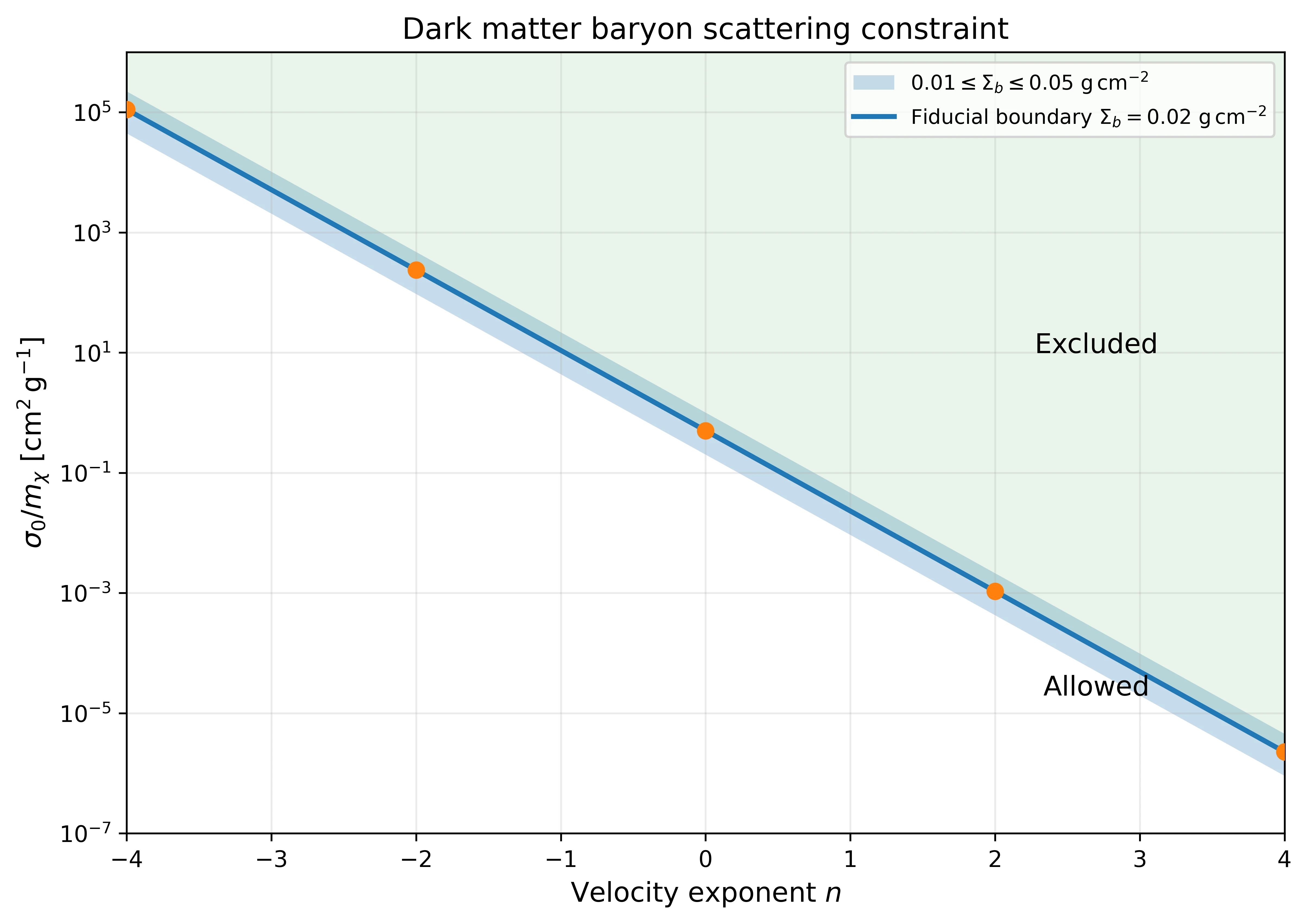
Astrophysicists have developed a quantitative criterion for such a sieve. They ask: what fraction of dark matter remains in the resulting galaxy after a collision? If that fraction is below a threshold (say, 1%), the mixture has truly separated. The condition is expressed as an inequality, where the main variables are the intensity of 'stickiness' (momentum-transfer cross section) and the fraction of the interacting component. The finer the sieve, the less impurity it can retain.
Not everything boils down to a head-on collision. Dark matter could cool and settle into a flat disk, such models are called dissipative. For the shell loss to succeed, the cooling fraction must be minuscule: less than a percent, otherwise matter won't separate. Another scenario is an ultralight axion field forming quantum clumps. They are torn apart by tidal forces if the escape velocity from the system is about 96 times greater than the drift speed. This picks out a narrow mass window: roughly 10⁻²³–10⁻²² eV. Each such option is its own cell in the galactic sieve.
The slow stars of NGC 1052 DF2 are not an anomaly but evidence of a giant sieve at work. Each such galaxy becomes a tool that probes the properties of invisible matter at the microscale. And the more of them future surveys like LSST find, the more precisely we will tune this sieve. What began as a mystery of an almost weightless star cluster turns into a key to one of the main problems in physics.
In the galaxy NGC 1052 DF2, the stellar velocity dispersion is only about 8 km/s, as if all the mass were provided by the stars themselves, with no dark matter halo.