Galaxies without dark matter: a sieve for the invisible ✛
Context
Almost a century ago, Fritz Zwicky noticed that galaxy clusters were held together by invisible mass, and in the 1970s, Vera Rubin confirmed that stars at the outskirts were spinning too fast. Since then, dark matter has become a cornerstone of cosmology, yet its nature remains elusive. Recently, galaxies with anomalously low dark matter content, such as NGC 1052 DF2, have been discovered. These are not mere curiosities—they open up a new way to test microscopic models.
Methods
The authors introduce a criterion for the separability of dark matter and baryons by comparing the fractions of material captured in the final object during the formation of a deficient system. The key parameter is the final mass ratio δ, which must be below a threshold (e.g., 0.01). This condition is translated into constraints on the interaction cross section, the fraction of the interacting component, and the efficiency of gravitational capture. Three scenarios are considered: high-velocity collisions (like the Bullet Cluster), formation from tidal tails during galaxy mergers, and stripping of the envelope by an ultralight axion field. For each scenario, analytical inequalities are derived.
Results
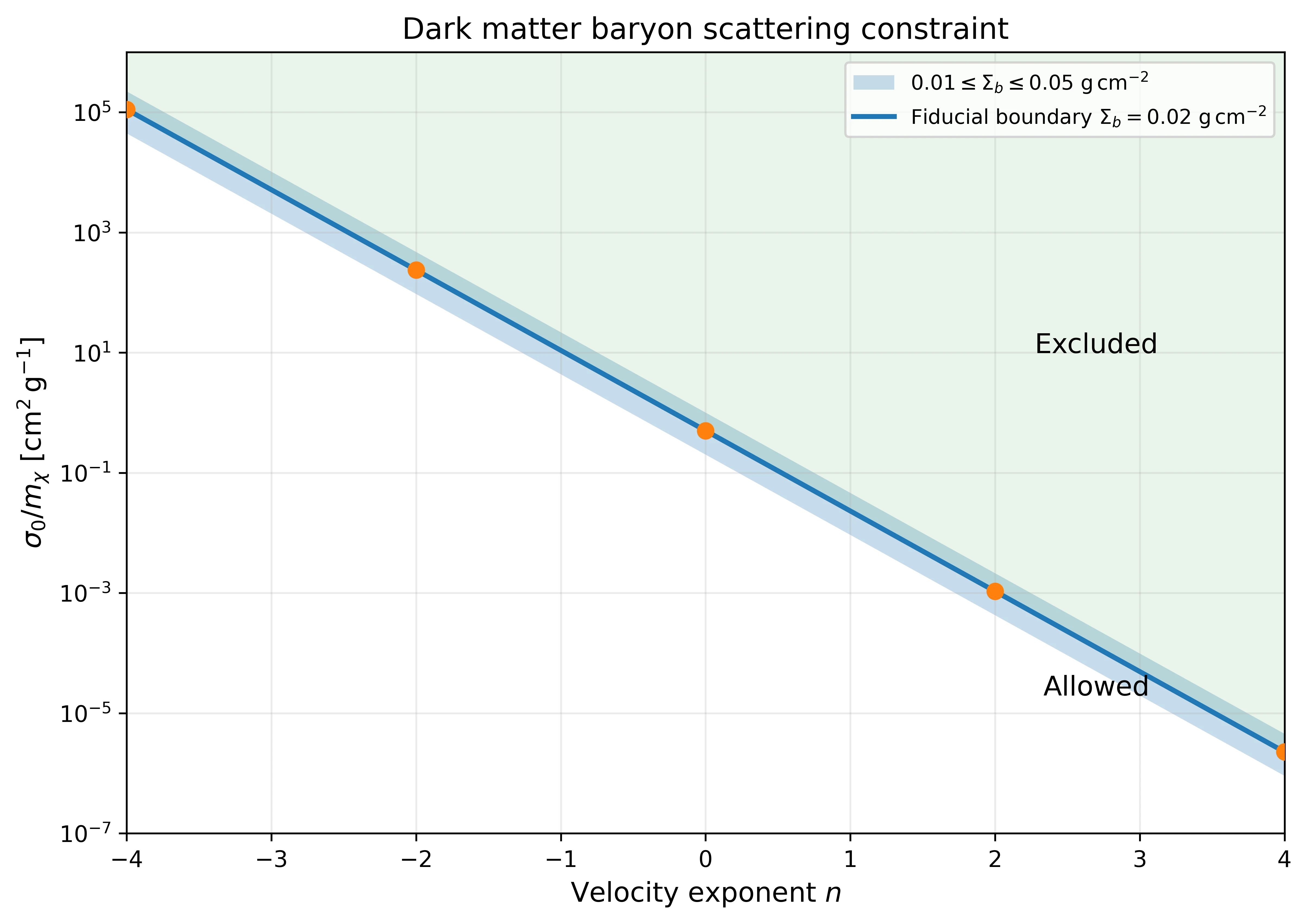
For the high-velocity collision scenario, a constraint on the momentum transfer cross section is obtained: σ/m ≲ 0.50 cm²/g for constant interaction. With a power-law velocity dependence (vⁿ), the constraint tightens to 1.1×10⁻³ cm²/g for n=2 and 2.3×10⁻⁶ cm²/g for n=4. If the interaction is strong enough to stop dark matter, its fraction in the interacting component cannot exceed ≈0.5%. For dissipative dark matter, the cooling fraction must be less than 1% or have a cooling time exceeding 10⁶ billion years. Ultralight dark matter requires that the escape velocity during tidal stripping exceeds the travel velocity by a factor of ∼96; this selects an axion mass window around 10⁻²²–10⁻²³ eV. The results are sensitive to environmental details and need refinement through numerical simulations.
Implications
The proposed approach turns individual deficient systems into a universal tool for probing dark matter physics. Unlike constraints from the cosmic microwave background or galaxy clusters, these tests operate at late times and in a specific dynamical environment. They complement laboratory searches and cosmological observations that are sensitive to the early universe.
Future development
With a growing sample of deficient galaxies (expected from surveys like LSST and JWST) and the development of detailed hydrodynamic simulations, the constraints will become more precise. We will be able to not just note their existence, but also predict their frequency for different models, gaining statistical power.
Impact
The method will directly impact theories of dark matter (especially interacting, dissipative, and ultralight), as well as our understanding of galaxy mergers and tidal disruption events.
Next steps
Reconstructing collision parameters (impact parameter, gas structure) for specific objects; building self-consistent models of ultralight dark matter with a solitonic core; cataloguing deficient systems with high spectroscopic resolution.
Key open problems
The article relates to the nature of dark matter—one of the key unsolved problems in physics. It also touches on the separability of components in nonlinear dynamics and the stability of quantum solitons.
The knowledge machine's view
This section is addressed to the author of the paper and their colleagues. Neighbouring works were found by meaning-based search across our archive, not by word overlap. We do not review: we show the field around the work.
What the work does
The paper introduces a separability criterion for dark matter and baryons based on the finite mass ratio δ, and derives analytic constraints on the interaction cross section, the fraction of the interacting component, and other parameters for three scenarios of galaxy formation with a dark matter deficit.
Where its strength is
The strength of the approach lies in turning individual dark matter-deficient systems into a universal tool for testing dark matter microphysics in the late Universe, complementing cosmological probes.
Where it could go next
- It might be interesting to see how the proposed separability criterion relates to detailed numerical simulations of dark matter-free system formation, as considered in a companion paper.based on: The Cosmic Pearl String: How Galaxies Lost Their Dark Matter arXiv:2606.05144v2
- Nearby lies a study where neutrino telescopes search for dark matter annihilation signals; one could consider whether deficient galaxies provide additional constraints on such signals in interacting dark matter scenarios.based on: Symphony of Shadows: Neutrino Telescopes Catch the Whisper of Dark Matter arXiv:2607.05335v1
Worth trying
- Test whether stellar stream data in deficient galaxies can be used to independently estimate the efficiency of gravitational capture.
- Compare the derived cross-section constraints with laboratory dark matter searches, such as levitating particles.
Why this may matter
If deficient galaxies indeed act as a universal sieve, they could close the long-standing gap between cosmological constraints on dark matter and its microscopic models testable in laboratories.
Nearby works in our archive
- Invisible Conductors of Galactic Diskssimilarity 0.66
- Dark Matter Without Fine-Tuningsimilarity 0.66
- Symphony of Shadows: Neutrino Telescopes Catch the Whisper of Dark Mattersimilarity 0.65
- Where Does the Universe's Matter Go?similarity 0.65
- The Cosmic Pearl String: How Galaxies Lost Their Dark Mattersimilarity 0.64
- A Levitating Dust Grain Hunts Invisible Mattersimilarity 0.64
The closest work in the archive sits at 0.66 by meaning — the usual level for our corpus.
Original abstract
as written by the authors arXiv:2607.26085v1
Dark matter deficient galaxies provide a direct way to test whether baryons and dark matter can become sufficiently separated during galaxy evolution. We formulate a Dark Matter-Baryon Separability condition based on the relative incorporation efficiencies of the two components, requiring the final dark matter to baryon ratio to fall below an observationally defined threshold. Applied to high speed collisions, this condition constrains dark matter baryon momentum transfer cross section, interacting dark matter fraction and the efficiency of gravitational recapture. The same framework gives us bounds on the abundance and cooling time of dissipative dark matter, and on the integrated escape rate of ultralight fuzzy dark matter from shallow or tidally disturbed potentials. These results show how dark matter deficient galaxies can complement cosmological and laboratory probes by constraining late time dark matter interactions, dissipation and halo stability.
In the galaxy NGC 1052 DF2, the stellar velocity dispersion is only about 8 km/s, as if all the mass were provided by the stars themselves, with no dark matter halo.
Key numbers
- cross section σ/m (n=0): ≲ 0.50 cm²/g
- cross section σ/m (n=2): ≲ 1.1×10⁻³ cm²/g
- max fraction of interacting DM: ≲ 0.5%
- typical column density: 0.02 g/cm²
- mass window for ultralight DM: 6.6×10⁻²³ – 1.0×10⁻²² eV