Cosmic accelerators push particles to the limit express

Original: "Ultra-high-energy $$\gamma$$-ray imprints from PeV particles accelerated by supernova remnants"
· Zhen Cao, F. Aharonian, Y. X. Bai, Y. W. Bao, D. Bastieri, X. J. Bi, Y. J. Bi, W. Bian, J. Blunier, A. V. Bukevich, C. M. Cai, Y. Y. Cai, W. Y. Cao, Zhe Cao, J. Chang, J. F. Chang, E. S. Chen, G. H. Chen, H. K. Chen, L. F. Chen, Liang Chen, Long Chen, M. J. Chen, M. L. Chen, Q. H. Chen, S. Chen, S. H. Chen, S. Z. Chen, T. L. Chen, X. B. Chen, X. J. Chen, X. P. Chen, Y. Chen, N. Cheng, Q. Y. Cheng, Y. D. Cheng, M. Y. Cui, S. W. Cui, X. H. Cui, Y. D. Cui, B. Z. Dai, H. L. Dai, Z. G. Dai, Danzengluobu, Y. X. Diao, A. J. Dong, X. Q. Dong, K. K. Duan, J. H. Fan, Y. Z. Fan, J. Fang, J. H. Fang, K. Fang, C. F. Feng, H. Feng, L. Feng, S. H. Feng, X. T. Feng, Y. Feng, Y. L. Feng, S. Gabici, B. Gao, Q. Gao, W. Gao, W. K. Gao, M. M. Ge, T. T. Ge, L. S. Geng, G. Giacinti, G. H. Gong, Q. B. Gou, M. H. Gu, F. L. Guo, J. Guo, K. J. Guo, X. L. Guo, Y. Q. Guo, Y. Y. Guo, R. P. Han, O. A. Hannuksela, M. Hasan, H. H. He, H. N. He, J. Y. He, X. Y. He, Y. He, S. Hernández-Cadena, B. W. Hou, C. Hou, X. Hou, H. B. Hu, S. C. Hu, C. Huang, D. H. Huang, J. J. Huang, X. L. Huang, X. T. Huang, X. Y. Huang, Y. Huang, Y. Y. Huang, A. Inventar, X. L. Ji, H. Y. Jia, K. Jia, H. B. Jiang, K. Jiang, X. W. Jiang, Z. J. Jiang, M. Jin, S. Kaci, M. M. Kang, I. Karpikov, D. Khangulyan, D. Kuleshov, K. Kurinov, Cheng Li, Cong Li, D. Li, F. Li, H. B. Li, H. C. Li, Jian Li, Jie Li, K. Li, L. Li, R. L. Li, S. D. Li, T. Y. Li, W. L. Li, X. R. Li, Y. Li, Zhe Li, Zhuo Li, E. W. Liang, Y. F. Liang, S. J. Lin, B. Liu, C. Liu, D. Liu, D. B. Liu, H. Liu, J. Liu, J. L. Liu, J. R. Liu, M. Y. Liu, R. Y. Liu, S. M. Liu, W. Liu, X. Liu, Y. Liu, Y. Liu, Y. N. Liu, Y. Q. Lou, Q. Luo, Y. Luo, H. K. Lv, B. Q. Ma, L. L. Ma, X. H. Ma, I. O. Maliy, J. R. Mao, Z. Min, W. Mitthumsiri, Y. Mizuno, G. B. Mou, A. Neronov, K. C. Y. Ng, M. Y. Ni, L. Nie, L. J. Ou, Z. W. Ou, P. Pattarakijwanich, Z. Y. Pei, D. Y. Peng, J. C. Qi, M. Y. Qi, J. J. Qin, D. Qu, A. Raza, C. Y. Ren, D. Ruffolo, A. Sáiz, D. Savchenko, D. Semikoz, L. Shao, O. Shchegolev, Y. Z. Shen, X. D. Sheng, Z. D. Shi, F. W. Shu, H. C. Song, Yu. V. Stenkin, Y. Su, D. X. Sun, H. Sun, J. X. Sun, Q. N. Sun, X. N. Sun, Z. B. Sun, N. H. Tabasam, J. Takata, P. H. T. Tam, H. B. Tan, Q. W. Tang, R. Tang, Z. B. Tang, W. W. Tian, C. N. Tong, L. H. Wan, C. Wang, D. H. Wang, G. W. Wang, H. G. Wang, J. C. Wang, K. Wang, Kai Wang, Kai Wang, L. P. Wang, L. Y. Wang, L. Y. Wang, R. Wang, W. Wang, X. G. Wang, X. J. Wang, X. Y. Wang, Y. Wang, Y. D. Wang, Z. H. Wang, Z. X. Wang, Zheng Wang, D. M. Wei, J. J. Wei, Y. J. Wei, T. Wen, S. S. Weng, C. Y. Wu, H. R. Wu, Q. W. Wu, S. Wu, X. F. Wu, Y. S. Wu, S. Q. Xi, J. Xia, J. J. Xia, G. M. Xiang, D. X. Xiao, G. Xiao, Y. F. Xiao, Y. L. Xin, H. D. Xing, Y. Xing, D. R. Xiong, B. N. Xu, C. Y. Xu, D. L. Xu, R. F. Xu, R. X. Xu, S. S. Xu, W. L. Xu, L. Xue, D. H. Yan, T. Yan, C. W. Yang, C. Y. Yang, F. F. Yang, L. L. Yang, M. J. Yang, R. Z. Yang, W. X. Yang, Z. H. Yang, Z. G. Yao, X. A. Ye, L. Q. Yin, N. Yin, X. H. You, Z. Y. You, Q. Yuan, H. Yue, H. D. Zeng, T. X. Zeng, W. Zeng, X. T. Zeng, M. Zha, B. B. Zhang, B. T. Zhang, C. Zhang, H. Zhang, H. M. Zhang, H. Y. Zhang, J. L. Zhang, J. Y. Zhang, Li Zhang, P. F. Zhang, R. Zhang, S. R. Zhang, S. S. Zhang, S. Y. Zhang, W. Zhang, W. Y. Zhang, X. Zhang, X. P. Zhang, Yi Zhang, Yong Zhang, Z. P. Zhang, J. Zhao, L. Zhao, L. Z. Zhao, S. P. Zhao, X. H. Zhao, Z. H. Zhao, F. Zheng, T. C. Zheng, B. Zhou, H. Zhou, J. N. Zhou, M. Zhou, P. Zhou, R. Zhou, X. X. Zhou, X. X. Zhou, B. Y. Zhu, C. G. Zhu, F. R. Zhu, H. Zhu, K. J. Zhu, Y. C. Zou, X. Zuo, Y. Li
arXiv:2604.22621 · 2026-04-24 · CC BY 4.0 · 2 min
Supernova remnants turn out to be capable of accelerating protons to energies millions of times higher than those achieved in the Large Hadron Collider.

Every second, invisible projectiles from the depths of space pierce through us. These are cosmic rays — atomic nuclei accelerated to speeds nearly indistinguishable from the speed of light. Their energy is hundreds of millions of times greater than what our most powerful accelerators can achieve. Where does this monstrous force come from? For a long time, suspicion fell on shock waves from supernova explosions — the giant fireworks that mark the end of massive stars' lives. But catching such an accelerator working at the edge of its capabilities had proven elusive.

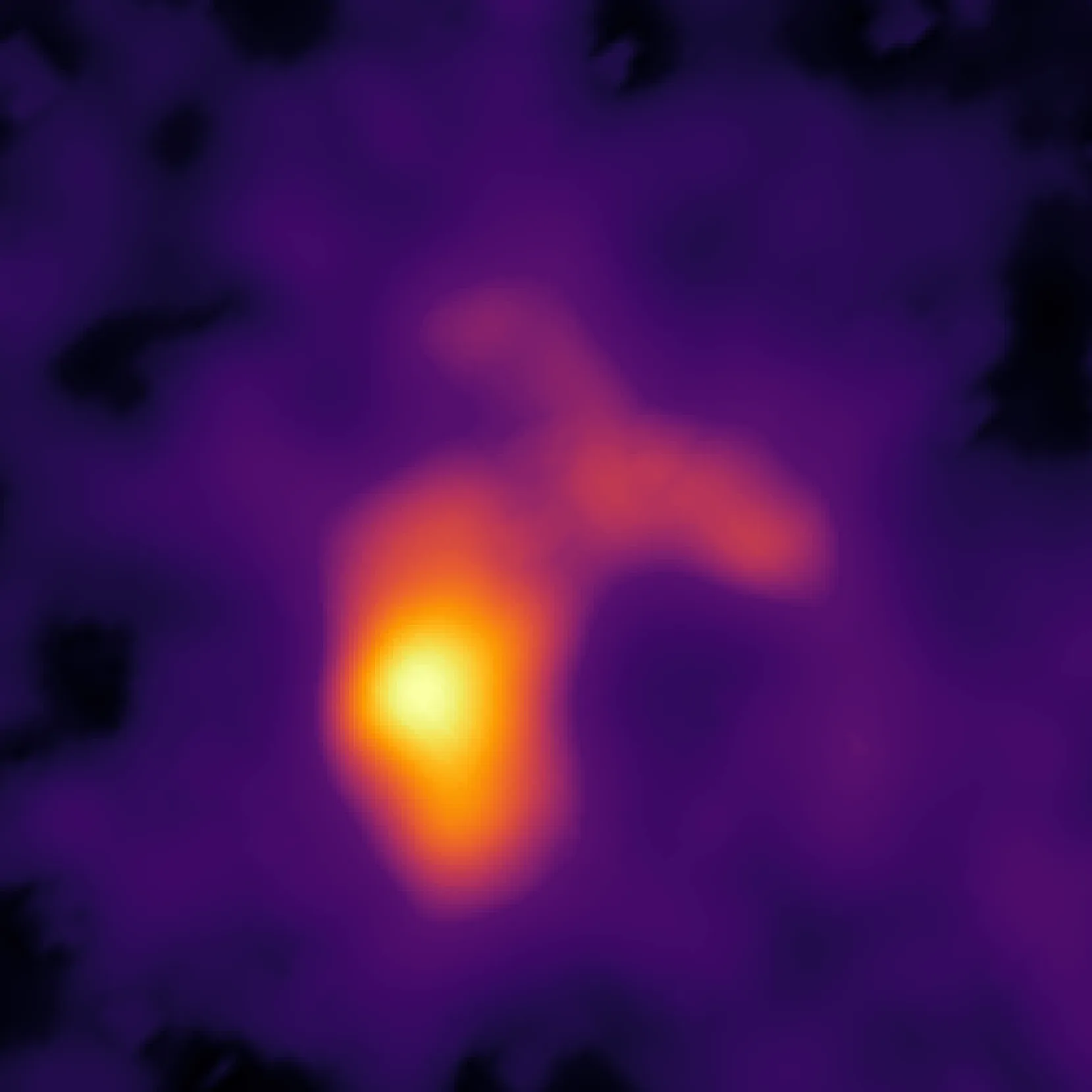
Now the veil has lifted. The Chinese LHAASO observatory, spread high in the mountains like a giant net for catching light, has registered powerful gamma-ray emission from two supernova remnants — G150.3+4.5 and γ-Cygni. These objects are no longer young: they are tens of thousands of years old, and their shock waves have slowed down. But precisely now, as if exhaling accumulated power, they fire off particles with energies up to several petaelectronvolts. That is a thousand times more than the Large Hadron Collider can produce. The gamma rays that LHAASO sees are not the direct glow of accelerated particles but the echo of their collisions with clouds of interstellar gas — hydrogen and dust.

A petaelectronvolt (PeV) is the energy of a flying mosquito compressed into a single atomic nucleus. One such proton carries as much motion as a tennis ball served by a professional.

The key clue is the shape of the glow. The telescope sees two, and in places three, distinct components: one, more diffuse, shines at moderate energies; another, compact, at the highest energies. And this compact source coincides with the location of dense molecular clouds. Inside the remnants themselves, there are no powerful pulsars (rotating neutron stars with winds) that could fake the picture. This means that the particles crashing into the clouds are indeed protons accelerated by the supernova shock wave. This is the first direct indication that old supernova remnants are still capable of acting as accelerators at petaelectronvolt energies, illuminating the surrounding nebulae like a searchlight.

Surprisingly, the peak of acceleration occurs not at the moment of the explosion but at the end of the free-expansion phase — when the stellar shell, expanding, sweeps up interstellar gas ahead of it like a bulldozer, creating ideal conditions for particles to surf on the shock wave.

The supernova remnant G150.3+4.5 is so large in the sky that it covers an area 50 times bigger than the full Moon, but it can only be seen in gamma rays.

In Isaac Asimov's novel 'Foundation', cosmic rays are used as an energy source for a galactic civilization — no one knew back then that their real sources could be so close.
Scientists
Enrico FermiHenri PoincaréFritz ZwickyJoseph WeberStephen HawkingRainer Weiss
Concepts
ultra high energy gamma ray supernova remnant ultra high energy cosmic ray source supernova jets cosmic accelerator pulsar wind nebula particle acceleration kink neutron star light emission crab nebula neutron star structure stellar explosion pulsar tev central engine population iii stars cherenkov radiation stellar remnant progenitor Gamma radiation