Ultraviolet Trap: How TRAPPIST-1 Star Fakes Signs of Life ✛ ✎ ✦
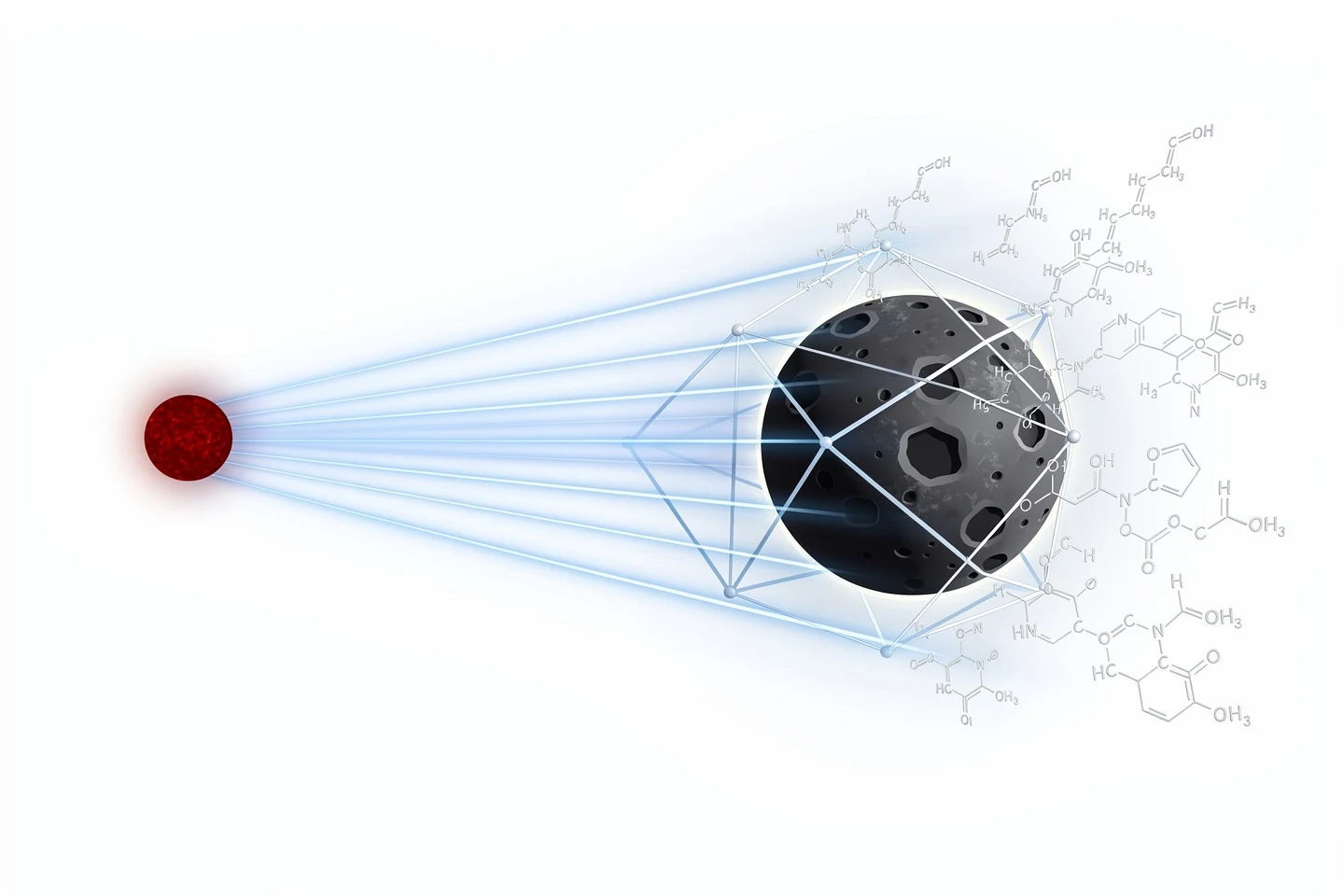
In the orchestra of interstellar life search, every note counts. And the score here is dictated not by man, but by a distant star. For the planet TRAPPIST-1 e, one of seven in the system of an ultracool red dwarf, the conductor's baton is harsh ultraviolet light. And this baton can play a cruel joke: slip astronomers a melody of life where cosmic silence reigns.
Scientists took five reconstructions of TRAPPIST-1's ultraviolet spectrum, from the calm PHOENIX to the aggressive Mega-MUSCLES SEM, and calculated how they would rewrite the atmosphere of planet e, similar to Archean Earth. The photochemical code, based on the laws of Maxwell and Fraunhofer, yielded steady-state concentrations of key gases. The results stunned: methane abundance wandered within three orders of magnitude, while oxygen ranged from barely detectable traces to 5.3% in an abiotic scenario. Worse: in some combinations, methane and ozone appeared simultaneously — astrobiology's Holy Grail, which can now turn out to be a counterfeit.
This upends the rulebook for biosignature hunting. For a long time, astronomers, inspired by the work of William Borucki, believed: the combination of a strong oxidizer and a strong reducer is almost life's autograph. Now it turns out that carbon monoxide is a more honest marker. Its high concentration in a transit spectrum almost guarantees lifelessness, while a low one may hint at microbial uptake. To avoid mistaking an abiotic trick for a living orchestra, telescopes like James Webb must learn to read the ultraviolet 'handwriting' of the parent star with unprecedented precision.
In the future, three-dimensional climate models will be needed, accounting for tidal locking and cloud cover — since the real planet doesn't bathe in uniform ultraviolet. Right now, we resemble a listener trying to reconstruct a symphony from a single line, written by a trembling hand. New spectroscopy and photometry campaigns on JWST should yield reliable UV spectra of cool stars and help separate living notes from noise. The irony is that this very chemical deception may once have cleared the path for the Great Oxidation Event on Earth, so the mechanism of lie and truth are woven into a single knot. A mistake in the conductor's baton could cost us a discovery, but it also reminds us of the fine line between alive and lifeless.
TRAPPIST-1 is so dim that a year on planet e lasts only 6.1 Earth days, and its surface is likely always turned with one side to the star. Yet the system is closer to us than many known exoplanets, just 12.5 parsecs away.