Ultraviolet uncertainty challenges biosignatures on TRAPPIST-1 e ✛ ✎ ✦
Context
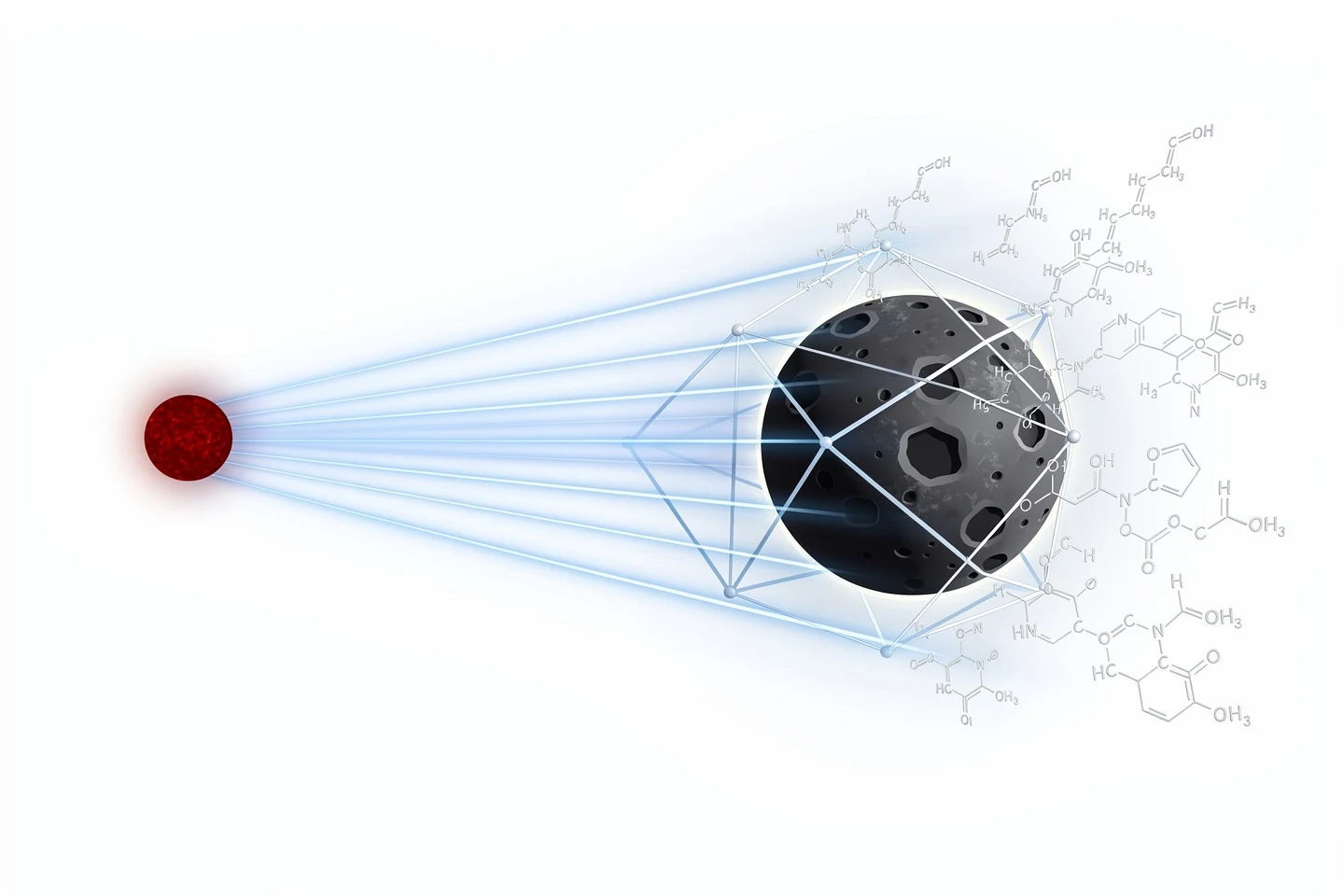
The TRAPPIST-1 system, only 12.5 parsecs away, includes seven planets, four of which lie in the habitable zone. The planet TRAPPIST-1 e is one of the primary targets for the search for extraterrestrial life. However, its star — an ultra-cool red dwarf — emits intense and variable UV radiation capable of dramatically altering atmospheric chemistry. For planning observations with JWST and future telescopes, it is crucial to understand how the uncertainty in the star's UV spectrum affects the interpretation of potential biosignatures obtained through transit spectroscopy and photometry.
Methods
The researchers applied a one-dimensional photochemical code, including detailed photolysis cross-sections based on the laws of electrodynamics, for five different reconstructions of TRAPPIST-1’s UV spectrum. The atmosphere was modeled with pressures of 1 bar and 0.1 bar of CO2 at a surface temperature of 288.4 K. Abiotic (weak sinks) and biotic (strong sinks for CO, H2, O2) boundary conditions were considered with CH4 fluxes ranging from $10^8$ to $10^{11}$ molecules/cm²/s. For each case, steady-state concentrations were calculated, after which synthetic transmission spectra were generated using spectral synthesis in the NIRSpec and MIRI bands of the James Webb Space Telescope.
Results
The results revealed that, depending on the UV spectrum, the concentration of methane varies by three orders of magnitude, and oxygen ranges from traces to several percent. In the abiotic scenario with a high FUV/NUV ratio (Mega-MUSCLES SEM model), the abundance of O2 near the surface reached 5.3%, and a noticeable ozone layer formed in the atmosphere, detectable in transmission spectra — a field pioneered by William Borucki. Simultaneously, CH4 was present, creating a false-positive biosignature. In biotic cases, active uptake of CO by microorganisms suppressed CO concentration and contributed to the accumulation of O2 (up to 390 ppm) even without oxygenic photosynthesis. Radicals OH, formed from the photolysis of H2O, and the reaction CO + OH → CO2 + H played a key role in regulating the redox balance. Abiotic buildup of O2 was enhanced when this pathway was suppressed due to weak UV radiation in the NUV region.
Implications
The findings mean that the joint detection of CH4 and O3 in the atmosphere of an exoplanet around a red dwarf is not unambiguous evidence of life. High levels of O2 also do not necessarily indicate oxygenic photosynthesis. Carbon monoxide acts as an anti-biosignature: its high concentration points to abiotic processes, while a low one suggests biological uptake. Therefore, reliable interpretation of biosignatures requires a comprehensive analysis of the atmosphere in the context of the stellar UV environment.
Future development
Future research should aim at obtaining more accurate empirical UV spectra of cool stars using JWST and future missions such as the Origins Space Telescope. There is also a need for three-dimensional climate-photochemical models that account for cloud cover and tidal locking on planets like TRAPPIST-1 e. This will reduce uncertainties when planning searches for life.
Impact
The results will impact astrobiology, the study of exoplanet atmospheres, and the strategy for future observations using photometry and high-resolution spectroscopy.
Next steps
The immediate steps include campaigns of transit observations of TRAPPIST-1 e with JWST to search for spectral features of CO and O3, as well as laboratory measurements of photolysis cross-sections at temperatures typical of planetary atmospheres around M dwarfs.
Key open problems
The work is directly connected to the fundamental problem of searching for extraterrestrial life: how to distinguish biogenic gases from abiotic ones under conditions of incomplete knowledge about the star. This echoes long-standing questions about the evolution of Earth's atmosphere, including the faint young Sun paradox, and underscores the need for an interdisciplinary approach in astrobiology.
The knowledge machine's view
This section is addressed to the author of the paper and their colleagues. Neighbouring works were found by meaning-based search across our archive, not by word overlap. We do not review: we show the field around the work.
What the work does
This study models the atmosphere of TRAPPIST-1 e under Archean Earth-like scenarios using a one-dimensional photochemical model. It investigates the impact of five reconstructions of the star's UV spectrum on the concentrations of CH4, CO, O2, and O3 under abiotic and biotic conditions. The results show that UV uncertainty leads to variations in concentrations by orders of magnitude and can produce false-positive biosignatures, including abiotic accumulation of O2 and ozone.
Where its strength is
A key strength is the quantitative demonstration of how uncertainty in the stellar UV spectrum directly translates into ambiguity in interpreting biosignatures, with emphasis on the role of the FUV/NUV ratio and the OH radical. This provides a concrete benchmark for planning observations and interpreting JWST data.
Where it could go next
- It may be interesting to compare the obtained photochemical profiles with the capabilities of high-resolution ground-based spectrographs such as ELT/ANDES, which can resolve O2 and CH4 lines in the atmospheres of nearby transiting planets.based on: Molecular Melodies: How ELT/ANDES Will Tune Into the Breath of Exoplanets arXiv:2607.12017
- A related study examines the influence of stellar spectra on photosynthesis: one could extend the model to include not only chemistry but also the availability of photosynthetically active radiation for a potential biosphere, to assess which UV scenarios are compatible with a productive biota.based on: Why Red Dwarfs Have Fewer Chances for Photosynthesis arXiv:2602.20789
- There is work in the archive on how atmospheric escape around cool stars may depend on UV: it might be worth linking your steady-state models with long-term atmospheric evolution to understand how stable the derived concentrations are over geological timescales.based on: Why Cold Stars Lead Scientists Astray arXiv:2601.05313v1
Worth trying
- Test how the concentration dependence on UV changes when varying CO2 pressure over 0.01–1 bar for each of the five UV spectra.
- Compute synthetic transmission spectra for ELT/ANDES and compare their sensitivity to O2, CH4, and O3 across UV scenarios.
- Add a parameterization of photosynthetic productivity dependent on the stellar spectrum to assess which UV reconstructions could support a biosphere.
Why this may matter
If stellar UV uncertainty can produce false-positive biosignatures, then precise characterization of red dwarf radiation becomes critical for interpreting future JWST observations and planning life-finding missions. The work underscores the need for an interdisciplinary approach combining stellar astrophysics and atmospheric modeling.
Nearby works in our archive
- Wiretapping a Star: How a Naked Planet Helps Find Airsimilarity 0.69
- A Planet’s Breathing Unveils the Mystery of Lifesimilarity 0.67
- The Invisible Conductor of the Super-Puff Planet Systemsimilarity 0.60
- Why Cold Stars Lead Scientists Astraysimilarity 0.60
- Cosmic Artist: How Photosynthesis Paints Habitable Worldssimilarity 0.60
- Molecular Melodies: How ELT/ANDES Will Tune Into the Breath of Exoplanetssimilarity 0.60
- Why Red Dwarfs Have Fewer Chances for Photosynthesissimilarity 0.60
The closest work in the archive sits at 0.69 by meaning — the usual level for our corpus.
TRAPPIST-1 is so dim that a year on planet e lasts only 6.1 Earth days, and its surface is likely always facing the star with one side. Meanwhile, the system is closer to us than many known exoplanets — just 12.5 parsecs away.
Key numbers
- maximum O2 concentration in the abiotic scenario (Mega-MUSCLES SEM): 5.3%
- O2 concentration in the biotic scenario (Revised PHOENIX): 390 ppm
- range of CH4 concentration variation: three orders of magnitude
- range of FUV/NUV ratio for different SEDs: two orders of magnitude
- distance to TRAPPIST-1: 12.5 parsecs