How Proton Beams Birth Waves and Take the Shape of a Hammer: Secrets of the Young Solar Wind ✛ ✎ ✦
Context
The young solar wind is a unique laboratory for studying fundamental plasma processes. Measurements from the Parker probe near our star revealed narrow proton beams, consisting of ionized hydrogen, moving relative to the background plasma at speeds exceeding the Alfvén speed but still much less than the speed of light. These beams carry excess kinetic energy and can excite electromagnetic waves, much like wind generates ripples on water. Understanding their evolution is critical, as such processes redistribute energy and can accelerate particles to dangerous energies, impacting space weather.
Methods
Researchers used the explicit hybrid code Hybrid-VPIC, in which protons are treated as particles and electrons as a neutralizing fluid. This is a compromise between fully kinetic and magnetohydrodynamic approaches, allowing the capture of wave and kinetic effects without enormous computational cost. Two cases were simulated with parameters taken from actual observations: Case 1 with moderate drift and low plasma beta, and Case 2 with a fast beam (velocity 4.5 Alfvén speeds) and hotter plasma. A two-dimensional grid of 1024×1024 cells evolved over hundreds of gyroperiods, enabling the tracking of instability saturation and the back-reaction of waves on particle distributions. Dispersion analysis of the waves, essentially plasma oscillation spectroscopy, identified the right-handed polarization and compared it with linear theory.
Results
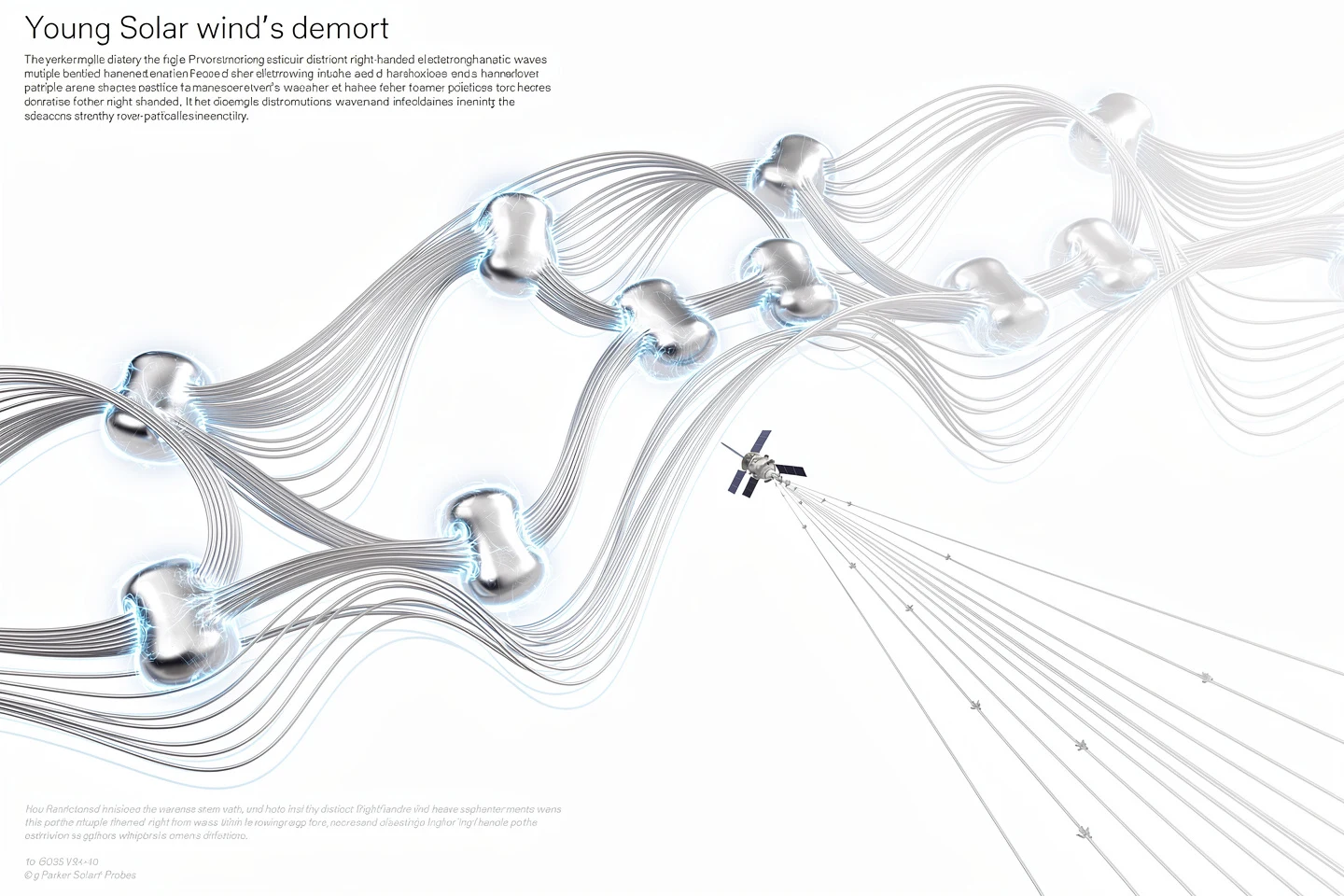
Simulations confirmed that right-handed waves grow from thermal noise and reach saturation. In Case 2, where beam drift was nearly four times larger, the magnetic energy of waves increased by two orders of magnitude compared to Case 1, and the growth happened three times faster. The waves caused noticeable beam relaxation: its velocity dropped from 4.5 to ~2.1 Alfvén speeds (a decline of over 50%), and perpendicular heating produced a temperature anisotropy of up to 2.8 before the system approached a new quasi-steady state. This irreversible conversion of beam kinetic energy into heat illustrates the growth of entropy in the system. Moreover, the proton distribution function changed dramatically: parallel cuts developed a characteristic plateau, and overall it took the shape of a hammerhead — a hammerhead distribution. In Case 1, by contrast, changes were modest: the beam only slightly heated, and the core remained virtually untouched. Crucially, the system's trajectories in the “anisotropy versus relative drift” space for all tested initial conditions converged to the same stability threshold predicted by quasilinear theory.
Implications
These results for the first time directly confirm that hammerhead profiles in the young solar wind are not a fluke but a natural product of nonlinear wave–particle interaction. Agreement with the quasilinear threshold means that analytical methods can be confidently applied to diagnose distant plasma environments where full-scale numerical simulation is impossible. This builds a bridge between microscopic kinetics and macroscopic observables — wave spectra and ion distributions.
Future development
In the future, scientists plan to extend the simulations to three-dimensional configurations and include heavy ions, such as helium and oxygen, which are also observed in the solar wind. Of particular interest is the study of secondary instabilities discovered in this work at large propagation angles and their connection to additional heating. The advancement of exascale computing will allow mass ratios and grid sizes to reach realistic values, blurring the line between simulation and direct observation.
Impact
The results are important for space weather forecasting, as beam relaxation influences the generation of energetic particles. Moreover, they will find applications in astrophysics of accretion disks and Big Bang remnants, where similar plasma instabilities govern momentum and magnetic field transport.
Next steps
Immediate tasks include comparison with new data from the Solar Orbiter probe and statistical analysis of hammerhead event occurrence. Controlled experiments on laser facilities that recreate collisionless plasma beams are also needed.
Key open problems
This work addresses the unsolved problem of solar corona heating and solar wind acceleration. Understanding the microscopic relaxation of beams directly impacts models of global energy circulation from the Sun to the heliosphere boundaries and resonates with questions about the origin of the cosmic microwave background, where primordial plasma inhomogeneities may have spawned similar instabilities.
The knowledge machine's view
This section is addressed to the author of the paper and their colleagues. Neighbouring works were found by meaning-based search across our archive, not by word overlap. We do not review: we show the field around the work.
What the work does
The work presents hybrid modeling of proton beam evolution in the young solar wind, showing that hammerhead distributions arise from nonlinear saturation of right-handed waves, and that the system's trajectories converge to the quasilinear stability threshold.
Where its strength is
The strength is the direct confirmation of the quasilinear threshold and the demonstration of the universality of hammerhead profiles across a wide range of parameters, providing a solid foundation for further generalizations.
Where it could go next
- It may be interesting to compare the obtained hammerhead distributions with Parker probe observations and assess their impact on particle acceleration in the context of space weather, using approaches applied in the work on solar magnetic loops.based on: The Sun's Magnetic Loops: Chaos You Can Measure arXiv:2608.05596v1
- A related avenue is the analysis of proton beams in medical applications: perhaps the beam-plasma interaction modeling methods developed there could help refine the applicability limits of the hybrid approach.based on: A Proton Beam Instead of an Umbrella arXiv:2606.07637
- It is worth considering analogies with processes in protoplanetary disks, where instabilities and plasma heating are also important; this could open new aspects of energy redistribution in astrophysical flows.based on: How Dust Disks Dance Around Newborn Stars arXiv:2608.02204v1
Worth trying
- Test whether convergence to the quasilinear threshold persists when multiple ion components (e.g., alpha particles) are included.
- Apply the hammerhead identification method to real Parker data for statistical confirmation.
- Investigate the influence of initial temperature anisotropy on saturation time and the shape of the final distribution.
Why this may matter
Such studies are important for space weather forecasting, as hammerhead distributions can serve as indicators of recent wave activity and associated plasma heating.
Nearby works in our archive
- The Sun's Magnetic Loops: Chaos You Can Measuresimilarity 0.66
- How the Electron's Shape Controls Gamma Lightsimilarity 0.63
- How Cold Clouds Survive in the Fire of the Sunsimilarity 0.63
- The Atomic Nucleus: Not a Soloist, but a Choir of Voicessimilarity 0.62
- How Dust Disks Dance Around Newborn Starssimilarity 0.62
- How Clouds Reshape Oceanic Vorticessimilarity 0.62
- A Proton Beam Instead of an Umbrellasimilarity 0.61
The closest work in the archive sits at 0.66 by meaning — the usual level for our corpus.
If the proton beam in Case 2 had not slowed down, it would have traveled from the Sun to Earth in just 20 minutes (typical solar wind takes 2–4 days). Fortunately, waves act as an effective 'brake'.
Key numbers
- Initial beam drift velocity (Case 2): 4.5 v_A
- Drift reduction by simulation end (Case 2): ~53%
- Maximum beam temperature anisotropy: ~2.8
- Beam-to-core density ratio (Case 2): ~0.053
- Core beta parameter (Case 2): 1.0