The Celestial Forge: How Proton Beams Take the Shape of a Hammer ✛ ✎ ✦
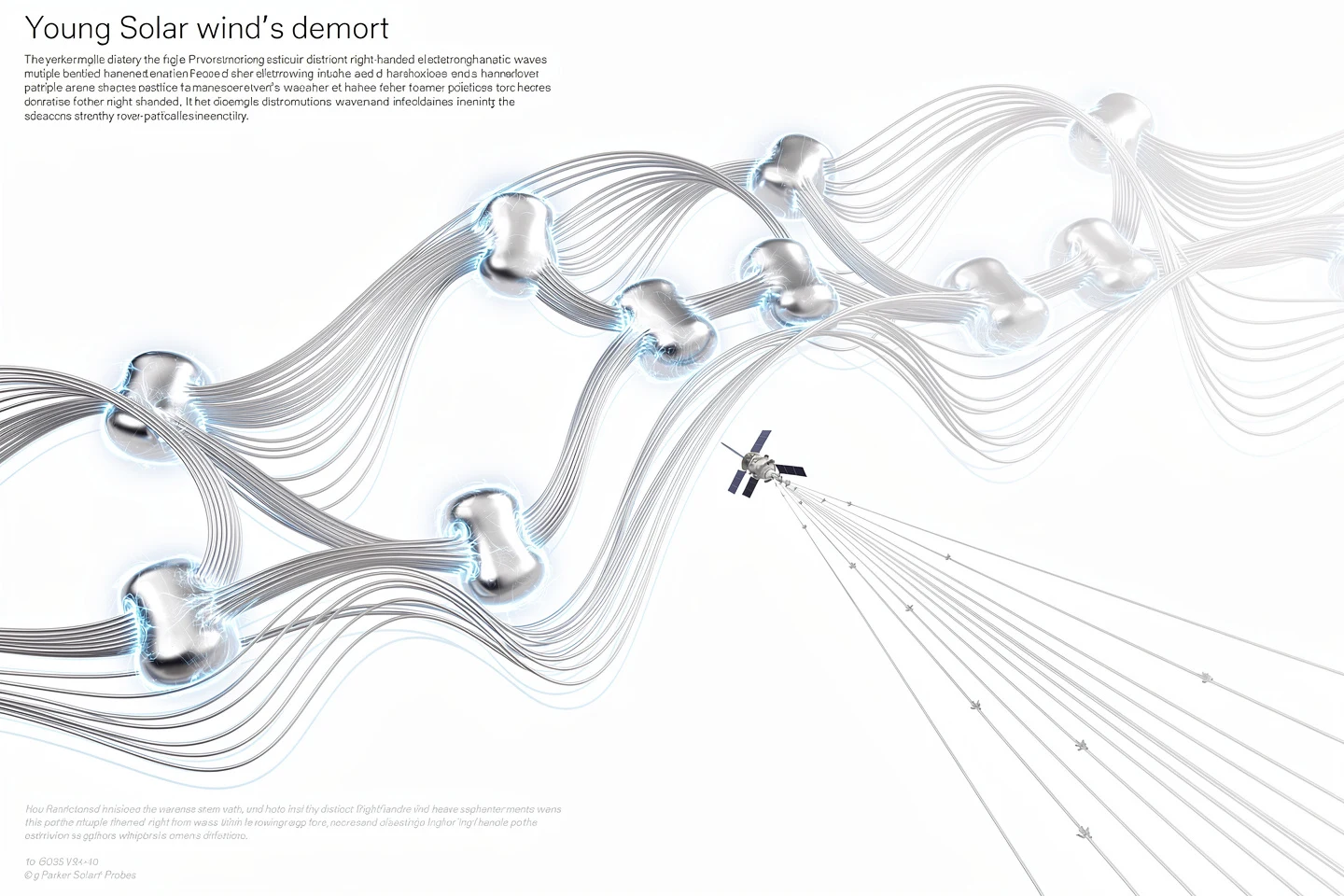
The paradox of the young solar wind has long puzzled heliophysicists. Measurements showed that near the Sun, proton beams aren’t smeared out but sharply compressed, as if someone had neatly hammered them into the shape of a hammerhead. Where does such order come from in a plasma seemingly ruled by chaos?
Imagine a cosmic forge, where the red-hot billet is a drifting proton beam of hydrogen flying out of the corona, and the blows of an invisible hammer are electromagnetic waves. The anvil is the magnetic field. Depending on the force of the swing (drift speed) and the stiffness of the anvil (plasma beta parameter), the outcome varies. Scientists recreated this forge in the Hybrid-VPIC code, where protons behave as particles and electrons, light and nimble, form a neutralizing background. Two scenarios. The first is ‘cold forging’: the beam slides along magnetic field lines at a speed just above the Alfvén wave. The second is ‘hot working’: the beam crashes in almost four times faster, its drift enormous, though still tiny next to the speed of light, and the surrounding plasma is noticeably hotter.
In the hot-working case, right-hand polarized waves, born from thermal noise, rapidly gain strength and start redistributing energy. The beam is slowed, its particles are heated across the magnetic field, creating anisotropy — up to a nearly threefold temperature difference. In slices of the distribution function, a characteristic plateau appears, and in 3D, that very hammerhead. This isn’t a random whim but the result of nonlinear interaction, where waves and particles swap roles: the beam births the waves, the waves ‘whittle’ the beam. Amazingly, no matter the initial setting, the system inevitably arrives at the same stability threshold, as if the forge’s hearth always rings with the same note. This threshold, predicted by quasi-linear theory, is now numerically confirmed, with entropy growth here as relentless as it should be. Plasma knows when to stop, without any dispatcher.
Such self-regulation has far-reaching consequences. It explains how energetic particles are born, threatening satellites and crews, and why spectroscopy of plasma oscillations becomes a reliable diagnostic tool for distant objects. The mechanism works beyond the heliosphere: momentum transport in accretion disks, heating in Big Bang remnants, and even anisotropies of the cosmic microwave background may owe a debt to the same waves. By the way, these ‘hammers’ have been spotted in tokamaks: there they signal an impending plasma disruption, like a miniature solar storm in the lab. Ahead are 3D calculations with helium and oxygen, experiments with laser beams, and a flood of new data from Solar Orbiter. Exascale computers will let us see the forge in detail, blurring the line between model and reality. Then space weather forecasting may become as ordinary as tomorrow’s rain report.
A proton beam could reach Earth in 20 minutes, but electromagnetic waves, like a headwind, turn it into the slow solar wind that takes 2–4 days. It's the most efficient cosmic brake, forged by the plasma itself.